100 Days
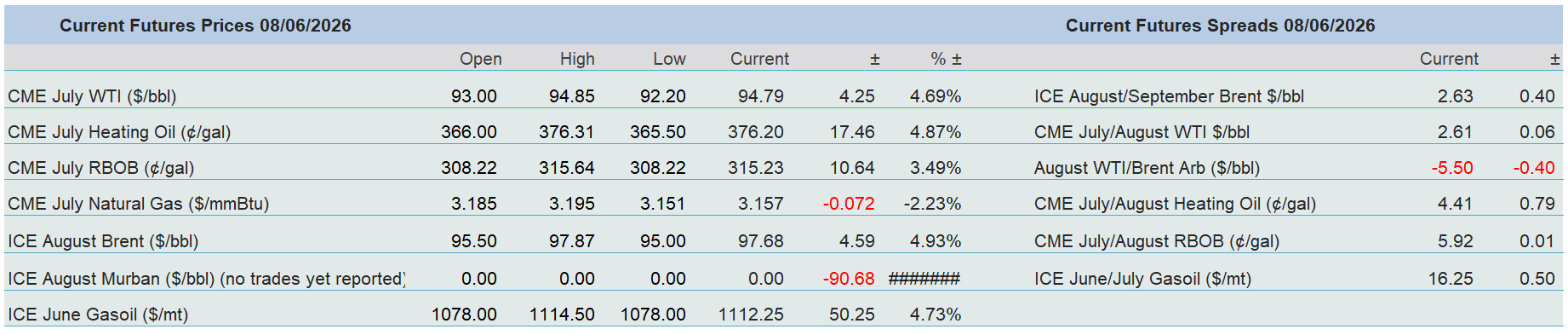
After another week of great suspense and even greater expectation, the sum of what we learned from those that have the ability to end this battle of the pugnacious have delivered a great big, solid, fat zero. In the major M1 futures contracts the biggest mover over last week was Gasoil and its 5 percent rise but given that an approaching summer ought herald some tightness in Gasoline, RBOB surprisingly fell by 2.5 percent, and the arguably main marker of all oil futures contracts, namely Brent, ground out a paltry 1 percent rise.
There is a victory here, albeit caveated against a ticking clock. It belongs to the narrative of the Trump administration, and despite whatever off-ramp is missed and the next one assured to bring hope, oil prices remain intent on keeping faith with the idea that an unlikely agreement is all but done in name only. The President insists that it is true. Although Israel has risen to the Iranian bait by avenging the missile attack it endured yesterday and proceeded to launch counterstrikes into Iran, Donald Trump in an interview with the ‘Financial Times’ said he was still in charge. Asked about Benjamin Neyanyahu’s seeming spoiling of the current talks, Trump said Israel would have to accept what agreement Washington may reach with Tehran. “He won’t have any choice,” Trump told the ‘FT’ in a phone interview, adding, “I call the shots. I call all the shots. He (Netanyahu]) doesn’t call the shots.” A smack of desperation maybe, but one that has once again stopped oil prices from roiling into a rage above $100/barrel this morning.
Additionally, the IEA-coordinated emergency stock release has proved invaluable in being able to supress any march higher in oil prices and keeps sowing seeds of doubt in those that have been expectant of tightness since the Strait of Hormuz was closed nearly 3 months ago. Yet, the IEA is becoming more vociferous about the state of oil stocks and last week there was something of a lament from the head of the International Energy Agency's oil industry and markets division. Toril Bosoni intimated that half of the 400-million-barrel release has yet to hit the market, leaving us with the only conclusion that 200 million barrels have been used already since March. At such pace, the balance will be done and dusted by the end of July with the only option being to bring a fresh call on the SPR of OECD countries. With two major wars concurrent with other fields of geopolitical stress, one wonders if any country, particularly the biggest contributor of oil stock relief, the United States, will be willing to denude themselves of further reserves.
It appears then a peripeteia is emerging on when the sweep of the hands of time in which the oil price-suppressing appeasements of Donald Trump may continue in their effectiveness, happen upon a nexus when the citizens of the world, particularly those of the Northern Hemisphere, are about their summer travels and when we get to “unheard of inventory levels.” So says none other than America’s largest and the world’s second-largest oil company Exxon. Senior Vice President Neil Chapman expanded, “You can debate whether that’s going to hit, those really low (oil stock) levels, in two weeks or three weeks. Once you get to that point, then you’ll see prices shoot up, […] the price of physical Brent oil cargoes will spike to $150 to $160 per barrel.”
Warning indeed. The child’s game ‘Snakes and Ladders’ springs to mind, and we do not apologise for likening the words of the American administration as the ‘snakes’ which bring down market prices and by selling that a war-ending deal is alive. Meanwhile, the ‘ladders’ are stacking up and time grows short until the market starts to tread their rungs higher. Other than a complete end to hostilities, the last ‘snake’ that might bust the chance of reaching record highs is demand destruction.
Examples of a taming of oil appetite are probably present across the many segmented industries and their accompanying part of the barrel, however, the outstanding example being bandied is on how China’s crude imports fell by 2mbpd in May against the April reading and at levels not seen since 2016, according to ‘Kpler.’ There is little argument on how the continued inventory building seen in China last year singularly saved prices of crude falling into the $50/barrel area and tormenting all producers. If we accept that China will buy oil when it is cheap, then it will curb its enthusiasm when barrels are being bartered at or around $100/barrel. This then is not demand destruction per se, it is strategic wisdom.
We here discuss the idea of less oil usage due to its increased cost on a daily basis and agree it cannot fail to play a part in the future direction of prices. However, it is extraordinary when listening to or reading on various opinions that demand destruction is a good thing. These are of course from those that are so bullish equities that they cannot see beyond the backwardated futures curve and that high-flying energy costs have some potential in bursting their balloon. Hoping for demand destruction is akin to turkeys voting for Christmas, but such is the swivel-eyed belief in all that is A.I. and the very few companies that might be rewarded with great riches if success prevails.
We are now 100 days into this Iranian war and appear to be further from solution than we ever have. The currency of the US President’s words is eroding, but his performance politics in keeping oil prices subdued is aided by differing forms of demand destruction that is slowly being revealed. Yet Hormuz remains closed, and if suddenly opened tomorrow, will take up to a year to revert to normalcy. The trajectory of oil prices might have flattened as we wallow in a contemplative period, but the dangers of $150/barrel Brent are still present and what we would ask is if we accept $100 Brent as being the strike, where would you bargain on where the next $50/barrel might be?
Overnight Pricing
08 Jun 2026
