2-Flation is a Dream
Having been almost satirised after his debut press conference following July’s FOMC decision to keep rates on hold, every nook and cranny of economic writing was waiting for a goodly dollop of clarity when Fed Chair, Kevin Warsh, addressed the Jackson Hole Symposium last week. Without treading on old ground, it is worth remembering Warsh was greatly criticised for suggesting that the market could police inflation with naturally forming higher yields, constraining overheated parts of the economy and that any FOMC decision and forward guidance were not some sort of marker that investors could game.
Whether or not the bond vigilantes, those that bet against government bonds as a protest to monetary policies, scarper the field of yield battle, remains to be seen. Afterall, the Fed’s job is made so much more difficult by the US Treasury’s campaign of bond buyback, yet Warsh’s speech has in some ways regained confidence from economic commentators, and those that incredibly after a maiden performance, questioned his credibility. Warsh was succinct in stating inflation is running too high and would be the main focus for the US central bank. "We must be confident that underlying inflation is moving to our objective (2 percent), clearly and at sufficient speed. Otherwise, we have work to do, it is the Fed's job to deliver stable prices."
Given that the year-on-year July CPI reading was 3.4 percent, the PPI being 4.7 percent and the Core PCE, apparently still the favoured measure of inflation of the Fed, accelerated at 3.3 percent, all journeys for any of the major price rise measures back down to 2 percent will be at best a drawn out affair or at worst, and in current financial and geopolitical climes, impossible. Still, taking the cue from his words, pricing of a 25-basis points increase for September on the CME FedWatch Tool increased Thursday to Friday from 35.4 precent to 57 percent. Frankly, and as improved as the Fed’s reputational currency has been repaired, lifting rates by a measly quarter of one percent is a metaphorical finger in the dam. Such snipping around the edges might put upon the ordinary American to buy carrots from the bargain aisle rather than the organic one, but it will do little to quash what is really driving prices.
Charging Kevin Warsh, the Fed or any other central bank to reel in the massive spends seen in the A.I. buildouts is ridiculous. Individually it is beyond the control of the Fed if any of the huge hyperscalers fund spending from elsewhere. Take Alphabet, the parent company of Google, for example. As summarised by ‘Bloomberg’, the tech giant has been on a tear in funding markets as it looks to finance its AI ambitions. It has sold more than $80 billion of debt this year across multiple currencies including the US, Canadian and Australian dollars, Swiss francs, euros and Japanese yen, and even issued a £1 billion ($1.4 billion) of rare 100-year bonds. Foreign debt monies raised and spent in the US are not only inflationary but immune from any hikes in interest rates as exposure is modified because a rallying US Dollar decreases foreign debt.

Then of course, there is the price of oil. The Fed’s crystal ball, despite the now new policy of not offering forward guidance, can only show a white mist of occlusion. Can anyone from the verandas of the White House to the sandy shores of Hormuz really believe there is plan in place or timetable as to when this unnecessary conflict will end? Over the weekend, the tit-for-tat missile exchanges between the US and Iran bring validation to those who believe that even if not a ‘forever war’, this conflict will run and run like an awful film franchise. ‘Kpler’ as seen on ‘Reuters’, report on how only 5 commodity vessels per day are transiting Hormuz at present, and while consideration must be given to ships running dark or practising ship-to-ship transfers, the globe continues to build issues of supply.
There might be a gusher awaiting if, and when, oil once again flows freely through the bottlenecks in the Middle East, and at present our marvellous fraternity is still, against all odds, getting some, but nowhere near all feedstocks to where they need to be. However, this is causing a great drawdown on existing stockpiles in the United States. Both the salt caverns in which SPR is stored, and the multifaceted storage at Cushing, Oklahoma, are near operational lows. This is where any further drain of oil kept within will compromise the geology of the caverns and the integrity of the tanks of Cushing.
With such large backwardations existing across the oil complex, there is no incentive to refill storage capacity. There is little point in buying oil now that in 3, 6 or even 12-months’ time will be worth less. The conundrum for solving the oil puzzle is growing. It is of course a circular affair in how one of the best hedges for inflation is holding length in oil. As inflation continues to be fed by higher oil prices, one of the very few armaments available to Kevin Warsh and his kith and kin, is to raise interest rates. Circle back to the need for oil storage to increase and another problem arises. If forward interest rates are likely to stalk higher, then the cost of holding oil in storage, be it on land or at sea, will become more expensive to finance. Even in the price sensitive country of the Netherlands, the Dutch state-owned gas infrastructure company Gasunie, has reported reserves will not reach the level deemed necessary to withstand an exceptionally cold winter because market conditions have made stockpiling unprofitable.
Front end strength will continue in all oil derivatives and so on and so forth. There is a lot more than meets the eye to Kevin Warsh’s dance with inflation and interest rates. But the bright new thing at the helm of the US Federal Reserve will only be able to consider leaving the ballroom, even the new one at 1600 Pennsylvania Avenue, if the conductor in charge of the war in Iran puts down his baton.
Overnight Pricing
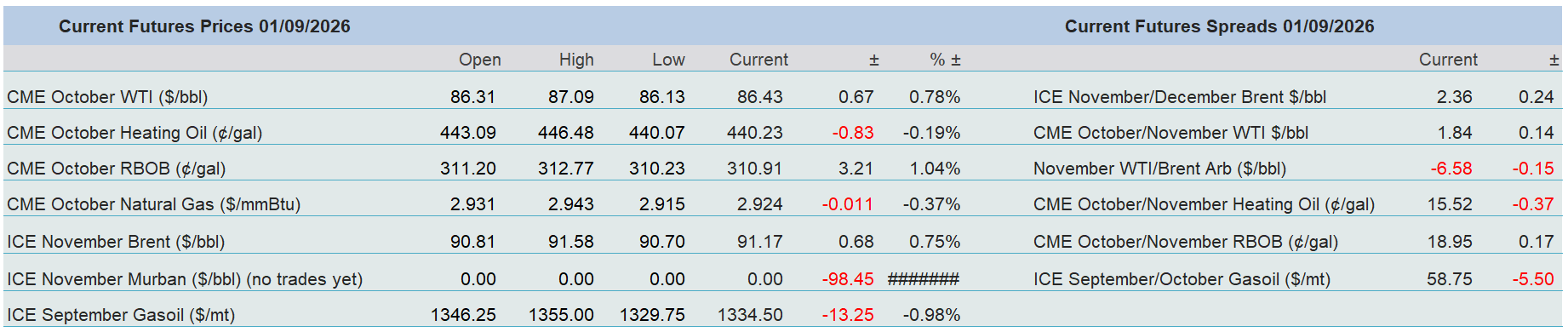
01 Sep 2026
