Adding to the Chaos
After 55 years, it was time to call it a day—the end of a beautiful friendship. The UAE’s decision to leave both OPEC and OPEC+ can be described as a seismic change, though not in the short term. The UAE is one of only two oil-producing nations, alongside Saudi Arabia, with a substantial supply cushion. Its production capacity is around 5 mbpd, compared with its OPEC quota of roughly 3.4 mbpd. This discrepancy has long been a source of frustration for the country. Yet the decision will not alter the immediate dynamics of the Iranian conflict. Even if the UAE’s increased production finds a way to ship from the “correct” side of the Strait, there will still be around 10 mbpd stranded on the “wrong” side from Gulf producers.
In the medium to long term, however, the picture may turn out differently. It would not be surprising for OPEC and OPEC+ to present a unified front and even attempt to encourage other producers to join the organisation. Nonetheless, cohesion is likely to weaken, and the group’s role as a swing producer will diminish, simply because it will lose market share and spare capacity. The decision is a significant win for the US, which has periodically accused OPEC of anti-competitive efforts to influence the oil balance and, by extension, prices. In a nutshell, one might conclude that the slow but unmistakable erosion of OPEC has truly begun. Will it result in rising tension between the UAE and Saudi Arabia and a possible price war? Time will tell.
The UAE’s decision did not rattle the crude market, as WTI and Brent both gained over $3/bbl on the day. Products, particularly distillates, on the other hand, came under pressure. As reported by the Financial Times, Chinese state oil companies applied for permits to start exporting refined products, a sign of sluggish domestic demand and bulging inventories. The resumption of exports would go a long way towards easing tightness in the Far East, notwithstanding the continued closure of the vital chokepoint in the Persian Gulf. And just when you thought unpredictability could not become more unpredictable…
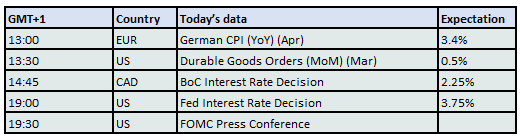
Frankly, It is a Mess
The US government’s modus operandi has been clear almost since January 20, 2025, the first day the President reoccupied the White House. It is confrontational and follows the principle of ‘might is right’. Whether in tariffs and trade talks, the Monroe Doctrine, Greenland, or NATO, the US appears confident that sabre-rattling in diplomacy and foreign policy is more effective than talks or co-operation. Naturally, the same belligerent rhetoric and actions characterise the US approach to the perpetual Iranian conflict. It may be sprinkled with a healthy dose of jealousy towards the penultimate Democratic President, Barack Obama. Whether this stems from his Nobel Peace Prize or from Mr Trump’s unappeasable desire to leave a more significant footprint in the history books is open to interpretation. Nonetheless, when it comes to the adversarial relationship between the US and Iran, it is useful to compare the nuclear agreement struck under the Obama administration with the incumbent’s attempts to end the conflict.
As noted in Monday’s note, when the trigger points of the hostilities are obscure, pinning down the ultimate goal is equally gnarly. In fact, it is worth recalling the now-infamous tweet from Mr Trump in 2013: “Remember that I predicted a long time ago that President Obama will attack Iran because of his inability to negotiate properly – not skilled!” Go figure.
Yet here we are: the current conflict shows no signs of abating, oil is stuck behind the Strait of Hormuz, Brent is sitting comfortably above $100, and anxiety about re-ignited inflationary pressures is on the rise. Although it is a moot point, one can only wonder what the state of the world would be if President Trump had decided not to scrap the 2015 nuclear agreement, which, according to a leaked memo in 2019, he abandoned “to spite Obama”.
The Joint Comprehensive Plan of Action (JCPOA) was struck in 2015 between Iran and the world’s leading political powers: the US, the UK, France, China, Russia, Germany, and the European Union. It was designed to limit Iran’s nuclear capabilities to peaceful purposes and, in return, international sanctions, including those on oil exports, were lifted (Iran’s crude oil production reached 3.811 mbpd in 2017 versus 2.763 mbpd in 2014).
It is important to note that so-called ‘sunset’ restrictions were attached to most provisions. Uranium enrichment levels were capped at 3.67% (weapon grade is 90%) for 15 years. The number of operating centrifuges was cut to around 5,000 for 10 years. The country’s enriched uranium inventories were limited to 300 kilograms for 15 years. A heavy-water reactor was transformed so it could not produce weapons-grade plutonium. Finally, the International Atomic Energy Agency (IAEA) was granted access for monitoring and inspections.
It was the sunset clauses, together with the lack of restrictions on Iran’s ballistic missile programme, that led to the unilateral US withdrawal from the JCPOA in 2018. One consequence of that decision, and Iran’s response to the ‘maximum pressure’ policy, was a sharp increase in uranium enrichment, which reached 60% in the early 2020s. Additionally, IAEA access was curtailed. Iranian oil output fell below 2 mbpd in 2020.
In other words, the scene was set for escalation, which duly materialised last June, resulting in the 12-day war and, bowing to Israeli pressure, the current war that broke out at the end of February.
The declared goals of the current administration are to prevent the Iranian regime from ever developing nuclear weapons; to severely impede the military threat Iran poses in the region; to dismantle nuclear infrastructure and key facilities; to weaken its proxies, such as Hamas, Hezbollah, and the Houthis; and to reopen the Strait of Hormuz, which only closed after hostilities began.
The JCPOA and the current US strategy share similarities, such as preventing Iran from obtaining nuclear weapons. However, while the Obama administration attempted to achieve its goal through containment, President Trump has applied maximum pressure—for better or worse. It is conspicuous that Iran’s enriched uranium stockpiles are currently around 500 kilograms versus 300 kilograms a decade ago; IAEA access to nuclear facilities is significantly restricted, if not entirely blocked; and the country’s oil production, even with the help of friendly buyers and shadow fleets, remains below 2017 levels. The situation is more explosive than it was under the JCPOA; just look at the price of a barrel of oil. US retail gasoline prices averaged $2.4/gallon in 2015-2017 versus the current level of $4.2/gallon. Irrespective of whether a hastily arranged deal is struck or the situation escalates further, the current Iranian regime is unlikely to adhere to uncompromising US demands. Chaos will continue to prevail.
Overnight Pricing
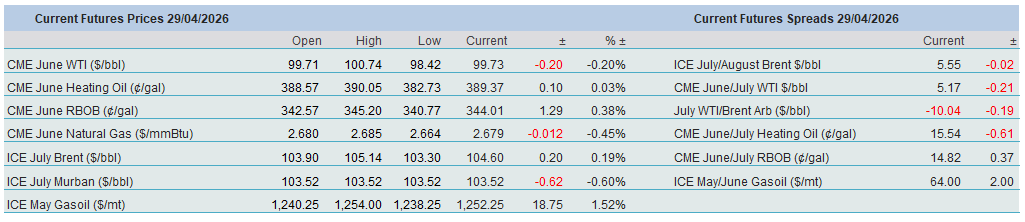
29 Apr 2026
