All-in or TACO?
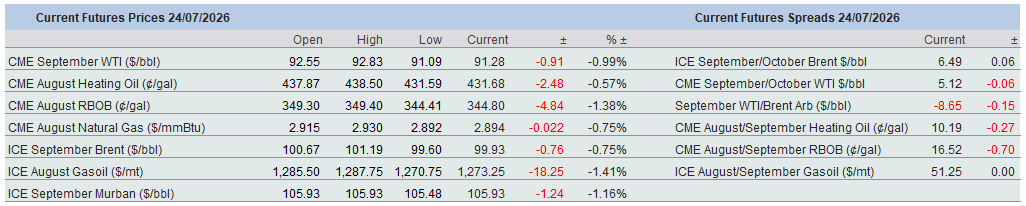
Wanton Iranian actions in the Persian Gulf, and now in the Red Sea, have fallen on fertile ground, with the US responding in kind. The Houthis' claim that they attacked two Saudi oil tankers has opened a new and alarming front in the conflict. The closure of the Bab el-Mandeb Strait would paralyse an alternative oil transportation route to the Far East, potentially disrupting almost 5 mbpd of Saudi crude that normally reaches its destinations without delays. Yesterday, Brent sliced through $100/bbl like a hot knife through butter.
What now? Will the Donald duck, or will the US follow through on its threat to strike Iranian nuclear facilities and civilian targets, despite the latter constituting war crimes? Oil prices above $100 are only one ominous aspect of this escalating conflict. According to the AAA, US retail gasoline prices averaged $4.09 per gallon yesterday. The risk of further interest rate hikes, not only in the US but globally, is increasing. Stock markets sold off yesterday (also pressured by new 10% US import duties on 60 countries), and bonds also came under immense attack as fears of renewed inflationary pressures resurfaced. Given these developments, it is difficult to believe that the US would escalate the conflict further, but then again, in an irrational war, looking for logic is futile. Investors are clearly anxious, and with good reason. Further strength in oil prices ahead of the weekend cannot be ruled out, as supply considerations are once again at the forefront of thinking. Nevertheless, sharp market adjustments, one way or the other, should be expected when trading resumes on Sunday night if events unfold over the weekend. And you can bet your bottom dollar that they will.

Relying on the US
As the oil market has proven admirably adaptable in the face of adversity, one of the key factors, perhaps the most salient, has been the newly established role of the US as the world's swing oil exporter, both for crude oil and refined products, or, in other words, as the supplier of marginal barrels. This shift has been reflected in rising US crude oil production, significant changes in net and gross exports and imports of crude and refined products, and, naturally, substantial stock drawdowns across the board. Although this helped tame the initial price rally and subsequently sent front-month WTI from a peak of $119.48/bbl on March 9 to a trough of $67.04/bbl on July 2, the increased reliance on the US has also provided a significant boost to refining margins.
Against this backdrop, it has been intriguing to observe sizeable builds in US commercial oil inventories this week, as reported in the latest Weekly Petroleum Status Report covering the week ending July 17, released by the Energy Information Administration on Wednesday.
To begin with, commercial oil inventories increased by 11.5 million bbls. It was the second consecutive weekly build following 13 weeks of drawdowns. While the major categories, crude oil, distillates, and gasoline, all posted increases, it is worth noting that, owing to pronounced seasonal patterns, the 7.4 million bbl increase in the "other products" category was the primary driver of the overall swelling. Inventories in this category typically begin to decline again in September or October. Nevertheless, despite the overall increase, total commercial oil inventories remain just over 2% below both their year-ago level and the five-year average.
To varying degrees, the same is true for the individual categories. All of the major inventory groups remain below both benchmarks, with gasoline showing the largest deficit: current inventories are 8.6% lower than in the corresponding week of 2025 and 5.4% below the long-term seasonal norm. The shortfall comes despite refiners running at 96.1% of their capacity nationwide and above 100% in PADD2 and 4. When assessing stock changes, the Strategic Petroleum Reserve should not be overlooked. Its inventories have fallen from 415 million bbls just before hostilities in the Middle East broke out to 311 million bbls in the latest reporting week.
There is little to report on the demand side. Products supplied, the EIA's proxy for consumption, continue to fluctuate around 20 mbpd. Gasoline demand is hovering near 9 mbpd, while the equivalent measure for distillates, although more volatile on a weekly basis than gasoline, has remained consistently close to 4 mbpd.
The export and import data, on the other hand, have been considerably more dynamic. Total net exports of crude oil and refined products stood at 2.93 mbpd last week, a marked decline from 6.68 mbpd recorded at the end of April. This reflects an increase of more than 3 mbpd in net crude oil imports, as the US imported 2.45 mbpd of foreign crude last week, compared with being a net exporter of around 700,000 bpd three months earlier. By contrast, net exports of refined products have held up relatively well, amounting to 5.38 mbpd last week compared with 5.99 mbpd at the end of April. Meanwhile, domestic crude oil production, which reached a record high of 13.86 mbpd two weeks ago, edged lower last week.
The latest statistics suggest that foreign demand for US oil has begun to soften. Of course, it does, as it does not yet reflect the breakdown in negotiations between the US and Iran or the renewed exchange of fire between the adversaries, which has once again resulted in the closure of the Strait of Hormuz and raised the prospect of disruptions in the Red Sea. While admittedly a simplified framework, it is not unreasonable to assume that, in the event of a prolonged conflict, demand for US oil would increase once again, leading to higher exports and renewed stock drawdowns.
And what about the price implications? By now, the direct relationship between the geopolitical thermometer and US (and global) crack spreads has become painfully obvious. Prolonged hostilities provide a favourable backdrop for refiners; therefore, fresh record highs in refining margins cannot be ruled out. More intriguing, at least in our rudimentary view, is the WTI-Brent arbitrage. We observe the same pattern that emerged at the beginning of March. The arbitrage is weakening (it settled at -$8.50/bbl last night) as the growing scarcity of readily available crude, particularly because of its proximity to the key Asian market, is providing greater support for Brent than for WTI. However, one of two scenarios is likely to transpire. Either (a) Far Eastern refiners will soon have to source crude from more distant suppliers, boosting US exports, or (b) the conflict will subside, the Strait will reopen, and oil flows will resume, putting downward pressure on Brent relative to WTI, much as occurred between May and June. In either case, we believe the arbitrage is approaching its floor.
Admittedly, this is a bold assertion, and the confidence it conveys may ultimately prove misplaced given the extraordinary unpredictability of oil markets over the past few months. That is our caveat.
Overnight Pricing
24 Jul 2026
