All Roads Lead to Washington, D.C.
The new year started where 2025 left off. The US and its administration remain the principal driving force of world politics and the global economy. Politicians and investors are desperate to second-guess the next move of the Trump government, and more often than not, they are caught off guard. What they nonetheless spotted during January was how the US focus shifted from economic matters to foreign policy.
The antagonist would argue that it is standard practice for any global power to deflect attention from domestic troubles, be it the Epstein files or the affordability crisis. The Trump advocate would point out that, in conjunction with the “might is right” principle, US influence in the Western Hemisphere, as set out in the National Security Strategy 2025, is being implemented.
In any case, the brazen abduction of the former Venezuelan dictator, Nicolás Maduro, at the beginning of January sent shockwaves through markets. The official justification was a long-standing criminal indictment of Maduro on charges such as drug trafficking, narco-terrorism, and weapons offences. Removing an autocrat might be viewed as a step in the right direction, but the aftermath of the operation was truly troubling. It did not lead to regime change. Several countries warned that the raid violated the UN Charter, and international law was ignored. Nonetheless, the US monopolised the oil industry of the Latin American country, with questionable short- and long-term implications.
Although Venezuelan crude oil exports have been partially revived, it is not entirely clear whether this adds to global supply or whether grey and black cargoes have simply been “whitened”. US offers to invest in the country’s ailing oil sector were met with a lukewarm reception due to logistical, financial, and security concerns.
In the middle of the month, Greenland came into the US crosshairs more intensely than ever before. The current crisis was triggered after President Trump renewed his attempt to acquire the largest non-continental island for security purposes. Despite opposition from Denmark and Greenland, the US did not rule out military intervention, which, for the first time in NATO’s 80-year history, would have pitted member states against one another, much to the joy of Russia.
Rhetoric, however, was toned down in Davos, Switzerland, when it became apparent that allies threatened with economic sanctions would not back down. Yet the issue of Greenland remains unanswered and could, and probably will, again lead to flare-ups in tension between the US and European NATO members.
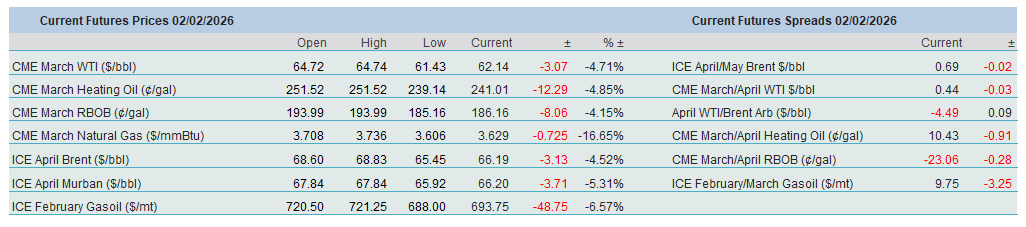
The brutal crackdown by the hardline Iranian regime on protesters last month opened a new chapter in the book of the US–Iran conflict. The latest round of oppression against the disgruntled population provides an irresistible excuse for the US to assert military pressure on the Persian Gulf OPEC producer to halt its pursuit of a nuclear weapons programme, as part of the US strategy of deterrence and coercion. Given the sharp morning sell-off, based on vague promises that Iran is prepared to talk, further escalation and, therefore, jeopardising regional oil production and transport, seems unlikely, at least for now.
Whilst US foreign policy understandably remained in focus, the global economy ticked along nicely in January. The IMF upgraded its global and US economic growth forecasts as the negative effects of potential trade wars largely subsided. The appointment of the new Fed chair at the end of last week stabilised a nervous dollar and sent safe-haven precious metals into a tailspin. Major equity indices finished the month higher, hitting several record highs in January, despite Friday’s sell-off.
Notwithstanding this auspicious backdrop, downside risks persist, taking the form of a potential AI-bubble burst, a re-escalation of trade tensions, or disappointing US economic data confirming the affordability crisis.
The favourable economic snapshot implies healthy demand for oil. The three main agencies do envisage encouraging growth in global oil consumption; it is most likely already built into prices. What caused last month’s rally, which took WTI and Brent 14% and 16% higher, was uncertainty on the supply side, together with temporary price support for heating oil precipitated by the polar vortex in the US. As these factors started to fade in relevance, it comes as no surprise that prices started to correct toward $65/bbl, as worldwide oil inventories are still widely anticipated to build this year.

Tit for Tat
Apart from the US focus on foreign policy, another noticeable change last month was the growing discontent towards the US administration’s strategies, both globally and domestically. European countries defied being bullied into handing Greenland over to the US; Canada and the UK are rebuilding economic bridges with China; and the EU struck trade deals with India and several Latin American nations. It appears that coercive action is being met with intransigence.
After the disturbing events in Minneapolis, which were reminiscent of Kristallnacht, the backlash prompted the US Department of Homeland Security to reassess the role the Immigration and Customs Enforcement agency plays in upholding immigration laws.
Responding to coercion with reciprocal measures, or to cooperation with goodwill, however, may not bear fruit in the long run. It is now blatantly obvious that President Trump neither respects weakness nor accepts strength. The remaining alternative is conflict and confrontation, his very raison d’être. Tariffs and foreign and domestic policies might be dialled back until the midterm elections, but afterwards, the gloves may well come off again.
Given the capricious, transactional, and sometimes incoherent policies of Mr Trump, and the growing resentment surrounding them, Oliver Cromwell’s words to the Rump Parliament might soon be cited in Congress or even from within the government itself:
“It is high time for me to put an end to your sitting in this place, which you have dishonoured by your contempt of all virtue, and defiled by your practice of every vice. Ye are a factious crew, and enemies to all good government […].
Is there a single virtue now remaining amongst you? Is there one vice you do not profess? […].
So! Take away that shining bauble there, and lock up the doors. In the name of God, go!”
Overnight Pricing
02 Feb 2026
