Back from Heaven, Back to Hell
The relief rally, triggered by the reinstatement of Nvidia’s CEO, did not last. Euphoria and the ostensible assurance that his presence at the helm of one of the world’s most valuable companies guarantees US AI dominance quickly turned to gloom, and equities resumed their slide yesterday. Looking beyond the two weeks of charade surrounding the chipmaker, the market remains anxious that the outlook for the sector is still ambiguous. Excessive borrowing and spending, together with a potentially stricter regulatory environment in the new year, are keeping investors pragmatic and cautious. The Nasdaq Composite Index dropped 1.5%, with Anthropic falling below its IPO price and Nvidia shares retreating 6% after Monday’s 31% surge.
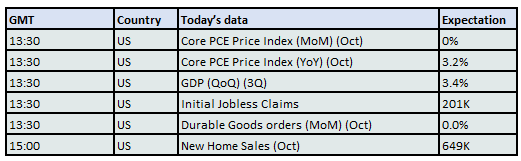
The revival of US tariff policies did not help either. The November-January period, before the Democrats take control of Congress, was always going to be a busy two months, and, right on cue, President Trump is reportedly preparing to impose the next round of punitive measures against governments, including China, which, in the US administration’s view, illegally subsidise their companies and thereby undermine US competitiveness. If there was a lesson to be learnt from the midterm embarrassment, it appears to have been long forgotten. Asian equities have been infected, and a disappointing US PCE report this afternoon could pile further pressure on equities.
The money that fled equities found a home, at least partially, in oil. The ongoing attacks on ships in the Strait of Hormuz, on Riyadh and Saudi ports, and on refineries in Russia are always a convenient and justifiable excuse to get back into oil, especially in a falling market. According to the Iranian Revolutionary Guards, two oil tankers struck mines in the Strait overnight, following attacks on three vessels on Monday. De-escalation in Ukraine is not imminent either. President Putin has threatened severe repercussions in response to strikes against Russia’s energy sector. Yet it is worth keeping in mind that supply is widely expected to exceed demand in the near future, hence the reversal this morning, triggered by the crude oil and distillate inventory builds in the US, as reported by the API. A return to $100 will only be justified if the rise in global oil inventories is halted by renewed and significant disruptions to crude oil and fuel production, refining and exports.
Risk Premium Recalibrated
Although Persian Gulf oil producers’ flexibility and their ability to adapt to new circumstances became evident over the summer months, weakness in oil prices only truly gained traction after the US midterm elections at the beginning of November. Sentiment has clearly changed this month. One possible explanation for this reversal is that investors are increasingly convinced that US foreign policy will be markedly different when Congress begins its new term under a Democratic majority in January – notwithstanding what history suggests, namely that lame-duck presidents tend to concentrate more on foreign than domestic policy in the latter half of their terms. And the incumbent is well known for his rambunctious attitude on the global stage.
The most potent weapons in the new Congress’s arsenal to rein in the belligerent executive will be its constitutional powers, such as over tariff policy and appropriations, something that was conspicuously lacking over the past two years. Whether it will exercise these powers, or whether doing so will prove effective, remains unclear at this stage. Nonetheless, judging by this month’s price action, investors clearly envisage significant de-escalation in the geopolitical hotspots that drove prices higher during the first 10 months of the year. Call it the bandwagon effect, herd mentality or fear of missing out; the price movements have been considerable. Month-to-date, Brent has lost 25% and Heating Oil 23%.
Of course, sentiment is a powerful driver of prices. Markets can, and very often do, move on expectations rather than outcomes. Undoubtedly, the current price erosion is chiefly a function of the conviction that, from next year, the global oil market will have to contend with a supply surplus and that significantly depleted global and regional oil inventories will be replenished. Shipping rates and, to a much lesser extent, insurance costs, on the other hand, already reflect the realities on the ground; they are both falling.
Tanker freight rates have undergone a seismic retreat this month. In the preceding two months, they had skyrocketed due to a shortage of available vessels, largely driven by ship-to-ship transfers in the Persian Gulf, which helped circumvent the Strait of Hormuz. Data as of November 20 suggests that the freight market is doing more than stabilising; it is actually declining. While chartering a VLCC to ship crude oil on the Persian Gulf–China route would have cost $1.37 million a day at the beginning of the month, the rate had fallen to $1.06 million a day just over two weeks later. The cost of shipping one barrel of crude oil from the Middle East to China dropped from 68.5 cents/bbl to 53 cents/bbl, according to LSEG data. At the same time, as Asian refiners shifted their focus away from the US, VLCC freight rates from the US Gulf Coast to China nearly halved, falling from $415,000 a day to $232,000 a day.
Insurance costs have also trended lower, although they have failed to keep pace with the retreat in freight rates. Insuring a tanker carrying oil worth $150 million would have cost 10% of the cargo's value, or $15 million, in mid-October. This cost had halved by mid-November. While this is a welcome development for oil exporters and importers alike, it must be emphasised that an insurance premium of 5% of the total value is still 20 times higher than the pre-conflict level. Nevertheless, the decline in November reflects underwriters' assessment of a slight mitigation in geopolitical risk. Having said that, nothing would prevent insurance premiums from rising exponentially again if attacks on vessels continue unabated or even intensify across the region.
A growing number of analysts now believe that 2027 will bring a considerable supply surplus. Geopolitical risk premium, while it is omnipresent, has been considerably downgraded. This view is exhibited in the underlying price trend. Although the move lower is driven mainly by perceptions, falling freight rates and insurance premiums reinforce these expectations. The first signs of a trend reversal will likely come from an upturn in these two pivotal indicators – if it happens at all.
Overnight Pricing

25 Nov 2026
