Bibi is in no Mood to End the Game
As we approach the summer season of tennis, the current game of deuce between the US and Iran offers no sign that an eventual winner might emerge. On Monday morning the US served with stronger terms and by the end of the day, Iran had counter-volleyed that unless Israel stopped its expanding attack on Hezbollah, all negotiations would be put on hold. “Drinks, new balls,” then declares an imaginary umpire because this tiebreaker is going all the way. The world remains besotted by words rather than oil flow but in another slip of his inner thoughts, Donald Trump, when talking on the negotiations with Iran told CNBC, “If they’re over, they’re over. If they’re not, you know, I think they took too much time. Frankly, I thought they started to get very boring.” In the same telephone interview, the US President was asked whether he had spoken with Benjamin Netenyahu about Iran’s insistence on Israel’s cessation of hostilities. He replied, “No, but I’m going to ask him what’s going on with Lebanon.” A spate of headlines emanating from Washington has since declared that conversations have taken place with Israel and Hezbollah, and both had agreed to end the fighting. This morning, and according to Reuters, the IDF intercepted missiles fired from Southern Lebanon into Israel. If Iran sticks to its words that a violation of the ceasefire in Lebanon is a violation to all terms, one wonders where this morass might end. Rather than “sit back and relax” as suggested by a Trump post, the world remains clueless and stuck, sat on the edge of our seats and in no way finds anything “boring.”

Demand destruction not as plastic a theory as it seems
This current episode in the historical drama of Middle East war is adorned with so many facets that it is hard to keep up with or indeed, find a link. Of course it is tempting to look at the recent episodes of conflict that have moved the oil market substantially, and wonder if judging by the daily disappearing fear premium, that our market suspects that we are so sophisticated that a workaround solution will be found, much as happened after the illegal invasion of Ukraine and the far-ranging war Israel undertook after it started to attack Gaza. Whether or not it was oil weaponization or sanctions where Russia was concerned, or the Houthi ability to scupper the safety of the Red Sea and the conduit of the Suez Canal, the world found a way. Yet for all the confidence, which we confess to have been confounded by, the Russian and Suez stories are ones of successful renavigation. No matter the catch-up tariffs placed, Moscow has seemed always one step ahead with its nefarious ‘dark fleet’ able to ply the seas with Russian oil. And although it took a while to implement, oil-stuffs that usually coursed through the Red Sea, diverted, and took to rounding the Cape of Good Hope. The current sclerotic oil movement in the Middle East, does not appear to offer a cheat or alternative route, or at least one that easily comes to mind that will drain the area of some billion barrels of clot.
It may just be that we are in a peak non-committal time as spring turns to summer. The cold weather is over, but it is too early to ascertain whether or not people will still move themselves around en masse either by car or by aeroplane when the finer weather is taken advantage of. Try as we all might to kick around the can of future demand destruction on the things that are obvious, looking deeper into the barrel and that which has crept up on the blindside, is the loss of momentum in the petrochemical market. According to Reuters, the Middle East accounted for over 40 percent of polyethylene exports in 2025, led by Saudi Arabia, and ships to nearly every region outside North America, the next largest exporting region. Polyethylene (PE) and polypropylene (PP) prices have surged since the Middle East conflict began, matching crude and feedstock costs. ICIS data shows that prices for key petrochemical building blocks have risen more sharply than at any time since 2007.
China is an obvious candidate for study, but it has an open source to feedstock and derivatives if it so wishes, but the more vulnerable manufacturing and exporting countries of Japan and South Korea are becoming hamstrung in their inability to replace the naphtha imports they used to readily enjoy from the likes of Kuwait and Qatar. In fact, and according to Argus, two-thirds of Asia’s naphtha imports normally pass through the Strait, and the shortfall petrochemical basis effect is easily observed. Japan, South Korea and the other manufacturing giant, Taiwan, do not have the comfort of diversification, of inventory reserves and the ability to refine their own supplies. The Naphtha M1 (Japan Swap Asia) doubled in price from April 2025 to April 2026 from $557.47 to $1092.64/tonne and although it has since pulled back to $750/tonne, it is still a third higher as of close of business Friday.
Here then is evidence of demand destruction. Asia countries, driven by exorbitant naphtha prices are having to curb their buying. Refiners of petrochemical fuels or naphtha crackers are then having to implement run cuts as price reluctance from plastics manufacturers becomes something of an epidemic. A rather tempting description because of the depletion of critical medical supplies made with naphtha such as syringes, gloves and all manner of health equipment.
Does this then mean the world has dodged an inflationary bullet from fuels that are used in the process of the enormous plastics industry? Well, no. The potential inflation pressure might be decelerating in a small quarter oil-derivatives, but it has only transferred onto the end-of-line products which are far too numerous to list in plastics. Including sources such as the United Nations, the world consumes approaching 500 million tons of plastics each year, if then, because of fuel prices, that number is curbed due to secondary inflation, it could arguably be as impactful as primary oil price increases. The inflation in car prices and production dip post 2022 came from a shortage of microprocessors bogged down after the ravages of Covid and the Ukraine war, a plastics shortage will be decidedly much more problematic considering their use in almost every part finished goods.
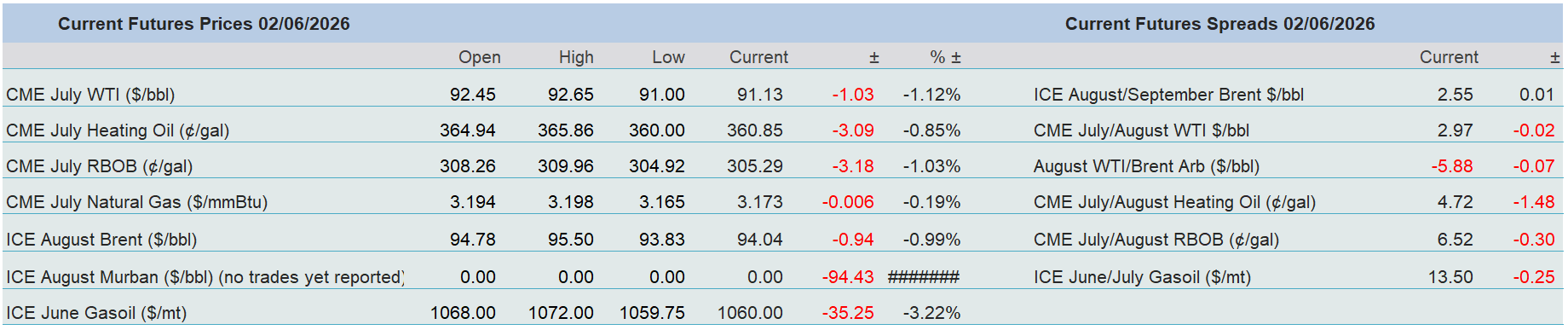
Overnight Pricing
02 Jun 2026
