Bulls Raise with 2 Straits and 1 Canal
Four vessels were attacked near Caspian Pipeline Consortium’s Black Sea terminal on July 17th, 19th, and 20th as it is not only the war in Iran where the gloves seem to be coming off. Ukraine has now upped the ante in its attacks on Russia and seems prepared to deliver collateral damage to not only internationally flagged vessels, but to the assets of Kazakhstan which has been forced to halt pipeline supplies through the CPC. Indeed, there is a little symmetry on how Iran targets neighbours to spread the pain it is enduring, and while there is no suggestion that Kyiv plans to adopt such a strategy, whatever compunction it might have felt in the past to avoid spilling warfare onto neighbours and other-than-Russian owned shipping is being forsaken. If the Iranian regime feels an existential threat, the whole of Ukraine can probably boast, an unfortunate description, that its civilians are under heinous attention from Russian missiles proving that there is no targeting of valid military targets. Kharkiv, Zaporizhzhia, Sumy and Kyiv have all been subject to waves of drones, and more seriously, ballistic missiles which are avoiding anti-aircraft defences. Therefore, retribution is being sought wider and further and with loosening limits. The striking of ships transporting oil associated with a Russian origin are now proving fair game, described by Ukrainian President Volodymyr Zelenskyy as targets that "finance Russian aggression,” and yesterday claimed that ‘dark fleet’ ships are now being hit.

Before the ‘Struggle in the Strait’ came about, Yanbu on the coast of the Red Sea, handled only 15 to 20 percent of Saudi exports. However, there ensued a diversion of record volumes of crude oil through its East-West Pipeline with a widely reported amount of 4.7mbpd emerging in the West of the Kingdom. Such an amount represents 75 percent of the total crude and condensate exports of 5.29mbpd and therefore the current importance of Yanbu and its role in circumventing Hormuz cannot be overstated. These exports were a key component in how, with other various means, crude oil continued to flow despite the dire warnings to the contrary and eventually brought a guillotine down on the rally seen at the start of the Israel/US and Iran conflict. Such an offset against $120/barrel crude and partial solving of a bunged Saudi system is now seriously under threat. After the Yemeni Houthis declared a maritime embargo against Saudi Arabia, reaction was muted. The rebels’ ability to close the Bab al-Mandab Strait is questionable, and after the outbreak of the Gaza war in which Houthis undertook their revenge campaign against commercial shipping in the Red Sea, an eventual diversion of shipping around the Cape of Good Hope almost negated the influence. However, it appears as if Saudi Arabia is not so dismissive. Yesterday it announced that three supertankers bound for China and India via Bab al-Mandab Strait, the Gulf of Aden and eventually into the Arabian Sea to the Indian Ocean, had come about and instead were going to take the ‘slow boat to China’ through the Suez Canal in a huge circular diversion. Maritime insurers are now advising vessels to avoid the Red Sea and war-risk premiums have soared significantly.
This brings a whole new dynamic to oil flows. Depending on the ship, Yanbu to China takes over 20 days to make passage. Forcing vessels back up through Suez, through the Mediterranean Sea, into the Atlantic and around the Cape of Good Hope comes with a journey time of over 50 days. This is where it becomes tricky and interesting. If a refinery in Liaoning, Fujian or any other destination in China now expects purchased Saudi Crude to land at the end of September rather than the beginning of August, what then should the refinery do with crude that it cannot utilise? Refinery margin might be at all-time highs around the globe, but will it still be so 50 days hence? The tardy cargoes might now be reoffered out to the market and Asian processors then seek feedstock from alternative sources. If those substitute grades become inflated, then the Chinese bid that has returned recently will disappear, as our opinion remains on how the Asian Dragon’s appetite for crude is price-driven rather than to placate demand. What of Saudi crude flow? Given such nightmares in getting exports to its favoured destinations in the Far East because both it its routes to market are now severely hindered, its crudes become unattractive. Supposition plays an intrinsic part of assessment and none of such scenarios may play out. However, at present the Houthi success in turning shipping around will take quite some time to workaround and for the present it is undoubtedly initially bullish as war is starting to ‘man-mark’ oil routes.
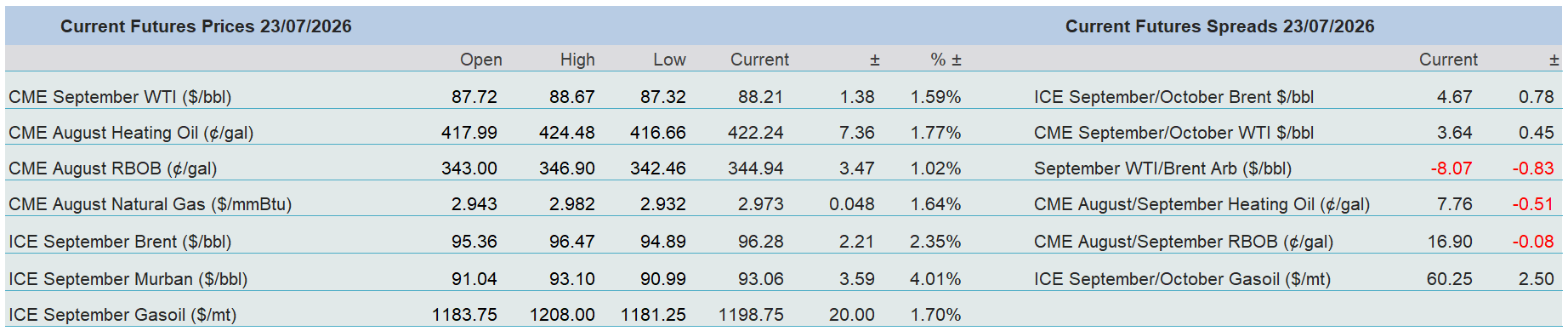
According to Kpler, and as seen on Reuters, Tuesday saw only 3 ships make a southerly crossing through the Strait of Hormuz, this is one less than on Monday and clearly shows how any oil flows from Arabian producers looking to trek south is once again at a standstill. It is above our pay grade to know whether there is actual dialogue being exchanged between Iran and the US in the background, but based on the public rhetoric, the increased state of warfare and the almost zero flow of oil coming through Hormuz, this present stage in the conflict shows little signs of ending soon. Calls for higher prices must come with a caveat on how the US President makes fools of us all if he once again surprisingly flicks the war switch to ‘off’. If not, even Goldman Sachs is warning on the potential of the Brent price being $120 in the fourth quarter. A very large part of the world’s oil supply is surrounded by war, and with cures such as further, higher US production and SPR releases hard to fathom, and with other remedies already played out, this current march higher in crude prices is not only understandable but required.
Overnight Pricing
23 Jul 2026
