Central Bank Decisions are Being Made by Oil Prices
We cover below how assumption is almost as important as forecasting for oil prices. Additionally, and judging by the words used by the great and the good of the central bank community, the world must now adopt an attitude where rising interest rates are part of the foreseeable future. Last week and speaking to the ‘FT’ in front of today’s European Central Bank rate decision, Central Bank of Ireland governor Gabriel Makhlouf said he felt “uneasy” regarding inflation and that “the decision we’re going to make next week will not be a surprise to anybody.” This morning, as seen on Reuters, Bank of Japan board member Kazuyuki Masu said the BoJ may eventually be forced to raise interest rates rapidly if inflation accelerates and planted the blame squarely at the foot of the Middle East conflict. While there remains a corridor of uncertainty in the pricing of a hike at the Fed’s 16th September meeting, a 25-basis point rise is still given a 61 percent probability on the CME FedWatch Tool, one wonders if that number can remain as conservative given the ratcheting up of attacks on shipping and the likely knock-on effect for inflation.
There are no reports of further shipping attacks after the US sank 5 Iranian tankers and in return IRGC forces fired on 10 vessels in Hormuz yesterday, yet it appears the US is not done with this particular wave of strikes. According to Al Jazeera quoting Iranian state media, projectiles have hit several areas in Iran’s Sirik, with multiple explosions heard across the coastal region, including Minab County and Qeshm Island. Some ships are still traversing the embattled strait, but it remains unclear how many of them are commodity vessels and under that broad term, if any are oil tankers. What then can we do other than to presume there will be less oil flow, and prices along with inflation will rise.
Contrasting Years
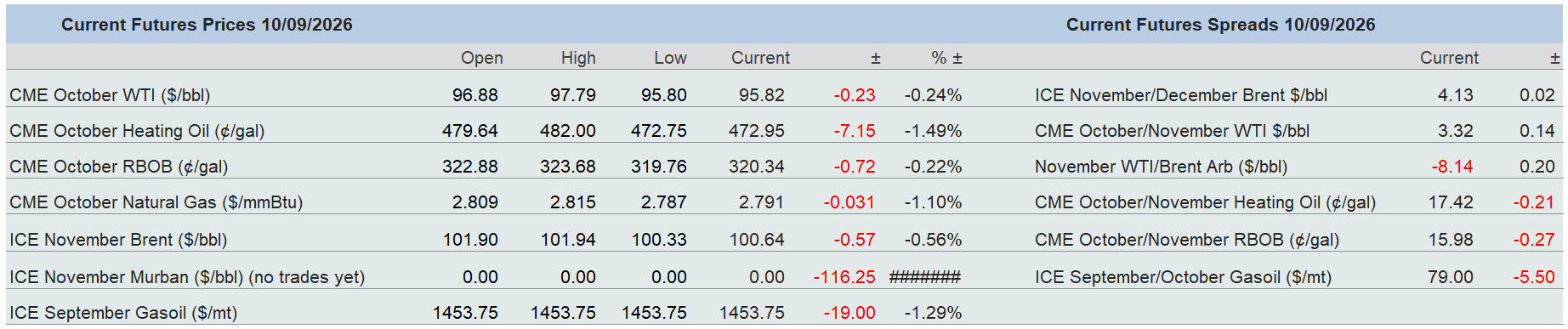
The recent price movement and the confident break above $100/bbl for Brent are a true reflection of what the market thinks about the escalation in the Middle East. Daily reports put the number of vessels transiting the Strait of Hormuz at a depressed level, even by recent standards. If anything, there has been a further escalation around the Red Sea following the Houthis’ attacks on Saudi cities and energy infrastructure. Simultaneously, the US and Iran are exchanging fire in the Persian Gulf. The recent run-up in prices lays bare the market’s approach: this conflict will last longer than anticipated even a month ago, let alone at the beginning of the summer. If oil supply and exports are diminished, the oil balance remains tight and prices remain elevated.
This attitude was reflected in the updated Short-Term Energy Outlook published by the EIA yesterday. The current year will see a hefty drawdown in global and OECD inventories, while the recovery in oil production and the replenishment of inventories will get under way in 2027. Of course, this is merely an assumption, or a snapshot, if you will. We have been here before, and the view that the conflict would end in the foreseeable future has been repeatedly amended.
However, in uncertain times, assumptions form the basis of most forecasts. In its latest issue, the EIA assumes that constraints on oil exports from the Middle East will persist throughout 2026 and that pre-conflict levels will not be restored until after the second quarter of 2027. The price of Brent, the European crude oil benchmark, will average $91/bbl in 2026 and fall to $74/bbl over the course of 2027. These represent upward revisions of $4/bbl and $5/bbl, respectively, from August.
The price indications, therefore, envisage a tight oil balance for the remainder of the year and a considerable increase in inventories during 2027. The first half of the year suffered a global stock drawdown of 1.58 mbpd, with the second quarter experiencing a plunge of 3.86 mbpd. The pace of this depletion will slow in the second half of 2026. It is estimated at 2.96 mbpd in Q3 and 1.71 mbpd in Q4. Quarterly estimates indicate an annual average of just under 2 mbpd. Translating this into the language of OECD stockpiles, the year-on-year decline will be 261 million bbls, from 2.829 billion bbls to 2.568 billion bbls.
The significant drawdown in global oil inventories is a function of an unprecedented deficit in OPEC+ supply. It averaged 39.25 mbpd in 2025, then dived to 31.15 mbpd in Q2 2026 and is seen edging up to 34.4 mbpd in the second half of the year. Yet, the year-on-year contraction is just above 5 mbpd. No wonder, then, that oil prices remain elevated throughout the year. On the other hand, it is also noteworthy that expensive oil has an adverse impact on consumption, which will fall from 104.28 mbpd in 2025 to 102.59 mbpd in 2026.
The global supply deficit will reverse into a surplus next year. To begin with, non-OPEC+ supply will expand faster than global oil demand. This gap is 1.70 mbpd: 4.08 mbpd versus 2.38 mbpd. Put another way, it is equivalent to the fall in the call on OPEC+ oil. It will average 36.57 mbpd in 2026 and retreat to 34.57 mbpd in 2027. This sizeable decline will be coupled with quarterly increases in OPEC+ supply as the situation in the Persian Gulf hopefully returns to normal. The mean supply level from the producer alliance for next year is projected to be 39.46 mbpd, an increase of 5.15 mbpd, more than offsetting this year’s contraction.
Based on these figures, it is only natural to see global and OECD inventories building quickly. While 2026 saw a drawdown of 1.96 mbpd in global stocks, 2027 will see a build of 4.89 mbpd, resulting in OECD commercial stockpiles jumping to 3.02 billion bbls, well above the end-2026 level and even higher than in 2025. A logical conclusion, which obviously comes with an important caveat, is that the tightness of 2026 will evaporate next year. It is, nonetheless, just an assumption. And, as we have seen frequently in the past, a small change in an assumption can lead to a significant change in the conclusion.
We shall look at OPEC’s findings in tomorrow’s report, but that verdict will be very similar to the current one: the situation needs constant monitoring.
Overnight Pricing
10 Sep 2026
