Clowns and Cunning Stunts, the Circus Has Extended its Run
The case for Iran’s hydra came back to haunt the peace process over the weekend, it is now difficult to know who the US should be negotiating with, the softer face of the likes of Iranian Foreign Minister Abbas Araghchi, or the battle-hardened, hardliners of the Islamic Revolutionary Guard Corps. Araghchi, described as a pragmatist and indeed, looked upon by the US as someone to do business with, seemed at the front of the deal in which the Strait of Hormuz was declared open on Friday. Whatever the Foreign Ministry was trying to achieve it was immediately undermined and refuted by what appears to be battlefield commanders. Forgive the long quote, but a piece in the Wall St Journal is so very eye opening. A member of the Revolutionary Guard’s navy, broadcast a message on marine radio saying the strait remained closed and that ships needed its permission to pass, according to recordings by crew in the Gulf that were shared with the WSJ. “We will open it by the order of our leader, Imam Khamenei, not by the tweets of some idiot,” the message said. It is unclear whether such a public chasm in chain of command and or policy outlines a split in decision making or whether it is an intentioned tactic in which there is a show of diplomacy and strength at the same time akin to something of a good cop, bad cop strategy. This outcome is probably another surprise for the Trump Administration who could very well have entered this conflict believing that a beheading of the Iranian regime would lead to internal strife and supplicant negotiations. Strategic autonomy and ambiguity are indeed useful for Iran at present.
So is, and arguably, the current ceasefire. Predicting whether the US President will leave himself open to war crimes charges by ordering the bombing of bridges and power plants is as buying a lottery ticket. But what is not in question is how this near two-week hiatus in the war has been useful for the taming of oil prices and the resumptive rally to all-time highs in equities. As we, among others, have noted, this is a market savvy White House, and can there be any argument against how the fortunes of the oil price and the S&P inspired the US to stop its maximalist air campaign? We toy with the notion that Mr Trump will activate his diplomatic credential when and if, either Brent trades towards $120/barrel, or the S&P threatens to fall to near 6000, which in all likeliness, as seen before, would happen at the same time. This is a convenience for Tehran too. While it prods and plots in diplomatic circles, Iran is likely to be in full swing of repairing hidden missile sites, setting up new air defences in areas not already known by Israeli and American pilots and ramping up the production of drones.

Above there is a representation of discord in the Iranian decision process. While in the US, there is little doubt on how the President is in charge, it does not stop mixed messages coming through. It appeared on Sunday that the US Energy Secretary was softening up US consumers by warning that gasoline prices would not drop back to $3/gallon until 2027. As seen on Reuters, this view was almost brutally put down, "I think he's wrong on that. Totally wrong," Trump told a reporter from ‘The Hill’, adding that prices are expected to come down "as soon as this ends." Confusion is a tactic of the President; what can only be a deliberate example is how yesterday he suggested that his Vice, J.D. Vance was in the air already, bound for Islamabad, but in fact Vance was still in Washington Monday afternoon. Tehran is becoming ever distrustful of the varying and vacuous statements coming from Washington, which is why it has yet to commit to attending any talks. The usual process of negotiation is that parties go away to reconsider their positions, at present it looks as if the US and Iran have just cemented their disagreement that derailed the first bout of talks.
Loss of life aside, if one is allowed to write such crass words, this ceasefire and possible extension, is as harmful to the flow of oil and the world economy as a continued exchange of missiles, bombs and drones. Iran cannot give up its superpower; it must maintain the control of the naval pinch point on its coastline to have any leverage in this miasma of an arbitration. The world can only assess the state of damaged infrastructure once the permanent and safe passage of Hormuz is again allowed. Until then, oil is being backed and stacked, and these negotiations serve only as a calculated prophylactic by President Trump to keep oil prices in check. However, one wonders how long this will work. As seen in the Asia Times, Trita Parsi, executive vice president of the Quincy Institute for Responsible Statecraft said, “Trump ends up prioritizing the optics of victory over actually getting a deal, […] instead of using de-escalatory signals from Iran to get closer to a deal, he declares victory and seeks Iran’s humiliation.” Our view is little changed. We see little hope for these war-ending talks, any immediate hope of the opening of the Strait of Hormuz, or more importantly, any hope at all of lower oil prices. The only thing guaranteed is a continued social media war that nigh on matches the damage to confidence seen when big bangs start ringing out across the Middle East.
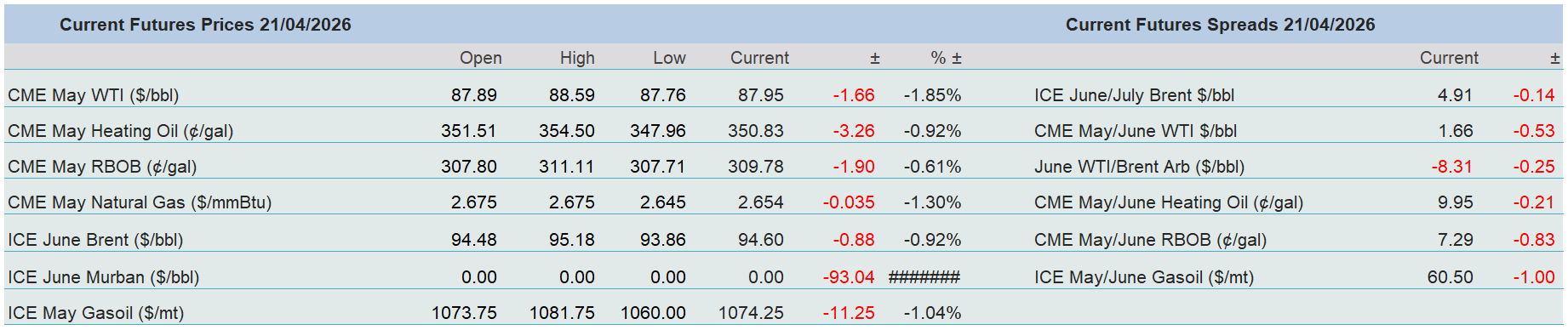
Overnight Pricing
21 Apr 2026
