Contemplation and Drift
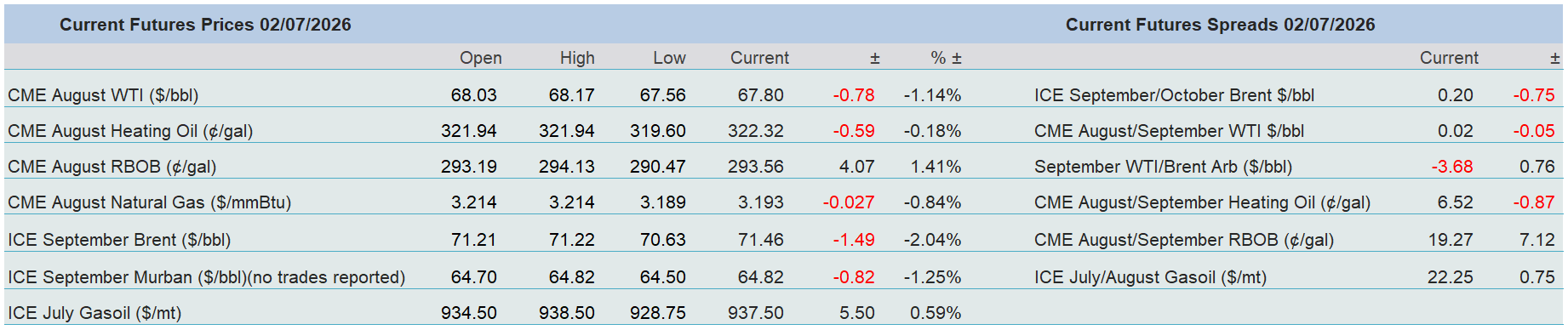
Oil prices are continuing to hang around on the street corner of trading with little to inspire them other than watch the latest act in the tragedy of the US/Iran war. The latest talks in Doha are drawing to a close with a Qatari Foreign Ministry spokesperson saying “positive progress” was made on issues relating to the MoU. Yet Iranian Deputy Foreign Minister admitted that no direct talks took place, and while US Vice President Vance mouthed on negotiations going well, his comments were still laden with threats as to what might happen if a path to peace was not found. Still, our market has little option than adhere to the ‘good news’ being peddled from these talks and oil prices continue in their slow erosion as more stories of oversupply are bled into the mix. This includes a Reuters report yesterday that OPEC+ will soon announce larger quotas which will be seen as an answer to an alleged threat on how Iraq has been considering leaving the cartel.
There is also a general checkback in investor sentiment across the varied suites. There seems to be any number of examples of so-called ‘rotation’ as investors sort their lot going into the second half and new quarter. This is made cumbersome by the US Fed Chair, Kevin Warsh, telling the Sintra Forum that he will keep the inflation target of 2 percent, which is an arrow in the eye to those expecting a looser policy or indeed a less hawking stance from the most important of all central banks. With the US Non-Farm Payrolls released early due to the US holiday tomorrow and the US failing to renew the USMCA (North American trade) agreement, it is an almost anti-Goldilocks day and the feeling of hands being taken off the wheel of investments is felt far and wide.

What draws down, must build up
The 400 million barrels of oil organised by the International Energy Agency to be released by its partners from strategic reserves has proven quite the calming balm for fervent oil prices since their highs of March and April of this year. To be specific and labour the point somewhat, M1 WTI futures has fallen $49.98/barrel from 9th March 2026 year-to-date high to the end of June 2026 close and Brent $53.49/barrel from 30th April to the same last trading day of the half-year. While there have been reflective falls in the values of Heating Oil, RBOB and Gasoil futures, their price-faring is a consequence of cheaper feedstock as SPR releases are crude oil rather than products. As much as the successful jawboning as this vociferous President has undertaken in trying to keep oil prices down, his words would not have carried as much clout without being backed up by the imminent arrival of a saving gusher from oil stores, particularly those of his own country.
Donald Trump decries the presidency of Joe Biden and is rude about his predecessor to the point that his words used being unprintable. Yet, the inspiration in utilising SPR can be found in how the former president help tame oil prices after the crunch felt due to the Ukraine war. The release of up to 180mb of oil over six months in 2022 was, until now, the largest since the reserve was created in 1974. Between the Presidents, there is no great sharing of international altruism, the two releases have the American voter in mind, rather than a struggling business or school in southern Asia. The symmetry can be found in how both Biden and Trump had and have administrations coming into the orbit of midterm elections and within the US, high oil and gas prices are incredibly politically sensitive.
Domestically, pressure on President Trump seems to be rising. Notwithstanding the midterm elections and his recent failures when up against the US Supreme Court, stubborn inflation is causing consternation within the US electorate and with the new Fed Chair, Kevin Warsh, offering a completely different aspect toward interest rates than that was hoped for by Trump, the outlook for interest rates appears to be short-term hawkish. With Americans taking to the skies and roads over the US holiday weekend the cost to travelling will hit home. Admittedly, forecourt gasoline prices, according to GasBuddy, have retreated from a national 18-month average of $4.50 to $3.80/gallon in recent weeks, but they are still over a $1/gallon higher than before the end of February US/Israel initial strikes on Iran. Again, and using IATA data, the Jet Fuel price is $50 lower than the high of $180/barrel in April in the US, but still $20/barrel higher from when hostilities broke out. The average US citizen has long been considering this war as completely unnecessary, and the resulting costs that are heaped on their shrinking shoulders not worth it.
The US SPR has seen a vast drawdown on two separate occasions in the last four years. The estimated balance of SPR is 350mb, that means there will only be spare capacity of 200mb more before the operational minimum capacity of 150mb is reached. According to yesterday’s EIA Weekly Inventory Report, US SPR fell by 5.5mb, something of a sedate pace but nonetheless the rundown of the reserve is a consistency. The maximum outflow at which SPR can be released is presumed at 4.4mbd, at such a rate there could only be 80 days of supply left after completion of the IEA led release. While it is unlikely that oil from the vast salt caverns located along the Gulf of Mexico would be drained so quickly, it emphasises the point on how low this incredibly important part of energy security will eventually be, and the possible damage that might occur if levels reach an ‘operational bottom’.
A recent US Government Accountability Office (GAO) report says, “aging infrastructure, repeated emergency drawdowns and the lack of a long-term strategy could threaten the reserve's future readiness.” The GAO goes on to point out that large drawdowns have placed additional strain on the elderly system, forcing the Department of Energy to prioritise emergency repairs while managing delays to major modernisation projects.
During Donald Trump’s election campaign, he repeatedly promised to fill the US SPR “right to the top” which is a little higher than 700mb. Allowing for a little whimsy, if by chance the SPR came within the realms of 200mb, then there is a potential ongoing bid of 500mb sitting in the background for oil prices to lean on. This point is made even more relevant when considering the saviour of the oil price swoon of last year. Without the ever-present buying of crude from China for its own SPR and Beijing’s besottedness with energy security, oil prices would have fallen to producer pinching levels. Therefore, if the US is now in the market for SPR barrels, along with many others of OECD countries that have taken part in releasing reserves to cow this recent oil price rise, is there not then a case for competing nation-state bids? It is an interesting muse in considering that the lower SPR levels become, the more bullish it will be for the oil price.
Overnight Pricing
02 Jul 2026
