De-escalation? Wishful Thinking.
Although it is beyond human comprehension what exactly is happening in the Middle East or what the endgame will be, it seems that the potentates of major central banks are aligned in their views. Rising energy costs will result in renewed inflationary pressures. It is no coincidence that the Federal Reserve, the Bank of Canada, the Bank of Japan, the Swiss National Bank, the Bank of England, and the European Central Bank have all decided to leave interest rates unchanged, and that China’s benchmark lending rates have remained unchanged for ten successive months. In the words of the ECB president—and the others sang from the very same hymn sheet—“the risks to the inflation outlook are tilted to the upside, especially in the near term.”
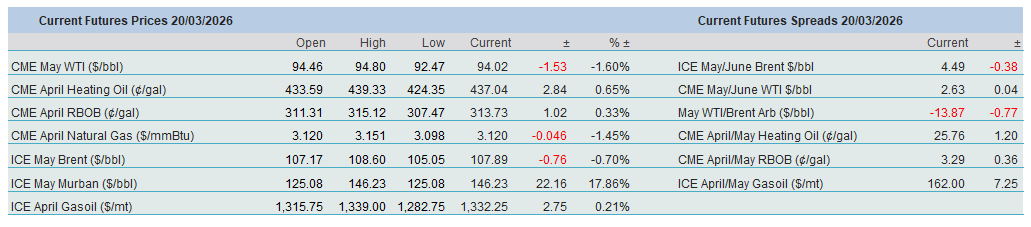
A deteriorating inflation outlook will impede economic and oil demand growth, but oil investors are understandably preoccupied with assessing the short-, medium-, and long-term impact of reciprocal attacks on energy infrastructure in the Persian Gulf. The Israeli assault on Iran’s South Pars gas field and the counterattack on the neighbouring Qatari Ras Laffan LNG plant, coupled with Iranian missiles soaring towards the UAE and Saudi Arabia, sent Brent briefly above $119/bbl, Middle Eastern crude premiums to record highs, and WTI to a decade low against Brent.
The ensuing sell-off was precipitated by what appeared to be desperate US attempts to calm nerves, alongside rising domestic gasoline and diesel retail prices. The Treasury Secretary floated the idea of lifting sanctions on Iranian oil stored on water (Iran has probably not stopped selling its oil through creative means) and releasing additional oil from the SPR, which the government had failed to replenish before the conflict began.
The subsequent move lower was exacerbated by the Israeli Prime Minister’s pledge to hold off on attacks on Iranian gas fields and his assessment that his country’s arch-enemy no longer has the capacity to enrich uranium or produce ballistic missiles. Is it, therefore, tempting to call the top or to describe last night’s developments as de-escalation? The question can be answered with another question: have the mutual attacks stopped, or does the Strait of Hormuz remain wide shut to most traffic?
The Unwanted Consequence of the War
The biennial IEA Ministerial Meeting took place in Paris in the middle of February. As usual, it aimed to take stock of the latest developments in energy markets and policies, and the implications for energy security, affordability and sustainability. We had planned to summarise the main findings of the gathering on March 2, but events hijacked the schedule. The Iranian conflict has understandably been dominating the airwaves and the pages of newspapers and magazines. It has taken almost three weeks to reach a point where the IEA event can be addressed. Outdated news? One might argue that the joint US/Israel attack on Iran and the subsequent harsh response actually make the IEA meeting truly topical.
In the run-up to the conference, the executive director of the International Energy Agency, Fatih Birol, warned of the “fracturing of the global order”, which is visibly leading to discord in the fight against climate change. This disunity does not come as a complete surprise. The reluctance of the US administration to acknowledge rising global temperatures is widely known. Not only is the US the most prominent opponent of climate action, but it has also taken practical steps to slow the process of mitigating the adverse impacts of a warming planet. It withdrew from the Paris Climate Agreement for the second time last year, as well as from the UN Framework Convention on Climate Change. The country’s president repealed a ruling that underpinned the US EPA’s authority to regulate emissions, and domestic fuel standards have been rolled back. His energy secretary labelled the IEA’s net-zero scenario “ridiculous” and threatened to withdraw the US from the IEA.
It was against this backdrop that the meeting took place. The energy trilemma of security, affordability and sustainability is invariably at the centre of any discussion about energy, and this time was no different. There was a tacit agreement that, given rising geopolitical tensions, energy security takes priority. The majority of participants supported the net-zero goal, but they were unable to conceal sharp divisions, predominantly between Europe and the US. This yawning gap was plainly discernible in the closing statement, which took the form of a chair’s summary that does not require unanimity, rather than a communiqué. The document made no reference to international climate agreements and included fewer mentions of climate and emissions than in 2024. The IEA’s executive director could not confirm whether the agency would maintain its net-zero roadmap when its next outlook is published.
So, what does this lack of a coherent strategy and the inability to reach common ground on climate change have to do with the Iranian war? In the past, differences of opinion were presented as a simple, albeit stark, choice between climate advocacy and energy security. The voices of those prioritising energy security grew louder four years ago, following Russia’s invasion of Ukraine. The war clearly demonstrated, according to this line of thinking, that decoupling from fossil fuels and pursuing a rapid low-carbon transition could be unrealistic and even harmful.
The world is now facing yet another, and markedly more severe, energy crisis, with the international crude oil benchmark well above $100/bbl and US retail gasoline and diesel prices at around $4/gallon and $5/gallon, respectively. Inflationary pressures are being reignited, and energy costs for consuming nations are nearing unsustainable levels. Economic growth is likely to slow, and policymakers will be compelled to reconsider the definition of energy security. Dependence on fossil fuels might decrease, while investment in nuclear and renewable energies could rise. The transition may regain momentum. The saying “the best cure for high oil prices is high oil prices” could be expanded. An oil supply shock makes renewables more attractive and boosts demand for alternative energy sources. Extending the IEA’s net-zero 2050 framework to 2070 seemed a compromise between climate change advocates and opponents before hostilities broke out. That may no longer hold, and 2050 might once again become the accepted milestone. The US will have to face the consequences of its decision to involve itself in stirring up the hornet’s nest in the Persian Gulf.
Overnight Pricing
20 Mar 2026
