The Dollar, Rare Earth, and the Strait
The ostensible ceasefire between the US and Iran must not be underestimated. It appears to be the most significant step towards instilling some calm, whatever that may mean, in the Middle East. The market reacted accordingly: oil prices dropped sharply, and equities rallied. At the same time, the possible truce must not be overestimated, something investors initially seemed guilty of, with both WTI and Brent falling as low as $91/bbl. After all, an autocratic regime is negotiating with a transactional, unreliable, and capricious US president.
A reassessment of views appeared to be the order of the day yesterday. Attacks on energy facilities in the region and in Lebanon continued, and only a small number of vessels transited the Strait. Saudi oil output capacity has been cut by 600,000 bpd, Bloomberg reports.
Talks are planned to get underway today in Islamabad, Pakistan. By now, investors have grown accustomed to the US modus operandi in foreign policy, which leaves allies sidelined in negotiations, whether in the Ukrainian dialogue or the Iranian ceasefire debate. It is also becoming increasingly evident that, by launching a joint assault on Iran, the US has cornered itself. It is highly unusual for a proposal from the adversary, in this case, Iran, to be labelled a “workable basis on which to negotiate,” when it is usually President Trump who dictates terms (unconditional surrender, etc.). One cannot help but conclude that this is a war Iran merely must not lose to claim victory, whereas the US must win it outright or risk losing face.
No credible ceasefire, let alone a permanent peace, will be achievable without both sides offering painful, even humiliating, concessions. Iranian demands, reportedly summarised in 10 points, not explicitly published but pieced together, foretell arduous and protracted negotiations in which a spectacular breakdown cannot be ruled out, especially given the US President’s short attention span. Iran will, to begin with, insist on the full lifting of both primary and secondary sanctions. The negotiating document also calls for the release of frozen Iranian assets held abroad, US military withdrawal from the Middle East, and an end to all US attacks on Iran and its allies or aligned groups, such as the Yemeni Houthis and Hezbollah in Lebanon. To formalise any potential agreement, a binding UN resolution will also be demanded, along with a vague call for broader regional de-escalation.

The three most contentious points are the relentless Israeli assault on Hezbollah, Iran’s right to uranium enrichment, and the reopening of the Strait of Hormuz. Whether Lebanon is included in the draft agreement depends on which side is asked; nonetheless, Israel’s continued strikes on the Lebanese militant group have led to Iranian accusations that the Jewish state is violating the truce and “rendering negotiations meaningless.”
Hence the early rally in oil prices yesterday, which only ran out of steam after the Israeli prime minister reportedly approved direct talks with Lebanon. This faithfully mirrors the convolution, or even the mess, surrounding the truce talks. Yet oil still managed to reverse some of Tuesday’s losses, as investors were forced to react to headlines, unable to put the genie back in the bottle.
Iran will insist on its right to enrich the radioactive heavy metal for peaceful purposes, and it may publicly commit not to build nuclear weapons. The US president claims that Iran has agreed to “dig up and remove” enriched uranium (from sites said to have been completely obliterated last June).
As for the oil market, the flow of oil through the Strait of Hormuz is the most salient issue. Iran is expected to allow ships to pass while negotiations are ongoing. But will it? The latest shipping data suggest that traffic remains limited, as Iran’s easing of the blockade is conditional and requires coordination with its armed forces. The complete, permanent, and unconditional reopening of this critical waterway will be complex, chaotic, and, frankly, nearly impossible.
As the US has long used the dollar’s exorbitant privilege to conduct foreign policy, and China has brazenly utilised its dominance in rare earths in response to economic coercion, Iran has used the Strait of Hormuz as leverage in the current conflict, to devastating effect. It is difficult to see it voluntarily relinquishing this trump card in the upcoming negotiations. Iran will insist on controlling the strait, and any safe passage will likely be under its oversight. It may seek to charge fees for ships sailing through, depending on vessel type and cargo. Iran is also expected to demand reparations for war-related damages.
Of course, the US will flatly refuse such terms, but allowing Iran to establish a form of toll system might be floated as a compromise for compensation. Given President Trump’s fondness for deal-making, the idea of taking a cut would not be entirely surprising.
Except it will not happen. First, as noted yesterday, such a scheme would violate international maritime law. Second, OPEC Gulf nations, Iraq, Kuwait, Saudi Arabia, and the UAE, would under no circumstances agree to it. It does not take an oil expert to see the leverage this would give Iran in negotiating OPEC quotas. Should such a deal be forced upon them, the very existence of OPEC would be jeopardised.
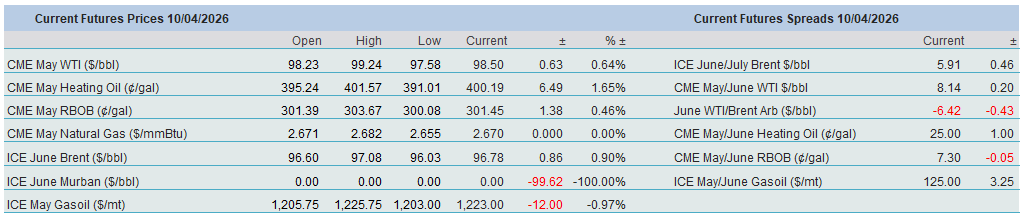
It is impossible to predict the outcome of the talks, if they go ahead at all, although a collapse remains a plausible scenario, especially now that oil prices have fallen back below $100. Key factors to watch include Iran’s insistence on its right to nuclear power, its desire to retain control over the strait, and Israel’s reluctance to halt its attacks until the Iranian regime or its proxies are removed. Representatives of an autocratic, arch-conservative leadership will face the world’s most powerful military and economic force, which did not need to start this war, but it did. It is an ominous setup.
History is written by victors, and both sides will claim victory; in reality, both may lose. If a peace agreement is reached, it may well be a PINO—Peace in Name Only.
Overnight Pricing
10 Apr 2026
