Duplicitous Headlines
Harvey Dent is a fictional character from the world of DC Comics with a nickname of ‘Two-Face’. He is a tragic figure, burdened with a good-looking half of a face, one which seems to represent truth and decency, while the other is scarred, burned with acid and has a personality of an insane criminal. Do not headline and political statements feel as if we are dealing with our own ‘Two-Face’ every day? Yesterday a shouty headline, and sourced to AP, said that the US and Iran had agreed in principle on extended the current truce. Twenty minutes later, and sourced from Axios, a complete counter-headline said the US had not agreed to any extension. In the early hours of this morning the US President posted that representatives from Israel and Lebanon would meet today, but according to social media posts attributed to Al-Arabiya, Israel will not agree to halting attacks against Hezbollah in its northern neighbour. Pick any headline and there is always a counter, but the troubling thing for all of us is which is the good and which is the bad? All the while there is a stream of invective trying to prompt us into believing that a solution is nearby including, and obviously ‘sourced’, Iran considering allowing shipping to flow on the Omani side of the Strait of Hormuz. Every statement is qualified with ‘considering’ which means it has not happened and only might. If Iran allows an Omani passage, then surely all ships would rush to the west side of the waters. It is confusing indeed, made all the more so by Scott Bessent, the US Treasury Secretary informing that there will be no extension to sanction waivers for Iranian exports, which is a precondition for any acceptance of a deal from Iran. Uncertainty and hiatus bring drift in markets, and such is the plight of oil prices at present. Sometimes it is hard to avoid conspiratorial notions, but maybe obfuscation is the plan.

Here's a novel idea, let's buy the stock market
Sarcasm aside, in terms of correlative values the performance of the stock markets in this world is frankly amazing. As a whole, the oil complex at yesterday’s prices has given back 50 percent of the value of the rally from the close of business on the 27th of February to the year-to-date highs achieved in either March or this month depending on which oil contract; the range since the start of the US/Israel attacks on Iran. The MSCI World Index yesterday was above 4,500 homing in on all-time highs. This is also true of the S&P 500 Index and therefore, all the losses experienced in many of the heavily watched global bourses have taken back the ground lost due to the real and or perceived threat to the economies of this world.
We are used to the exceptionalism of the United States, and the idiosyncratic insulation of tech companies, but for the rest of countries that are much more vulnerable to soaring oil prices, the performances of their national bourses are confounding. Arguably the pick of these is Japan. Its 100 percent dependence on imported crude runs to 95 percent from the Middle East and according to Reuters, 70 percent of which arrives via the Strait of Hormuz. It is a double whammy for the Land of the Rising Sun, because not only are oil prices inflationary, the Japanese government, as seen recently on Reuters, is tapping 800 billion yen ($5.02 billion) in reserve funds to finance subsidies aimed at keeping gasoline prices at about 170 yen per litre on average. That would cost as much as 300 billion yen per month. Yet the Nikkei 225 Index is once again knocking on the door of 60,000. The current contagion within investment markets is the ability to see beyond this current chapter in the tome of Middle East conflicts, no matter how long it might last, including the remaining residue of damaged infrastructure.
It would appear that the International Monetary Fund are much more worried than the gung-ho investor community populating the pervasive optimistic stock market view. Pierre-Olivier Gourinchas, the IMF chief economist, warned the continuation of the war meant the world was moving closer to an “adverse scenario” in which oil prices would remain close to $100 this year before falling back to $75 in 2027. In a world experiencing dug-in high energy prices, the IMF did not warn on inflation but on growth. It said global expansion would halve from 5.4 to 2.5 percent, with its reference being 3.1 percent growth with a crude price of $82/barrel. Even if one takes a dim view of the IMF and its often doom and gloom attitude, there are investment big hitters, with obvious time dependency, warning of the dreaded ‘r’ word. Citadel CEO Ken Griffin at Semafor World Economy conference in Washington said, “Let’s assume the Strait is shut down for the next six to twelve months; the world’s going to end up in a recession, there’s no way to avoid that.” As far as guardians of the economy are concerned, European Central Bank President Christine Lagarde recently warned that markets are "overly optimistic" about the Iran war's economic impact. In a Bloomberg TV interview on Tuesday, Lagarde expanded on how higher energy costs have pushed the euro zone away from the European Central Bank’s base case outlook and that the war in the Middle East had bruised European economic sentiment.
Betting against the defiance and perseverance of the US stock market, for let us not be mistaken it is the driver, seems as foolhardy as expecting the rest of this US Administration’s term being filled with diplomatic kumbaya. However, even if the US and Iran come to a state of terms, it will be a layered agreement, implemented over months. The slate will not suddenly be wiped clean in one fell swoop with the world going back to expecting 120 ships per day transiting the Strait of Hormuz. Yet, try representing that doubt within stock markets that suppose repaired oil communications being within the bounds of economic tolerance. Alexander Hamilton wrote about supporters of political executive in 1788 which can be turned to the current ambition in stock markets on how ‘supposition’ is destitute of foundation. We remain sceptical of any immediate solving of this war or the terms required by the protagonists and even when it is made so in the future, the IMF’s base case as mentioned above will be the best the world can hope for.
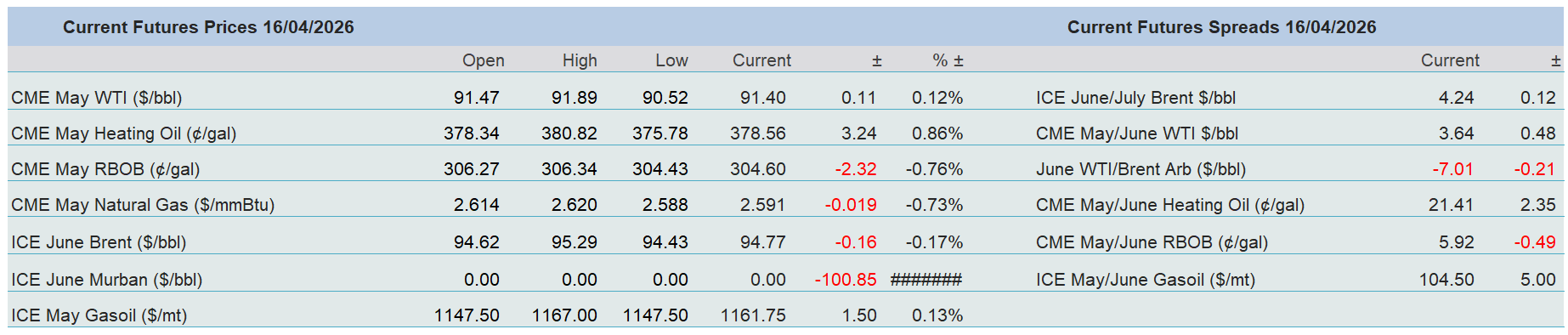
Overnight Pricing
16 Apr 2026
