Escalation, if Anything
Yesterday’s drop in oil prices was likely driven by growing concerns about demand destruction, as discussed below. Still, in the current environment, it is hard to see the market retreating considerably. Hostilities continue on both fronts in the Middle East, around the Persian Gulf as well as the Red Sea. Since the US has proven powerless to achieve whatever objectives it has regarding Iran, it has been forced to resort to a belligerent narrative, which will do nothing to ensure the uninterrupted flow of oil through the Strait. In its latest move, it threatened an indefinite naval blockade of Iran amid non-existent attempts to revive ceasefire talks. All the while, regular attacks on vessels and oil installations continue in the region as well as in Russia. Overnight, two ships belonging to the Abu Dhabi National Oil Company were reportedly targeted while transiting the Strait of Hormuz, while drones struck a major Russian energy export hub at the Black Sea port of Ust-Luga. Both conflicts were meant to be blitzkriegs but have turned into trench wars with no discernible end. While their impact on consumption is undeniable, supply concerns will remain the more important factor in the foreseeable future.
OPEC is the Outlier
The latest cycle of predicting future oil supply, output and demand has been completed. In a way, the setup is the same as it has been in the recent past. Gaps in views are considerable, which neatly reflects the ambiguous outlook. As emphasised in Wednesday’s note, assumptions must be made when attempting to prognosticate the oil balance in the foreseeable future. It is, by any stretch of the imagination, a bold undertaking, and the odds of getting it wrong are not negligible.
We noted that the EIA expects a tight 2H 2026 and a loose 2027. The IEA subscribes to this view. For the second half of the year, it envisages global oil inventories retreating by 800,000 bpd, less than the EIA’s 2.24 mbpd drawdown. Intriguingly, it foresees a 200,000 bpd build in the fourth quarter, and, as a result, OECD stocks will fall to 2.694 billion bbls by year-end, above the EIA’s figure of 2.477 billion bbls, but still low. Looking further ahead, both expect a supply surplus in every quarter of 2027 as expectations for a significant increase in global supply, both in OPEC+ countries and in the rest of the world, improve meaningfully. In total, it will amount to 8.9 mbpd, the EIA reckons, and 8.28 mbpd, according to the IEA, far outpacing demand growth of 2.22 mbpd and 2.40 mbpd, respectively.
OPEC, on the other hand, believes that global supply will accelerate more slowly, because of the lukewarm rise in non-OPEC+ countries. The growth rate will be 6.08 mbpd, more than 2 mbpd below the other two forecasts. There is a consensus on demand expansion, with OPEC putting it at 2.15 mbpd. Yet, the difference is stark. In 2027, supply will exceed demand by 4.78 mbpd (EIA), 4.6 mbpd (IEA) and a sluggish 200,000 bpd (OPEC).
This forces us to take a deeper look at the demand side of the coin, while acknowledging that supply forecasts, due to the perpetual Middle East war and the Russian-Ukrainian hostilities, will surely be amended as the direction of the wind from the White House and Tehran keeps changing routinely. But let us have a look at the table below, which sums up demand estimates from all three forecasters for this year and next.
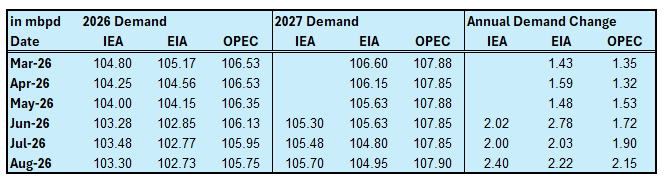
This year’s constant downward revision in global oil consumption between March and August catches the eye. The extent of it varies, with the EIA cutting its forecast by 2.44 mbpd over the last five months and OPEC by only 780,000 bpd. Nonetheless, it possibly reflects the fact that the conflict has lasted significantly longer than anticipated. It has had an impact on the global economy and inflation and, therefore, a discernible adverse effect on global oil demand. This trend is not palpable in the 2027 demand figures, at least as far as OPEC, which is by far the most bullish in absolute terms, as it has been for the last few years, and the IEA are concerned. The former has been very resilient in its demand view, while the latter upgraded its prediction between June, when it first published data for next year, and August. The comparatively upbeat approach for next year implies that the economy will keep roaring, but it also suggests massive stock fills, both commercial and strategic, creating an extra layer of demand and supporting oil prices, we would surmise.
Overnight Pricing
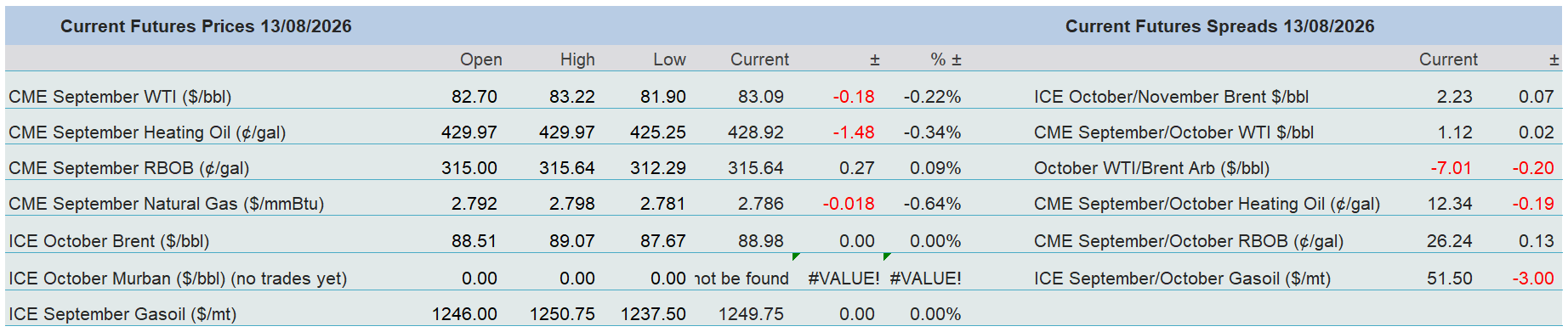
14 Aug 2026
