Everything the Bullish Heart Desires
Well, for one, oil investors either do not follow the US President on his social media platform, or they have serious doubts that Ukraine and Russia will cease hostilities against each other’s energy infrastructure. We are running out of adjectives to describe the performance of the CME Heating Oil contract, which gained the equivalent of $12.62/bbl yesterday, with ICE Gasoil rallying by the equivalent of $12.30/bbl. It is robust, brutal, frightening and merciless, yet, from a fundamental perspective, completely justified. Heating Oil is now $115/bbl above WTI, while Gasoil commands a premium of $101.60/bbl over the European crude oil marker. US truck and diesel car drivers are being forced to fork out an eye-watering $6.27 per gallon at the forecourts.
Those who were away from their desks yesterday would be mistaken to conclude that the price move is being driven exclusively by the middle of the barrel. We are confident that these US-induced wounds will heal and that the move higher will reverse. For now, however, crude oil supply from the Middle East is suffering on multiple fronts, too. Traffic through the Strait of Hormuz remains symbolic; the timing of the re-opening of the Saudi East-West pipeline remains unknown; loadings at the critical export port of Yanbu have been suspended; and, to rub even more salt into the bears’ wounds, if there is any that does not hibernate, Libya has shut three of its oil fields due to protests. The post-settlement API report, which showed builds across the board in US oil inventories, offers some relief this morning; however, no meaningful sell-off is anticipated, unless Saudi Arabia, which is offering some crude oil via Oman loading, manages to resume exports through Yanbu. Based on the current fundamental backdrop and sentiment, anything other than a Fed rate increase today would come as a shock. And if interest rates do indeed go up, US monetary potentates must brace themselves for a tirade of Truth Social insults.

Slow but Obvious Demand Erosion
There are intense discussions among analysts about how long the current crisis might last. Of course, this is not the precise subject of the debate; the more salient question is when to expect the current tight oil balance to start loosening. The latest round of monthly reports from the main forecasters suggested last week that, to varying degrees, next year will not be as undersupplied as 2026 is expected to be. Others would argue that the changes occurring before our eyes are structural rather than just a one-off. Bob McNally of Rapidan Energy Group, as quoted in the Financial Times, believes that the “oil market is correcting its biggest mispricing since Russia-Ukraine in 2022.” “Then the error was unwarranted pessimism about the size and duration of the disruption, and now it’s optimism.”
Current fears of a semi-prolonged supply and export deficit are obvious. This is what the recent rally to $110/bbl basis Brent indicates. There are reasons to believe that the mitigating factors at work in May will not resurface. An SPR release, a Chinese cutback in oil imports, the efficient use of alternative transport routes, and the emergence of the US as the global swing exporter helped alleviate the shortage four months ago. By now, SPR stocks are depleted, China does not seem willing to employ the same tactic, global and OECD oil inventories are plunging, and this includes the US, where refiners are working flat out, yet retail gasoline and diesel prices remain stubbornly elevated.
There is no help forthcoming from supply. Demand, on the other hand, paints a different picture. The adage that “the best cure for high oil prices is high oil prices” appears to be playing out. The accompanying chart speaks a thousand words. It shows how this year’s demand forecasts have changed since February. As OPEC has been somewhat of an outlier on global oil consumption for quite some time now, its figures are displayed on the right-hand axis to make the graph as illustrative as possible.
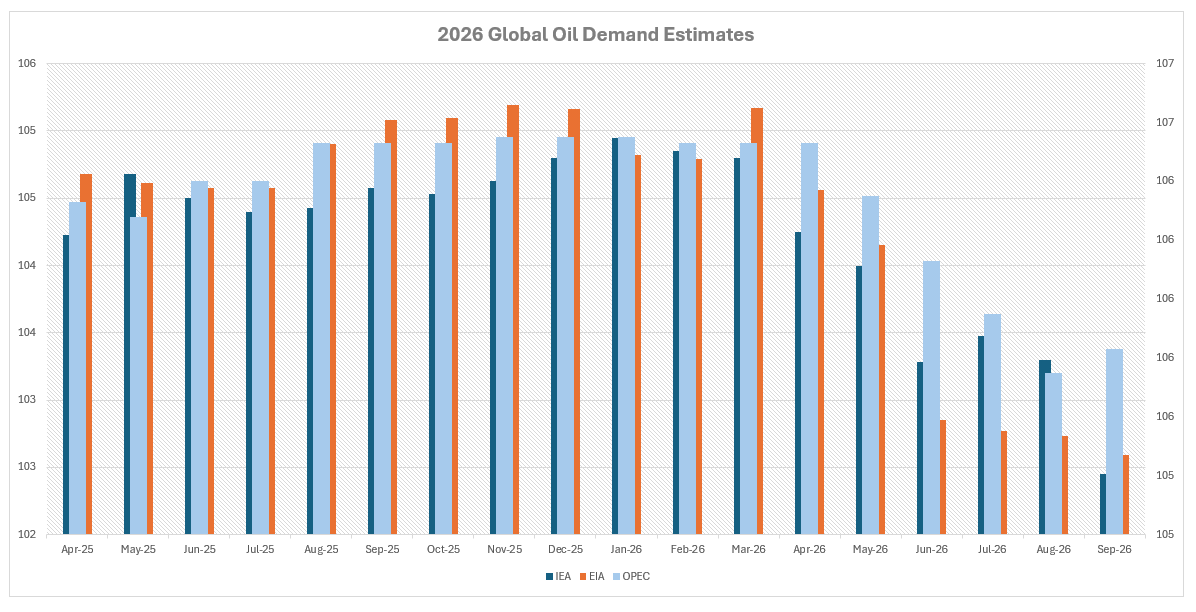
The trend is clear. Every agency—the EIA, OPEC and the IEA—has gradually but uncompromisingly reduced its 2026 global oil demand forecast over the months. To put numbers on the adjustments, between February and September, the downward revisions have been 2.2 mbpd (EIA), 700,000 bpd (OPEC) and 2.4 mbpd (IEA). One might deduce that these amendments are a clear manifestation of the economic axiom referred to above.
Will these cuts intensify? The IMF estimates that global growth is on course to be around 3% this year, a very respectable prognosis given the circumstances. On the other hand, consumer and producer price inflation is accelerating, which puts central banks in a bind and probably prompts an increasing number of monetary policymakers to favour higher interest rates. This, in turn, will act as an impediment to economic and, therefore, global oil demand growth. The ubiquitous use of renewable energy in the face of galloping oil prices is another factor that could help align global supply and demand, as energy security is at the top of the agenda of any politician worth their salt. Without a geopolitical U-turn, the forces of macroeconomics and technological innovation might run their course, and demand could turn out to be the ultimate straw that breaks the camel’s back. Only the timing is dubious.
Overnight Pricing

16 Sep 2026
