Geopolitical thermometer remained turned on in October
The recency effect, which leads people to place disproportionate weight on recent events, may make it seem as though global equities were in freefall last month. After all, the tech-heavy Nasdaq Composite Index lost about $2 trillion in value (-5.3%) over the course of the month, as investors grew increasingly doubtful that AI spending would ultimately deliver healthy returns. Yet the loss in the S&P 500 was limited to 1%, while the DJIA returned 1.7%. The global economy is holding up well; US GDP grew at a healthy 3.4% in 3Q, while consumers were spending like drunken sailors on shore leave. Inflation remains a constant headache for central banks, most of which left interest rates unchanged.
The opposite is true of oil. It feels as though the wars in Ukraine and the Middle East sent prices to fresh highs. Right on cue, both WTI and Brent gained well over 10% on the month, while the Russian crude oil export blend strengthened by around $15/bl against the European benchmark. The localised truce in eastern Ukraine does not amount to a complete halt in attacks on energy infrastructure (although Ukraine temporarily bowed to US pressure), and those who believe in facts rather than narratives remain sceptical that peace is imminent. Attacks on ships in the Persian Gulf reached their highest level last month, while the Houthis continue to pose an effective threat to Saudi oil refineries and ports.
Yet the picture is more nuanced, as illustrated by the sluggish performance of Heating Oil and RBOB, both of which lost value over the month, while Gasoil ended October broadly flat. The unabashed US deal with Russia to deliver diesel across the Atlantic was intended to ease supply pressures and appease US voters ahead of tomorrow's midterm elections, who will be acutely aware that the domestic pump price of this pivotal fuel for agriculture and trucking fell by only 10 cents per gallon last month and remains historically high at $6.31/gallon. Persian Gulf exports, while remaining volatile, may have picked up on the back of increased ship-to-ship transfers. Elevated freight rates have nonetheless probably offset some of the impact of this growing availability. The supply gap has not narrowed materially and, on balance, the oil market remains tight.
Despite the persistent supply deficit, the new month brought with it renewed hopes of a breakthrough in the Iranian stalemate as Qatari mediators have met with Iranian officials for three successive days and the US State Secretary said that his President prefers resolving the conflict ‘diplomatically’. Emphasis is on ‘hope’ as no tangible progress has been reported, while tomorrow’s US midterm election also provides an irresistible excuse to temporarily shed some length.

Current Snapshot: Significant Re-balancing in 2027
Those who commit themselves to the oil market as long-term investors face the routine task of rolling over their positions from one month to the next ahead of the expiry of the front-month contract. Looking back at how projections of the global oil balance have changed since the beginning of the Iranian conflict, it is striking to see that forecasters are forced to do much the same. The only difference is that they do not roll over actual positions from one month to the next, but rather their opinions, adjusting their views to reflect the latest developments.
Following up on the October review above, it is worth noting that the emerging consensus points to a narrowing of the global supply-demand gap in 2027. Not only will the deficit be eliminated, but the market is actually expected to move into surplus. The latest monthly updates indicate that global oil demand will grow more slowly in 2027 than the combined supply from OPEC+ and non-OPEC producers. Consequently, the call on OPEC+ oil will plummet year on year. According to the EIA, this contraction will amount to 1.57 mbpd, while the IEA puts it at 1.33 mbpd. Global and OECD inventories will swell. OPEC itself is the odd one out, as it sees rising demand for the alliance's oil and expects global inventories to draw down, potentially even falling below minimum tolerance levels.
If we are prepared to treat OPEC as an outlier for now, the rebalancing of supply and demand will have a tangible negative impact on prices. The EIA expects Brent to average $12/bbl below this year's level in 2027. The IEA does not publish price forecasts, but as mentioned in Friday's note, the World Bank Group anticipates a fairly sharp decline in oil prices next year, potentially extending beyond 2027. Experts polled by Reuters on Friday also predict an annual decline of around $8/bbl for Brent and $7/bbl for WTI. The backwardated structure of the two main crude oil futures contracts also points to lower prices further along the curve. The only point of contention is whether the current backwardation reflects tightness in the present market or oversupply further down the road.
The developing bearish outlook is, to some extent, explained by the chart below. It illustrates how the EIA's projections for monthly changes in global oil inventories have evolved between its pre-conflict assessment (January) and its latest update (October). The picture of a generally well-supplied market in both 2026 and 2027 envisaged at the beginning of the year has been transformed into a substantial supply deficit for this year and a persistent and considerable surplus next year. The scale of the revision brutally exposes the impact of the ill-fated conflict.
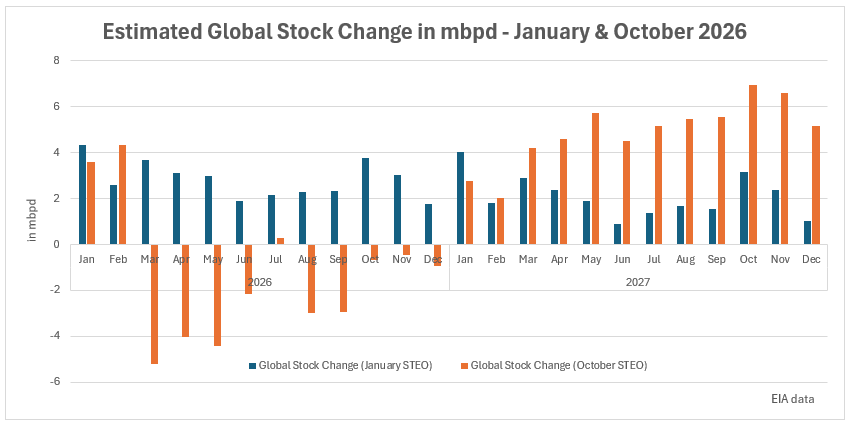
It is, nonetheless, imperative to emphasise that the chart is nothing more than an October snapshot. Given the elusive nature of the truce negotiations and the widespread speculation about renewed and possibly imminent joint Israeli-US attacks on Iran, followed by the inevitable retaliation against the region's energy infrastructure, one should not rule out the possibility that the current relatively generous projection of a 2027 supply surplus will be rolled over for several months, with all the repercussions this would have for global inventories and prices.
Overnight Pricing

02 Nov 2026
