Geopolitics Are Still More Powerful Than Data
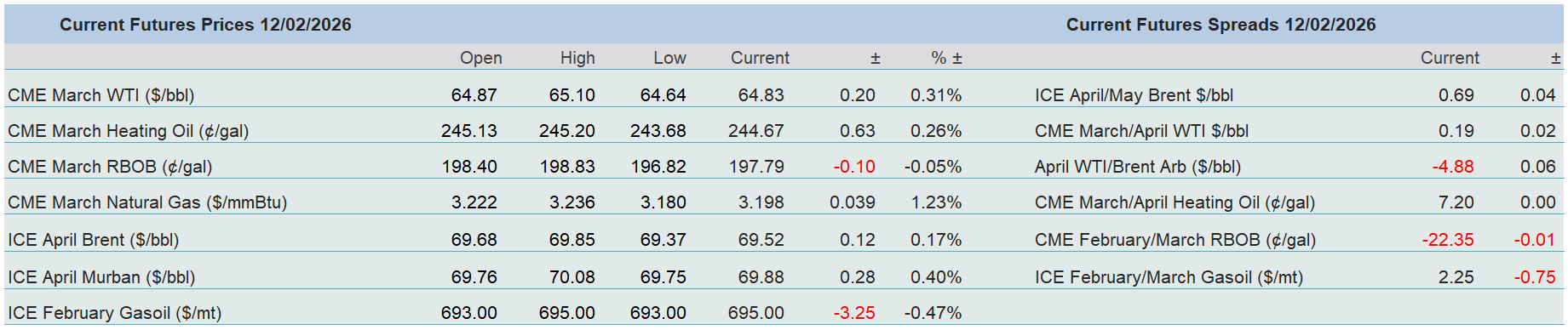
It takes a worried oil market to shrug off a weekly EIA Crude inventory build of 8.53mb, even if it can be explained away by reduced refinery runs. Our market smells trouble and with Benjamin Netanyahu visiting Donald Trump in Washington yesterday and be included in any decision in the next steps for the US when considering Iran, recent history suggests that the Israeli Prime Minister did not come armed with conciliatory language and a beacon of peace. It is not beyond speculation that Netanyahu allowed himself to be wheeled out as part of the pressure game, and his presence being added to the threat of another US carrier being deployed to the Middle East, but when these two conduct their mutual backslapping, jets end up flying. Again, strength in oil prices belie other news. Even OPEC’s monthly report, usually the most bullish among the others of the IEA and EIA, sees a demand drop in the second quarter of this year for OPEC+ crude by 400kbpd. Yet our market rightly concludes that no matter stock builds and reduced demand, the possibility of 20mbpd being corked in the Strait of Hormuz is the top trump, with every pun intended.
Giving aid to oil prices is the resumption of the downward track of the US Dollar, the Dollar Index has lost 1 percent in the last week. The better-than-expected January US Non-Farm Payrolls which with an increase of 130k nearly doubled expectation. This increase was accompanied by a fall in the unemployment rate to 4.3 percent from 4.4 percent and with pressure seeming to exhale from the various job space warnings. There might have been more reaction if it were not for the Bureau of Labour Statistics annual downward revision of payrolls that signalled less robustness than January’s figure might suggest, but it did not hold back speculation once again for cuts in US interest rates. The chatter was not reflected in the CME FedWatch Tool which does not see rates changing much at all in the near future. Still, the risk profile from investors has improved and the bourses of the world challenge all-time highs in many instances and they too serve oil bulls well.

It is more than just Venezuela
As if we needed confusing any more, the push for legitimisation of the US’s barely disguised takeover of the Venezuelan oil sector has started to see acceleration. Initially, it seemed hard to fathom why Uncle Sam would bring its might to bear on the alleged drug-smuggling boats that apparently were a clear and present danger to the security of the United States. The action was framed in the manner of ‘the war on drugs’ and the convenient and welcome collateral would be the overthrow of the authoritarian Maduro to free up oppressed Venezuelans. All well and good, but the kidnapped South American President’s feet had hardly hit the grim halls of the Metropolitan Detention Centre in Brooklyn before it became all too clear on how this whole false flag’s target was Venezuela’s massive oil capabilities.
Evidence to this is seen in an early January statement when the US President let slip and confessed, "what we want to do is fix up the oil, fix up the country, bring the country back and then have elections". A statement of intent indeed and nothing mentioning interim governments or Venezuela’s supposed role in drug transit. In fact, the Energy Secretary Chris Wright has speculated that there would be up to two years before any window for democratic transitions. Never let an election get in the way of a mineral asset, Venezuela’s government is now run by the remnants of Maduro’s party and headed by his vice president Delcy Rodríguez. Forget the legitimate opposition leader María Corina Machado, who must now be kicking herself for handing over her Nobel Peace Prize medal to The Donald. At the time he described it as "a wonderful gesture of mutual respect.” ‘Mutual’ suggests a regard for each other, but it is a resource now found scarce as VP Delcy Rodríguez continues in politics where Maduro left off, including, and according to some observers, persecution of individuals opposed to the incumbent government.
Rodríguez is then a stooge to US oil ambitions in her country and left alone while she waves through the paraphernalia of, metaphorically speaking, US wildcats. As first revealed in the Wall Street Journal on Tuesday, the Trump administration will let US companies supply Venezuela with equipment and technology needed to boost the country’s oil production. “Goods, technology, software, or services for the exploration, development, or production of oil and gas in Venezuela,” is now permitted under a new licence granted by the Office of Foreign Assets Control, part of the US Treasury Department. It will be interesting to watch how legislation within Venezuela need be amended to allow any foreign company, not already in relationship or holding domestic licences, be granted access to whatever part it might play in increasing Venezuelan oil production. Massive oil companies such as Exxon, already historically bloody-nosed by Venezuela when the country’s oil industry was privatised in the 1970s, have already expressed concern on any ‘two-footed’ entry into oil and diplomatic complexities that are Venezuela. Robust legal systems, guarantees of performance from both Caracas and Washington must be displayed before billions of dollars and tens of years be invested into business frameworks and production infrastructure. All this is made even less attractive by the self-same US Energy Secretary who will not guarantee security for oil companies in Venezuela. Output in the Orinoco belt might have recently increased to 1mbpd, but the increase is low-hanging fruit and any notions of Venezuelan oil slopping onto the trade routes in the immediate future ought to be questioned.
Corporate investment and their painstaking years must come with a future of certainty for the use of oil. Yesterday, my colleague touched on the almost decade by decade push back of when ‘peak oil’ might just rear its mythological head. The foray into Venezuela suggests that the powers-that-be in the United States think in similar terms and believe in eventual success, despite the barriers listed above. However, the wider consequence is at least worth a muse. It would be ludicrous to conclude on how all current conflicts are motivated by mineral security. Ideology, religion, borders and ethnicity can share so much of the blame for wars, be they short or long. However, it is utterly intriguing how resource disputes are often near the geography of any bloodletting. Even if military clashes are of other concerns, mineral wealth can magnify them and give reason for prolonged warfare. The Doomsday Clock runs closer to midnight than ever before and nations that can, are striving to secure mineral and energy security. If the United States, once policeman of the world and bastion of freedom can break international law by invasion in the name of national security, where are China, India and other energy thirsty, powerful countries looking to follow the pattern set by Donald Trump in Venezuela and what now would stop them?
Overnight Pricing
12 Feb 2026
