Going Cold on Venezuelan Oil, Anxious about Iran
Unilaterally monopolising a country’s energy sector was always going to be fraught with stumbling blocks, but until now, it has not been clear what those obstacles would be, nor from which direction they would emerge. Reluctance on the part of international oil companies is one possible hurdle to fulfilling the US President’s wish to channel an unlimited amount of Venezuelan oil to the United States. International backlash, particularly from China and Russia, could also have unforeseen consequences, and domestic sabotage of oil installations cannot be ruled out either. However, even in these unpredictable times, it seemed highly unlikely that Senate Republicans, five of them, to be precise, would throw a spanner in the works of the White House by supporting legislation that blocks the President from further military action in Venezuela without congressional authorisation.
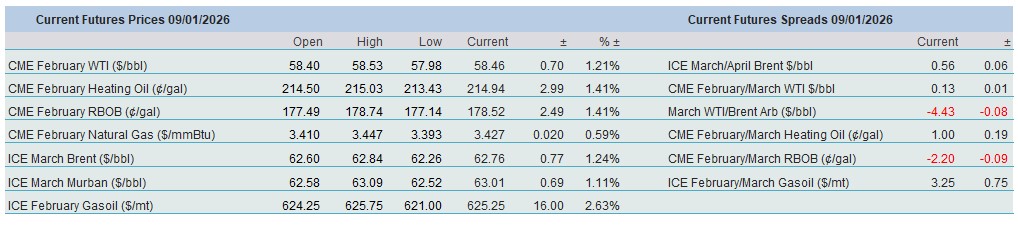
Nonetheless, that is precisely what happened yesterday, and the move proved an irresistible trigger for covering short positions built up over the previous days on expectations of rising Venezuelan supply. The advancement of the Russian sanctions bill in Congress, which would punish any country dealing in Russian energy, together with renewed Black Sea attacks on oil tankers, also helped push prices back to last week’s levels. Last, but very definitely not least, huge anti-government protests in Iran are another factor behind yesterday’s rally and this morning’s follow-through buying as the geopolitical thermostat is being turned higher.
It is a riskless bet that with tension rising in several oil-producing regions, the usual script will play out. Oil prices will keep advancing and could go significantly higher if physical supply is jeopardised. On the other hand, a retreat will be on the cards in a few days should the US successfully push ahead with its plan to get its hand on Venezuelan oil and should oil production and infrastructure remain intact in Iran. A more salient dilemma, one for one of next week’s notes, is whether there is a scenario under which the US’s adventure into a sovereign country might spectacularly backfire with currently unanticipated bullish effects.

The Land of the Annexed, not the Free
Theatrical? Consequential? Far-reaching? Serious? Probably all of them. As deftly observed in a political podcast, Donald Trump is the first political or military leader to have decided to seize land without any justification since Genghis Khan, the founder of the Mongol Empire, a thousand years ago. The consequences of the brazen US attempt to acquire Greenland, one way or another, now form a growing list of “known unknowns” that preoccupy the minds of those who closely, or even loosely, follow geopolitical developments. But what is it really about?
Looking at the map is a reasonable starting point. The semi-autonomous territory of the Kingdom of Denmark is situated closer to New York than to Copenhagen. It was colonised by Denmark in the 18th century. After the US bought the Virgin Islands, then called the Danish West Indies, in 1916 for $25 million, it declared that it would not object to the Danish government extending its political and economic interests to the whole of Greenland, formally recognising Danish sovereignty, as Reuters points out. Under the Danish constitution, Greenland is now a formal territory of the Kingdom, and a constitutional amendment would be needed to sell it. It is allowed to declare independence via referendum and Danish parliamentary approval. Its autonomy does not extend to foreign affairs or defence.
Denmark has always welcomed the US military presence, as it has provided security for this massive land mass through NATO. In fact, Denmark has in the past offered the US the opportunity to expand its military presence, only to no avail. Since the end of the Second World War, the US has closed all but one military base there.
Why does the US want Greenland? The cynical answer was provided by Stephen Miller, the White House Deputy Chief of Staff for Policy, who said that the US is a superpower and should behave like one. The official US view is that Greenland must become part of the country due to national security concerns. The island’s geopolitical location is pivotal: the shortest route from North America to Europe runs through it, increasing its military importance and making it an ideal location from which to monitor Russian vessels and submarines. According to the US President, “Greenland is covered with Russian and Chinese ships. We need Greenland from the standpoint of national security.”
In addition to its strategic location, Greenland is also rich in natural resources such as oil, gas, and rare earth minerals, although the volumes pale in significance compared with those of other nations and would not, on their own, justify the current bellicose rhetoric and action. With a warming climate, something the US administration consistently refutes, the northern shipping route is becoming more accessible year-round. The advantages offered by melting Arctic ice are not lost on Russia, as Europe–Asia travel times would be shorter than via the Suez Canal.
Having established why the US is keen to acquire Greenland, the next logical question is how it could do so. There is a history of attempts to trade it for US territories or to offer cash for it. Buying it is, therefore, certainly one option, although possibly the least plausible. It would require the support of two-thirds of the US Senate, funding would need to be appropriated by Congress, and the EU would also have to give its blessing. The US might try to win the hearts and minds of the 57,000 Inuit by offering economic benefits, and efforts to identify locals sympathetic to the US cause have intensified of late. Denmark’s preferred option, an expanded US presence within the existing defence agreement, has fallen on deaf US ears, although the EU might volunteer to fund the stationing of the troops.
Annexation is the nuclear option, but without Denmark’s consent, such a move would violate the UN Charter and would possibly mark the end of NATO, but it would likely not deter the US from pressing ahead with its nefarious plan.
The consequences of this course of action would be disastrous. Any short-term US benefits would be vastly outweighed by longer-term repercussions. Geopolitically, it would legitimise revisionism. One need only consider Russia’s territorial ambitions toward former Soviet states and China’s policies on Taiwan, the very opposite of the US’s declared foreign policy goals. An arms race in the Arctic would intensify, and neutral observers would withdraw their trust in the US as a reliable ally.
From an economic perspective, however unprecedented, sanctions would likely be imposed by the EU on the US, and possibly vice versa; there would be a massive backlash against US companies on this side of the Atlantic. Trust, not just political but economic as well, in the US would erode, leading to a more determined shift away from the dollar. This high-cost, low-return plan has global economic instability written all over it, with Russia and China as the only clear winners. Undeniably, next week’s planned US–Denmark meeting on the issue will be watched closely, with anxiety rather than hope.
Overnight Pricing
09 Jan 2026
