Grumblings on Capitol Hill, But Not Much Has Changed
Despite the US President insisting that he need not get congressional approval because of the current ceasefire. It appears as if the House of Representatives has conjured up some courage from somewhere and passed a motion to curb executive war powers and means that Donald Trump will now have to seek permission if he is to continue with the Iranian war. Now, this will have to pass the Senate, and it might just be too premature to believe the clock is ticking on the White House’s military free hand, but it is apparent that it would be a reputational disaster for Mr Trump if he were suddenly required to go cap-in-hand to any sort of oversight. Whether or not this inspires acceleration in negotiations is as clear as all the caveats now dangling from the current memorandum of understanding.
Iran insists on a halt to Israel’s aggression toward Lebanon, meaning Hezbollah, and indeed there does seem a breakthrough. Israel and Lebanon late yesterday agreed to renew a ceasefire that would be contingent on the Iran-backed Hezbollah militant group holding back all fire, but there are already reports of suspicious objects heading toward Israeli forces and in return IDF airstrikes, with a quote in ‘Al Hadath’ supposedly from Israel’s Defence Minister saying ground operations will continue. If Iran is to be taken at its word on how this situation must be resolved as part of the whole war negotiation, then it seems almost impossible to rely on Donald Trump’s appeasement that an agreement might be reached over this weekend.

From Hormuz to Tokyo, with not so much love
The stock market dismissal of all that is going on in the Middle East took another remarkable and interesting turn yesterday. The Nikkei 225 has been on a tear of late, bolstered by the success of companies such as SoftBank and all that are involved in the self-driving phenomenon that is A.I. What is the most extraordinary development is that instead of taking as a warning the cabinet of Prime Minister Sanae Takaichi’s approval of ¥311 trillion ($19.5 billion) aimed to take a way some of the pain being felt by Japanese citizens due to the Iranian war, markets cheer on the idea of looser money being released into a frenzied equity environment. The flush of money will still have to pass the approval of Japan’s parliament, but in the main, it is supposed to be used to prop up the subsidies that keep domestic gas and electric prices tolerable for consumers.
According to ‘Japan Daily’, electricity rates are set to increase at nine of Japan's ten major power companies in June due to rising crude oil prices caused by ongoing tensions in the Middle East. As per official announcements on May 28, 2026, typical households will experience a monthly bill increase of up to ¥91, while customers of four major city gas firms will see hikes between ¥20 and ¥24. Admittedly, a very small increase, but one that is still applied despite the subsidies and a possible warning of more. Average cash earnings in Japan rose by 2.7 percent year-on-year in March 2026, with real wages increasing 1.9 percent from a year earlier. It has taken an inordinate amount of time for such a personal wealth growth environment to emerge after more than two decades of near-total wage stagnation and deflation. This is now directly under threat by how high energy prices might be shoved if the choke hold continues in Hormuz.
The far-reaching effects of this morass of war in the Middle East is seeing curious decisions that are at best counterintuitive and at worst, economically unsound. There was always going to be a touch of push and pull between the Bank of Japan’s concern with protecting the country’s currency and guarding against a headlong rush into inflation versus the new government’s intent on growth. The thinly veiled intervention in the Yen in recent times highlights how the economy can ill-afford another strung out period of a weakened currency because of the costs increasingly incurred by importers. The BoJ is also servicing enormous debt, and up until the recent horrors in Sudan, which makes it the holder of the highest debt to GDP ratio, Japan was for years well out in front, and it now stands at 237 percent. For perspective, the US current ratio is 124 percent and China 88 percent.
Throwing more loose money around can only cause more friction within the inner sanctums of power. If the Ministry of Finance, in charge of currency intervention, does not instruct the BoJ to defend the $/¥ rate from falling below the hallowed 160.00 mark, the Central Bank will have little choice other than to hike rates. How curious then that stimulus costs will be added to by MoF defending costs which will be alternatively paid for by importers due to a currency dip or by debt holders as interest rate elevates.
Japan’s economy is not about to spiral back into the ‘lost decades’ of asset price bubble bursts with ensuing stagnation, but with a country so reliant on manufacturing exports which are all fed and subject to the raw materials found from international sources, there can be little doubt that keeping the hard won progress in growth, is seriously under threat. The eye of A.I. might be blind to the bottleneck caused by this increasingly senseless war, but the direct effect it is having on not only the economy of Japan, but indeed its internal politics, will find repetition around the world particularly nations which share in Japan’s need for oil and gas imports. The longer this lunacy goes on, the greater the scrutiny will become on those that are vulnerable to corrupted supply lines.
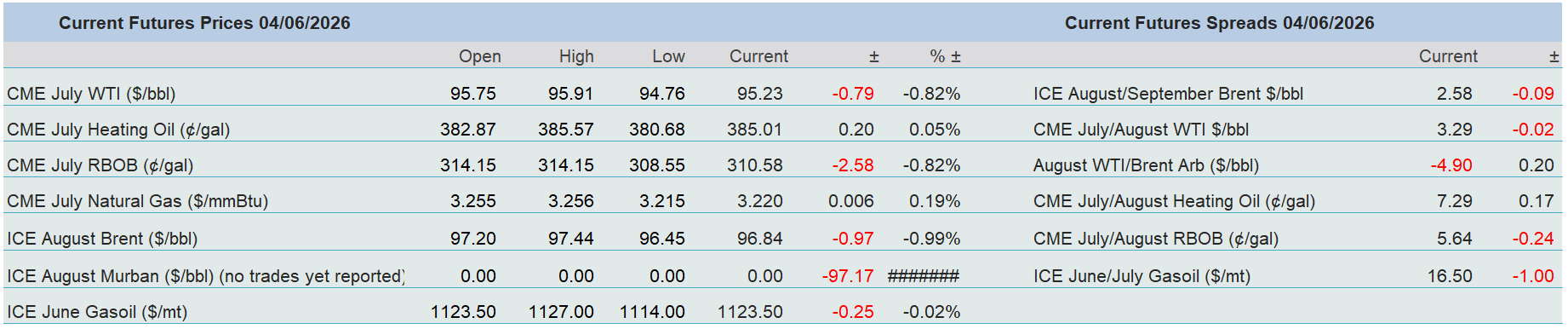
Overnight Pricing
04 Jun 2026
