Inflation is Hormuz Dependent
The markets lined themselves up yesterday in anticipation of the July US CPI reading which eventually delivered something of damp squib. Those that predicted only a meagre rise in the prices paid in the US were proven right and it was indeed the lower gasoline prices consumers enjoyed when the memorandum of understanding still held some viability that kept inflation in check. The strains of doves have increased in volume with the probability of a rate hike falling considerably on the CME FedWatch tool. But they do not reckon with another CPI reading before the next FOMC decision in September and by the state of oil prices at present, refined fuels are unlikely to offer anything of a repetitious soft landing.
The inflation interlude was as brief as the solar eclipse experienced in Western Europe last evening, and as heavens watchers revert to concentrating on the record-breaking summer heat, we return to the morass of Hormuz. Despite some diplomatic thrusts from the likes of Pakistan, Iran has vehemently denied that reviving the MoU or anything akin to it remains a long way off. Prices might have enjoyed another test into the $90s for Brent if it were not for the huge crude inventory build seen in the EIA weekly report. Imports were up 1.1mbpd, exports down 600kbpd and refinery runs reduced by 0.2 percent contributing to an overall stock increase of 17.4mb. Added to that was a joining in by OPEC’s monthly report with IEA’s warnings of reduced consumption due a mixture of a reluctance to pay higher prices and indeed lower supply.

Do not look here for cheer
The physical connotations of the Straits of Hormuz and Bab al-Mandeb being opened leave us with a binary alternative, and as discussed yesterday, a completely different outlook when attempting oil price predictions for the future. It is right that our thoughts are geo-centred on the Iranian war, it is after all the biggest influence on the fortunes of the globe’s economies. Notwithstanding the oil and gas that are bunged behind belligerent military doors, the disruption extends to many more goods such as fertilizers, industrial chemicals and raw metals. According to the ‘World Economic Forum’, roughly a third of global fertilizer supplies and substantial shares of essential manufacturing inputs originating from Persian Gulf ports are currently bottlenecked.
Up and until this recent deterioration to the prospects of an agreement allowing the free flow of goods in the region, commodity inflation had been kept at bay by a period of open seas, well relatively speaking, but the news this week that the sea artery between Oman and Iran has become so sclerotic that vessel flows have diminished to little more than a trickle will once again heap pressure on global supplies of all manner of manufacturing and industrial feedstocks. While this is all obviously inflationary, the consequences are not just confined to the raising of prices.
The ‘TRT World Research Centre’ points out how the IMF has warned that the current war is already increasing inflation and slowing growth. Poorer and energy-importing economies are likely to bear the greatest burden. This dynamic can be understood as a form of “indirect humanitarian transmission.” Security shocks propagate through economic systems before causing humanitarian stress. We have recently discussed the weaponization of bottlenecks, and the ‘TRT’ opinion does not ease any worry that civilian stress might translate into future national conflicts. Without listing them, for some are interlocking hotspots, there are, opines ‘The Week’, 65 active armed conflicts which is the highest level since World War II. It does not matter who is to blame, singular proportion is rarely correct, but there has been an erosion in what once had been considered international norms. Globalisation is dead. We live in a world crying “every nation for itself.”
Anxiety seems to have mathematical proof. According to a YouGov poll taken in the United Kingdom after the outbreak of the US/Israel and Iranian conflict, 53 percent of Britons thought World War III is likely within 5-10 years which is a 12 percent increase since April 2025. In March, and in an interview with ‘LBC’ radio station, General Sir Richard Shirreff, former Deputy Supreme Allied Commander Europe, stated that future historians could view the escalation in the Persian Gulf as "the final catalyst for a third world war" due to the potential for intervention by global powers like Russia and China.
Grim indeed. However, under the cover of the Middle East crisis, geopolitical agitation this week, and being elsewhere, barely made copy. In the early hours of yesterday morning, North Korea fired off a ballistic missile into the Sea of Japan, being the second one launched inside of a week. This would have been greater news if not for the black hole of attention in the Middle East but highlights how supposed rogue nations are arguably more emboldened in making their mark on the world’s geopolitical scene. In Africa, the Zawiya oil complex west of Tripoli is home to the country's largest refinery where a tank containing over a million gallons of gasoline exploded after a drone attack. If those in international corridors treading the ways of peace in ongoing areas of concern are distracted, it is feasible to believe the one of these actions designed to keep causes noticed might end up being more than a ‘we are still here’ nudge.
The technology of modern warfare has been a revelation. One only need swipe a few times on social media and be confronted with harrowing destruction meted out by drones on cities and individuals alike. These aircraft do not come with blazoned liveries; there are no roundels of the RAF or other national emblems under the wings to identify them, friend and foe all look the same. Aggressors are now operating with anonymity. The point to this very sobering note is that all the while nation-state and individual anxiety increases, so will the prospect of more conflicts or wars. Grabbing strategic materials is a natural course of events with oil being at the very top of the list. In a world enjoying relaxed borders and trade routes, the notion of war would be deemed bearish for oil prices. However, in this fractured state and the need for ‘national security’ everywhere, we argue that current climes will see a continued geopolitical, underlying bid for oil.
Overnight Pricing
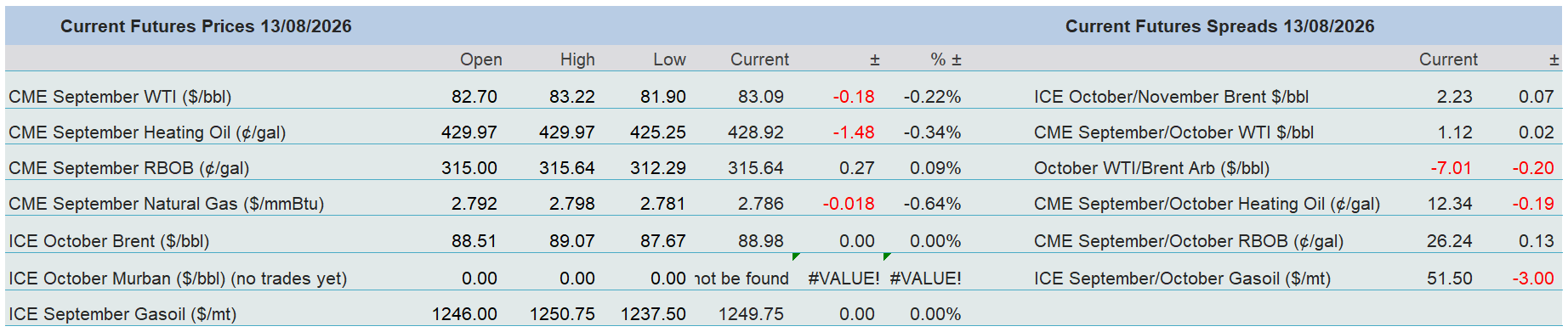
13 Aug 2026
