The Last Full Week of the Year Offers Little Chance to Relax
If the US Federal Reserve’s interest rate decisions are classed as ‘tier-1’ data, then our market’s equivalent must be what the outcome might be for an end to the Ukraine war. Last week was dominated by these two drivers, well, at least from an oil perspective because their global reach has the potential to run amok with the sensibilities of risk takers as we approach a very edgy end of year. Data, press releases and interviews are very much like art, reaction is never about the presentation, but about consumption. Points of view and taste have never been more varied in this lazily termed ‘post-truth’ but definitely over-exposed world. The point of view from this seat regarding the Fed is how the number of Members in their written projections hawkishly disagreeing with last week’s quarter point cut in interest rates and points to a future unable to guarantee a collective vision or indeed deliver the posse of rate reductions so yearned for the Trump administration.
Still, the indefatigable US equity investor, never far away from reading bad news as good, had already began to seize on the commentary from analysts that despite some of the direct hawkishness displayed in the Fed rate decision, there would be another two quarter-point cuts in 2026. Not exactly an indication for loose US money next year, but there are signs that this US government might be about to inject more debt into the economy and the central bank forced to oblige it in the name of liquidity. The US Treasury, in an attempt to fund its ever-growing debt burden will increase the size of Treasury Bill auctions, which if met with a poor uptake the ensuing adverse effect on yields would hamper all aspects of investment and burrowing. Therefore, the intention of the Fed to begin buying $40 billion of Treasury bills per month starting last Friday, makes sense from a management perspective, but not so if the current Administration portrays itself as being all about a smaller, less interfering state. Such claims look good on a banner or at meetings with hard-nosed Republicans, but when votes are at stake, austerity feints are quickly sacrificed. This refers to a $12 billion farm aid package aimed at helping farmers, a powerful voice in US politics, who have been suffering under a bout of low prices but more significantly the ongoing global trade wars instigated by the very White House that now seeks to bail them out. This comes after last month’s musing from Donald Trump on how Americans are set to be indulged with $2,000 each from the tariff windfall and while a study of the mathematics of such a pledge might be found wanting, the underlying sentiment for investors is of both a government and a central bank undertaking quantitative easing by stealth. If it were not for the missed results from the software giant Oracle last week and the sympathetic shiver in tech companies exposed to A.I., the mixed and almost unchanged performance of the DOW, S&P and Nasdaq last week would have seen further strides forward and continuing records for US bourses.
As for our market, we are caught in a temporal loop centred around whether a peace deal can ever be made in Ukraine and if not, what the fallout might be. However, there is little doubt on how the Kremlin is shaping the narrative. Russia is having to do such little work in negotiation other than portraying an openness to proposals but seizing on, and highlighting, Kyiv’s intractability on expressing how it is not serious because of its insistence on its own land not being part of a settlement. Vladimir Putin has also gained an unwitting European group of allies. Not only does the EU and UK’s insistence on being at whatever table might be set for an eventual sit-down act as an interjection for Russia to complain about, it also irritates the Europhobe who occupies the Oval Office. Moscow’s upper hand in diplomacy coincides with it being as financially vulnerable as it has been since its nefarious rampage into the Eastern reaches of Europe’s landmass. The sustainability of its war economy and massive military expenditure is being constantly questioned by economists. Described as ‘military Keynesianism’, such a nationwide war footing can only continue with unlimited labour resources and an exchequer laden with enough funds to finance it. These are failing with unemployment at its lowest on record and financial reserves dwindling so much that, according to Pensions Policy International, government is restricting the use of funds from the National Welfare Fund after almost two-thirds of its assets were spent during the war. The direct effect on Russia’s populace is now biting and much of the financial harm is coming from tariffs and sanctions. Income from oil and gas is being hampered on the ability to move oil, to produce oil because of Ukraine attacks on infrastructure, and having to pivot to the small numerical customer base of India and China who must be granted immense discounts for them to continue in risking the ire of the international community.
It is, therefore, made all the more extraordinary that the Kremlin remains in pole position in setting the tone in any peace deal because it has deflected all of the above onto how its military is inexorably inching further into Ukraine and the forces of the commander-in-chief, Volodymyr Zelenskyy, are at near exhaustion. The President even indicated Ukraine might be prepared to drop its long-held ambition of joining NATO in exchange for Western security guarantees in Sunday’s meeting with allies in Berlin. Whether Russia’s loud-hailing of winning the ground war are true or not, President Trump appears to believe the claim and because nothing irritates him more than stasis, he sees a deal favouring Moscow as the only viable one which cues our market into believing Russian oil may not be so very tariffed and sanctioned for much longer.
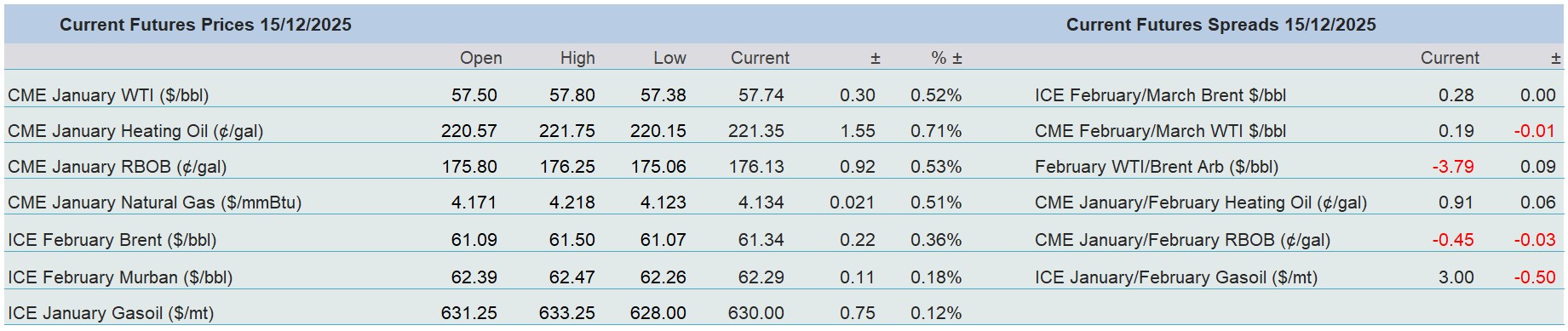
The grind lower in oil prices and the achieving of month-to-date lows across the major futures complex last week might have seen more negative pricing if it were not for the upping of the ante by the United States with regard to Venezuela. Whether or not heed has been paid to the public outrage at the US military attack on an alleged drug boat being called by some as a potential war crime, attention is now being given to Venezuelan oil tankers in a much more legalistic demeanour with a seizure of the vessel ‘Skipper’ last week and its up to 1.8mb of heavy crude allegedly destined for Asia. The legal ability to capture the vessel under sanction had been in place for two years, but up until this time has not been chosen to be exercised. However, with the barely disguised regime change actions by the US toward President Maduro there likely to see more instances of ship capture and interruption to Venezuela’s oil export flows.
Such is the state of our globally shared and unrelenting news environment at present; risk takers in oil could be forgiven in trying to coast this week out. Yet, the opposing geopolitical drivers are not the only thing capable of upsetting the investment apple cart or be digested as bullish or bearish. There are rate decisions from the Bank of England, the European Central Bank and the Bank of Japan to consider and how the Fed’s mixed and divided decision of last week will affect any outcome. With the delayed data of November’s Non-Farm Payrolls tomorrow and inflation on Thursday, the echoes of the US government shutdown still reverberate. There is little chance of a reflective week or indeed any change in having to bend attitudes as and when prices turn turtle with news, and It will of course be another week of eyes down as we await what numbers or instructions are bellowed from the greatest bingo caller of all time from his dais in 1600 Pennsylvania Avenue, Washington DC.
Overnight Pricing
15 Dec 2025
