Leave Us Alone Please, it's Friday
Oil prices and those that set them remain remarkably unhurried or unharried in reaching for their bullish buttons despite some potentially supply-constricting news. There remains a virtual standstill in vessels passing through Hormuz, well at least those that can be tracked, and the Caspian Pipeline Consortium reported it has again suspended operations after what it called additional “terrorist attacks” which came just days after operations resumed. However, because infrastructure, both oil and civilian, in Iran are not being struck by the US; overnight reports of two-way attacks have become de rigueur and their effects muted. After the $16/barrel washout experienced in Brent futures flat price at the beginning of this week, oil practitioners are painfully shy in being exposed to length particularly going into the weekend. Also serving as an anxiety appeaser is the new maritime coalition being grouped under the leadership of Saudi Arabia. To include countries from Africa, the Middle East and Europe, it will be charged with keeping the waterways of the Red Sea, Bab el-Mandeb and the Gulf of Aden free from the Houthi threat. Given that Reuters have reported increased activity in the Bab el-Mandeb Strait allowing two-way passage of “commodity vessels”, our fraternity is once again toying with the idea that oil always finds a way. There ought to be a passing mention on US President Trump’s Board of Peace announcing that Hamas will lay down arms in Gaza. With the terrorist group saying it is only a proposition, we can dismiss the blather as another attempt to swing voters in the US mid-term elections.

You can't Warsh this one away Kevin
With two active and destabilising wars, international relations being all-time strained, the enormous commercial intricacies of global trade once again dogged by tariffs, the value of A.I. and the companies that peddle it under scrutiny; one wonders what else might come along to upset the trading apple cart. Do not worry dear reader, we did not have to wait long. It has now been five-straight meetings where the Federal Open Market Committee (FOMC) maintained the benchmark federal funds rate at 3.5 percent to 3.75 percent. The actual headline decision does not come with any real surprise; however, it is the newfound policy of the fresh Chair, Kevin Warsh, not giving forward guidance that is causing consternation in the chattering classes of the financial establishment. In his post-decision press conference, Warsh fanned the flames of anxiety. “Let me reiterate. There is no soft inflation target. There is no soft implicit target, not on this committee’s watch. There’s only a target, and it’s 2 percent.” Tough talk indeed, yet one that did not see any follow-on in words on how such a seemingly challenging target might be achieved.
In June there was a decent slowing of headline inflation, falling to 3.5 percent from that of 4.2 percent in May. But despite it being a welcome first decline in five months, it was inextricably affected lower by the then cessation of hostilities between the United States and Iran allowing M1 WTI futures to fall from the June high of $97.00 to $67.04/barrel being the low on the second trading day of July. As seen on ‘Trading Economics’, energy costs declined 5.7 percent, after rising 3.9 percent in May, 3.8 percent in April, and 10.9 percent in March, with gasoline dropping 9.7 percent, with the fall in energy more than offsetting increases in other indexes. As my colleague has been at pains to point out, more importantly, gasoline prices have been much more sedate in correcting back with a decline nothing near the nigh on 30 percent erosion seen in the US oil feedstock. Using the 18-Month Average Retail Price seen on ‘GasBuddy’, gasoline on the American forecourt had dropped from $4.60/gallon at the end of April to $3.70 from the beginning of July. It is now back up to $4.15 with US drivers experiencing a favoured technical analyst’s indicator by the motor fuel retracing 50 percent of the value lost. With the recent rally-not-rally, pause, point and scratch one’s head in the latest bout of flare-up; the jeopardy for inflation is alive and kicking.
Warsh confirmed that at present the FED would still hang the gong of ‘favoured measure’ around the neck of Personal Consumption Expenditures (PCE) when assessing inflation. Yesterday, according to the US Bureau of Economic Analysis (BEA), the headline index fell by 0.1 percent month-on-month, while the annual rate eased to 3.7 percent from 4.1 percent, very much in line with market expectations. As seen in the CPI reading for June, the diminished price growth is due to lower gasoline prices, therefore, as good as the deflation looks, longevity in a lower state of expenditure in the US is not at all guaranteed.
Given the perilous state of affairs around the Persian Gulf, the propensity of widening conflagration and the lack of oil and gas emerging by ship, from the Middle East, pundits and intellectuals alike were looking for some pearls of wisdom from the FED newbie. But Mr Warsh has other ideas and stayed with his desire for markets to react to physical economic data rather than game any FED forward planning. Markets have become used to a meddling US Central Bank, for it now to take its hands off the wheel, or at least give the impression of doing so, has led to early onset calls of there being a “credibility shock.” However, there may be a case that the FED Chair is awaiting the BEA’s recalibration of the PCE measurement beginning in September and, according to the Wall Street Journal, core PCE inflation will be about two-tenths of a percentage point lower than under the old formula.
Where this becomes interesting from an oily point of view is how potentially bullish this stance could be. Without deploying higher interest rates, US Dollar dominated commodities become cheaper in local currencies. ‘Higher for longer’ has been a bane for investment, but if that turns into ‘steadier for longer’, debt, and the financing of it will be reduced for oil companies in all their ilk. Sentiment will get a boost as higher interest rates will not be around to throw wet blankets on demand. And lastly, if any more rallies occur and inflationary shocks ensue, the oil price has always been a successful hedge against rising prices, even if the circularity is driven by higher oil numbers themselves. This is fascinating stuff and will not doubt be returned to as the months wane in 2026 and further FOMC decisions reveal themselves.
Overnight Pricing
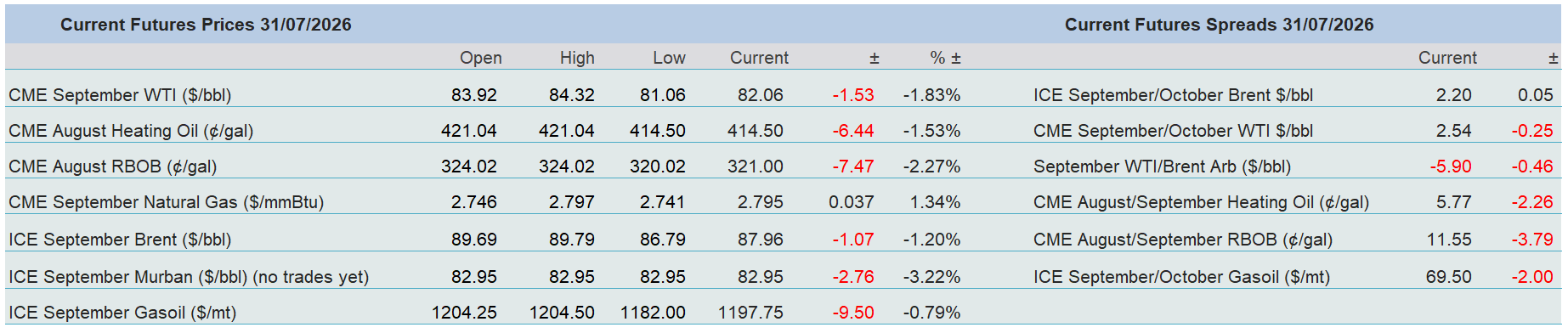
31 Jul 2026
