A Lesson in Cynicism
It is difficult to confirm whether Donald Trump is playing brinkmanship with markets rather than Iran. Last week he said, “The only thing that matters when I’m talking about Iran is they can’t have a nuclear weapon, I don’t think about Americans’ financial situation”. In a sea of half-truths, or worse, in his second term and peppered with an in ordinate number of gaffes, this one has curiously found little press or challenge. Having fanned the flames of a possible return to military hostilities by saying Iran’s peace proposal was “garbage” and that the ceasefire was on “massive life support”, he underpinned an oil rally almost as guaranteed as the forthcoming SpaceX IPO. The trouble with gambling with oil prices at these lofty levels is how they pave the way for wider fear in inflation and likely runoffs in global GDPs. There has since been a reckoning in the much-publicised rout in bonds, rally in yields and correction in equities. This morning, it would appear the US President does in fact care about American popular finances and knowing that his every word is still hung on to, even by markets reluctant to admit they do, he announced that the scheduled attack on Iran (of which all in the world seem ignorant) had been delayed. Despite the most relevant mediator, Pakistan, describing any likely progress in talks being “difficult,” Trump filled his Truth Social posts with hope of a nuclear deal acceptable to the United States and that his new patience was at the behest of other Gulf states. One wonders if when reading any new proposal from Iran, his eyes kept drifting to the $10/barrel rally in WTI or the near 1-year high in the US 10-Year Treasury Note Yield. Does not care about American’s financial situation indeed.

A bunch of Forget-Me-Nots from Ukraine
Just when you thought it was safe to ignore the war-grind in Ukraine, the terrible toll that has been outgunned in newsprint by that of Hormuz, comes back to remind us of another never-ending war which has a direct bearing on what happens to oil prices. Ukraine forces reported and backed up by Russia’s ‘TASS’ news agency, that it had carried out a successful attack on Moscow. It has been over a year since Kyiv sanctioned such an attack on the Russian capital, and while any act in war has obvious motivation and cynicism, it can only be assumed that suffering of his people now going unnoticed because of a 21-mile-wide stretch of water being closed, has inspired Volodymyr Zelenskyy to act. So says his account on ‘X’ with a message, “our responses to Russia’s prolongation of the war and its attacks on our cities and communities are entirely justified. This time, Ukrainian long-range sanctions reached the Moscow region, and we are clearly telling the Russians: their state must end its war.”
The weekend’s attacks, with sadly collateral deaths, included the targeting of a Moscow refinery and two oil pumping facilities and highlights the attempts in recent times by Ukraine to once again expand its strikes on key energy facilities across Russia and it is hard argue them not being legitimate targets as they allow Russia to continue its war effort. The United States lifted sanctions on Russian oil exports in March, which as of yesterday has been extended, and it is far too early to assume whether this state of sanction will continue or increase oil availability, because Russia’s total oil and petroleum product exports saw a marginal monthly dip in April, falling by 90kbpd to an average of 7.03mbpd according to the IEA. Russia’s decision to declare an embargo on gasoline exports, and the reduced refinery activity due to Ukraine’s interference, has seen refined product exports fall to 2.15mbpd last month. Total oil output has falling to under 9mbpd. However, the real teeth-gnashing chagrin for Zelenskyy, and revealed in the same IEA report, in annualized terms, is that total revenues for April were up by an enormous $6.28 billion compared to April 2025 as oil prices rise.
The Iranian war has been fortunate timing for Russia. The obvious tactic by Washington in temporarily lifting sanctions to help nullify the effects of less crude and derivatives making it to market from the Gulf states is undoing all the good work that years and years of incremental, grinding restrictions have achieved. Staying with IEA data, Russia’s revenue from crude and petroleum shipments rose to $19.18 billion in April, it is a remarkable turnaround from February when export monies generated a much smaller total of $9.5 billion. The thirst for feedstock in the Far East, and its preference for heavier crudes has seen times where the Russian grade of Urals has tripled in value from the outbreak of the Israel/US attack on Iran. As seen in a Chatham House analysis, this could easily boost oil and energy receipts to Russia by as much as $10 billion per month. According to Bloomberg, in the week to April 5, Russian oil export receipts had returned to the highest level since June 2022. Using Reuters calculations, revenue from Russia’s largest single oil tax will double to $9 billion in April as a result of the spike in prices.
With such an increase of payments going into the Russian exchequer, its ability to wage war increases with every day that Hormuz continues closed. All remains subject to how long the impasse in the Middle East lasts, and how quickly any additional tax receipts enjoyed in Moscow are converted to military investment. Kyiv has little choice other than to increase its attacks on Russia’s ability to reap reward from newfound high oil prices and by doing so keeping its valiant stance fresh in the flighty minds of a world so very adept in looking away when a global event does not interest us. If then Ukraine enjoys greater success in stymying Russian oil flows, the resultant inflationary pressure on oil prices will give greater urgency in some sort of Hormuz solution be it through negotiation or war. But will also remind the world how very important Russian oil is to the global economy and any threat to its free flowing is because of Moscow’s obduracy in ending its blood-soaked, illegal war in Ukraine.
Overnight Pricing
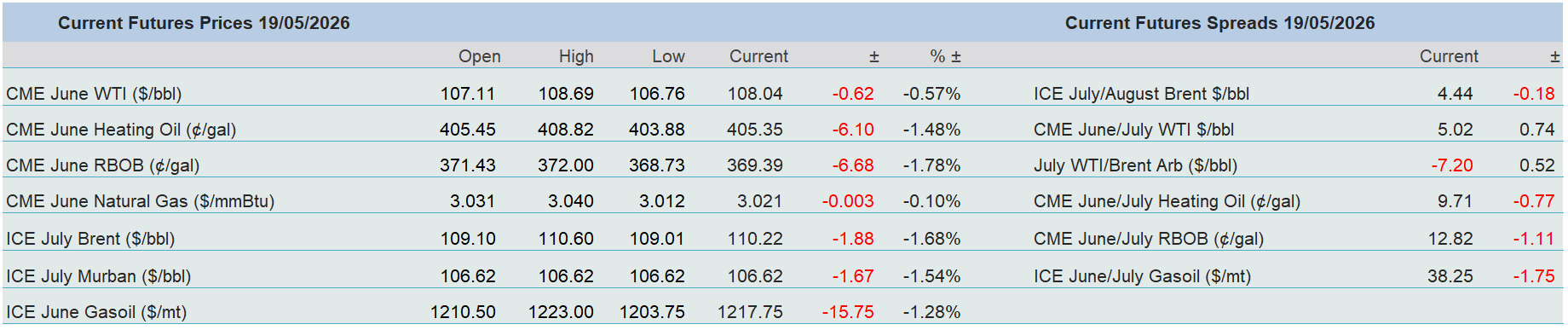
19 May 2026
