The Long Game Unfolds
The insulting invocation of ‘D-Day’ by Scott Bessent, the US Secretary of Treasury, when foregrounding in the ‘Financial Times’ over the weekend of the coming new sanction regime the US will impose on Iran was given meat to its bone yesterday. ‘Operation Economic Outcast’ aims to cut Iran’s economic lifeline by targeting all of Iran’s sources of revenue, including oil, with the goal of preventing corporations and countries alike from conducting trade with Iran. Through much posturing, Bessent’s comment on the international clearing system is the most striking. “Any entity that facilitates money laundering on behalf of Iran will be removed from the U.S. dollar system,” he said. “The clock just started ticking.” While time would be allowed for adherence and with President Trump making calls to other heads-of-state requesting “to cease their interactions” with Iran, the immediate and indeed longer-term effect on oil prices has yet to be worked out by our market’s constituents. Needless to say, most of the focus is on China. Beijing is the number one supporter of Iran by being the main destination for Iranian oil, whether the US will risk another sabre-rattling episode of a trade war standoff with its greatest trade rival does seem unlikely. However, when questioned whether China might fall foul of the new sanction regime, Bessent seem unequivocal by replying that any country turning oil into money would be subject to the new conditions. With warfare not working, diplomacy down to paper aeroplane messages being tossed into the winds of animosity, this new slow burning addition to how this conflict might end has guaranteed only one thing, a status quo.
Ships Ahoy!
According to the US Energy Information Administration, in 2025, total world petroleum and other liquids supply was around 106.12 million barrels per day. The EIA estimates during the period about 76 percent of that amount travelled via seaborne trade. Whether or not proposed new pipelines by the Gulf nations of the Middle East such as the Fujairah expansion by the UAE or the Iraq-Syria (Kirkuk-Baniyas) route which both aim to bypass Hormuz ever come to fruition, they will take an inordinate amount of time to complete. This is of course a localised solving of geographical supply disruption, it does not take into account intercontinental supply and even if oil reaches the Gulf of Oman or the Mediterranean Sea unencumbered, it will still have to board tankers to make any final destination.
The availability of oil shipping is becoming a constant niggle for those in charge of pathing the routes for oil and its derivatives to the far-flung place of the Earth. Be they ‘dirty’ tankers for crude or ‘clean’ tanker for products, wrangling ships to where they need to be is becoming increasingly difficult given the duress shipping lanes find themselves under. The Strait of Hormuz, the Red and Black Seas are surrounded by warfare and when shipping is caught on the wrong side of a bottleneck, it puts stress on global shipping capacity. Freight rates for oil tankers were already strong before the US and Israel attacked Iran but have since accelerated greatly. The Baltic Dirty Tanker Index, a weighted average of spot freight rates across key international crude and residual fuel oil shipping routes, started the year at 1200, has fallen away from the high of 3700 seen at the time of the outbreak of the war due to the hopes of the memorandum of understanding but is once again trading near 3000 as vessels are either caught behind a barricade of war or committed elsewhere.
The paucity of oil shipping is both acute and chronic. The near-term pressures of geopolitical choke points are exacerbated by the long-term issues of an ageing global fleet. So many ships that make up the global maritime fleet are older than 15 years and there is even up to 20 percent of geriatric vessels having ages of over 20 years. Desperate times call for blind eyes, but oil tankers of such ages pose severe environmental, safety and general regulatory threats to the safe movement of oil stuffs. Metal fatigue, corrosion and poor maintenance are bad enough, but when they are evolving in single-hull units, which older boats tend to be, the environmental threat is never far from disaster. Given that the ‘dark fleet’ (that which services Iran, Russia and before Venezuela are made up entirely of these old geezers) has no insurance because boats are sanction-busting, any accident with potential spillages will have no financial means to undertake clean-ups.
Back in June, ‘Bloomberg’, using ‘Clarkson’ ship broker data, reported on there being 262 supertankers under construction, each capable of hauling 2 million barrels of crude oil, on order at shipyards around the world. This is the highest order number since 2008, and the demand is driven entirely by the geopolitical unrest being the root cause of why shipbuilding is once again in vogue. A supertanker bubble then, one that will burst if and when Ukraine and Iran are solved? Well, no not really. Shipping regulators that cast a current blind eye because of the consideration of necessity will no longer tolerate the age and shabbiness of the global fleet. The rolling and replacement program will still emerge however long these conflicts last.
Such scope for building is happening even as costs soar. Demand for supertankers from Middle Eastern oil producers has pushed prices to all-time highs, the ‘Financial Times’ reported last week. The FT elaborated on how the cost of both newbuild and modern second-hand VLCCs reached more than $130M in Q2, and rates to charter a supertanker for a year have also hit historic highs. As seen earlier this month on ‘Reuters’, ADNOC Logistics & Services have acquired 6 more VLCCs as part of a $1.3 billion, 11-unit, gas and crude vessel expansion. These eye-watering sums, and commitment to fossil fuels are indeed fascinating insights to how those that conduct the music of maritime oil flows believe in the longevity of the black stuff and how the oil community has the wherewithal and the pockets to endure the higher prices in all petroleum products which will have to be charged for moving oil around the globe.
Overnight Pricing
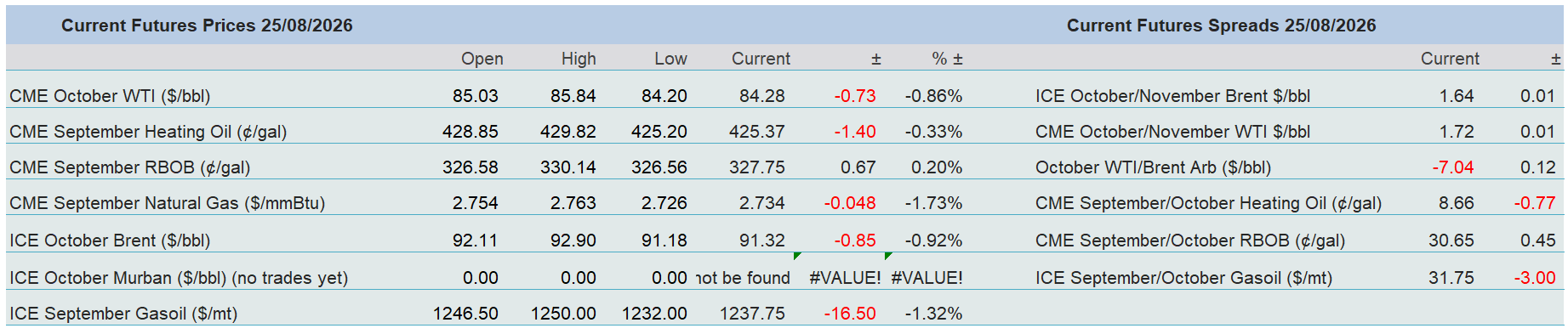
25 Aug 2026
