Masterful Oil Supply Diversions, but What Now of OPEC?
There was a particularly convincing and well written investigative piece in Petroleum Intelligence Weekly last week. It is something we not only admire but wished we had authored. Entitled ‘How Oil Markets Took Hormuz Crisis in Stride’, it picks apart the assumption most of our fraternity, including us, expected that closing the most important sea passage for oil communication would result in oil prices making record highs. Energy Intelligence calculates that the market's headline 20mbpd loss averaged closer to 12.2mbpd across March-May. The variety of reasons on how such an astounding achievement in proving that ‘oil always finds a way’ makes for a compelling argument and complete sense.
They include how Saudi was able to increase exports through its West Coast facility of Bab al-Mandeb from 650kbpd to 3.4mbpd. Such diversion in pipeline was emulated by Abu Dhabi, which pushed oil out at a much-increased rate through Fujairah, as it lies south of the Hormuz pinch, by increase flows from just over 1mbpd to 1.7mbpd. Happenstance plays a part in the next example of diversion, but the world suddenly enjoyed another 200kbpd of Iraqi crude as it once again made it to water via Turkey. There are any number of further examples touching upon ‘stealth trade’ to the tune of 2.6mbpd which avoided both US and Iranian policing, ship-to-ship (STS) transfers and of course the release of SPR which was brokered by the IEA. Frankly, using any more of the information might as well be a cut and paste exercise, but there has not been as extensive reasoning seen in the many words and pixels spewing forth in trying to explain away the counter intelligent moves in oil prices.
Forensically presenting the genius of those charged with pushing oil to the places it is needed adds to the growing appeal of thought processes that are emerging from oil interlocutors that our market is already on a heading toward oversupply. Where then, we ask, are the guardians of price? Judging by the hotchpotch ceasefire agreement being bandied by Donald Trump, one cannot believe that there was a foreseeing of this part of the Middle East war possibly being the final nail in the coffin of relevance for OPEC and the wider OPEC+ or DoC.
The greater concerns over Hormuz allowed the United Arab Emirates to slide out of OPEC membership under cover of war darkness and the move has not really been given enough thought on its ramifications. The early signs of such come from a Reuters source that the Emirate is now producing at a record 3.8mbpd. While it was part of OPEC, and according to Kpler, the UAE’s quota stood at ~3.4mbd, implying that close to 30 percent of its capacity remained idle (presuming a production capability of 5mbpd), the highest proportional spare capacity in the group. With such autonomous oil production, the UAE’s newfound ability to go it alone must be attracting sympathetic and possibly envious glances from other OPEC members.
The OPEC+ agreement over the weekend allowing for a raise in production by 188kbpd is in part a carte blanche for members to make a little hay while the sun still shines on an oil price harvest. Members have suffered dreadfully by enduring a collective shortfall in petrodollars and according to the OPEC monthly report, OPEC+ produced 42.77mbpd in February but only turned out 33.13mbpd in May. As much as OPEC+ have increased output quota now by 800kbpd from April to July, none of it, and despite Energy Intelligence examples of rerouting, has been able to make it to market.
Whether or not the increased quotas appease the growing fear that the cartel’s integrity is in trouble remains to be seen. However, with the exit of the UAE, opportunity knocks for the likes of Iraq which has never seemed to toe-the-line in what it should or should not do to adhere within cartel rules. Iraq’s oil ministry has denied any official position, but last week there were more than a few news sources telling of how Baghdad might end OPEC membership if it did not receive the quota it wanted. Such threats might not be as idle as they used to be bearing mind the reestablishment of oil deliveries to Turkey.
Indeed, given the newfound ability by all of OPEC+ members to bring oil in various ways to customers, does leave a cause for speculation on how OPEC, OPEC+ and the DoC can survive. Additionally, and probably most importantly, there is quiet from Riyadh. No nation has put more time, effort and sacrifice to OPEC’s cause than Saudi Arabia. The de facto leader of this oil producing countries council, is probably pulling out its metaphorical hair as its self-serving allies wallow in parochial considerations. Not only are its markets being treated as fair game by many competitors including its once great ally, the United States, as it pours out oil exports to all who would have them, the Kingdom still refuses to take its production to the capacity of 12.2mbpd from the current level of 10mbpd.
How long Saudi will endure this abuse remains to be seen. It might accept that OPEC+ needs to make up for lost production as Hormuz reopens, but how long will it endure malpractices of fellow members? The big question will arise as to what OPEC is for; Saudi might just answer it. The ignominy of the UAE leaving OPEC, the constant cheating of Iraq and the role of Russia as ally only when it suits Moscow must give Mohammed bin Salman Al Saud thoughts of retribution. Saudi has done it before, and not so long in the distant past. Ominously, and as seen on Bloomberg, Saudi Aramco will lower the price of its Arab Light oil to Asia next month by $11 a barrel to a $1.50 discount over the regional benchmark, the last two times it sold at such a discount were during the price wars in 2020 and 2015. If you keep it up chaps, Saudi Arabia will show what OPEC is for, and it is not a $15.98 low in Brent seen on April Fool’s Day 2020, when the Kingdom last decided to dole out a lesson.
Overnight Pricing
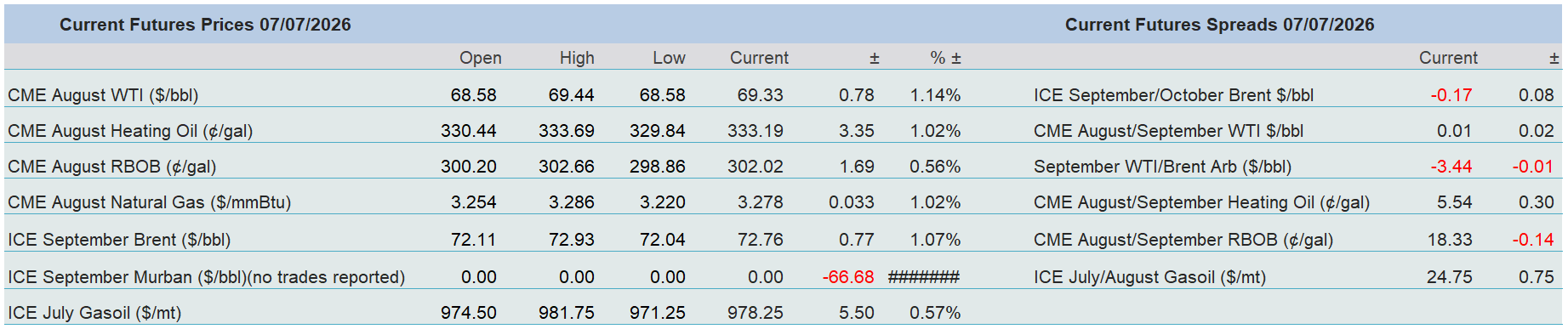
07 Jul 2026
