The Memorandum of Understanding Half Time Show is Over
It takes some brass-knuckled temerity for the President of the United States to criticize the England football manager concerning Thomas Tuchel’s tactics in England’s World Cup defeat to Argentina in last week’s semi-final. What Donald Trump fails to realise is that all persons from doctors in the Democratic Republic of Congo, to road diggers in Japan realise that in the ‘beautiful game’ such results are not uncommon and, in the end, football hearts are broken but not a soul loses their life. These two same workers might then in return, with the world on their side, ask why the US President went to war in Iran and why his own warfare tactics are going so badly wrong; not only causing continued death, but reaping havoc in the global economic puzzle.
What seems to be the only consistent rationale is the obfuscation tactics employed by the White House with no comprehensive explanation on why the US military are still putting their lives on the line, as well as those defenders in Iran and those receiving retribution in the ring of the Islamic Republic’s neighbours, targeted by unmanned aerial vehicles (UAVs). In the twenty weeks of this war our collective eyes and ears have been subject to all manner of volte-face. These include regime change, later denied, but insinuated again by how many of Iran’s leaders had been killed. On June 22nd, 2025, under ‘Operation Midnight Hammer’, the US attacked the Fordow uranium enrichment plant, the Natanz nuclear facility, and the Isfahan nuclear technology Centre after which Trump said Iran’s nuclear enrichment had been "completely and totally obliterated.” If so, then why after the start of the war at the very end of February did the US President insist on how Iran was only two weeks away from having a nuclear bomb capability?
“It’s the hope that kills you,” is sometimes attributed to the English journalist and author Peter Ustinov, and little could be more apposite in how many, particularly financial markets, have been lulled into believing the mealy-mouthed, untenable and unenforceable memorandum of understanding. It eventually accelerated a complete correction in the crude oil price spike and gave fresh impetus to the hungry bulls that prowl every step of the A.I. inspired stock market rally. The MoU was signed on the 17th of June and included a commitment from both sides to further talks to reach a final agreement over the succeeding 60 days and referred to reopening the Strait of Hormuz and the US lifting sanctions on Iran. We wonder, on behalf of a global all, how that’s going?
The US blockade of Iran is back, Iran says Hormuz is closed, commercial shipping traversing the Strait is being hit by missiles and Iran is being threatened with obliteration by the US President as he puts in his performative nonchalance when he continually informs our eager ears that Iran desperately wants to do a deal. What deal? The Iranians have put its Houthi allies in Yemen on alert to once again start attacking Red Sea shipping traffic if the US makes good on its threat to bomb Iran’s sensitive infrastructure such as power supply. There have now been nine-straight nights of American attacks and as seen on the ‘BBC’ website, Iran's Supreme Leader Mojtaba Khamenei said in a written statement over the weekend that America's "repeated breaches" of the agreement had "laid bare a fundamental truth: the signature of the US president is utterly worthless and devoid of credibility".
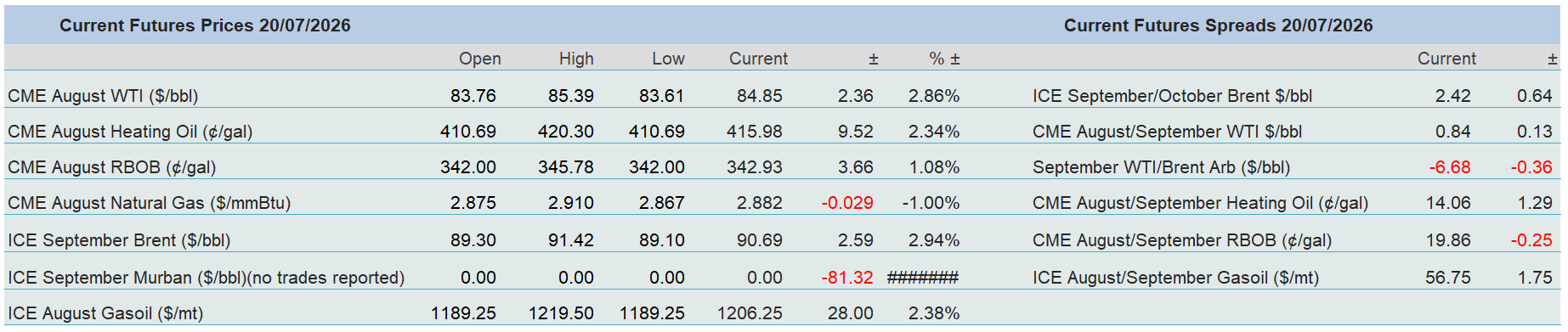
Last week M1 futures in WTI rallied $11.09/barrel (15.2%), Brent $12.09/barrel (15.9%), Heating Oil 51.13c/gallon (14.39%), RBOB 40.81c/gallon (13.67%) and Gasoil $135.25/tonne (12.97%). The universal rally across the futures complex implies the seriousness in which the oil fraternity now view the current mess. For a while it looked as if the oil problem would be that of a product one, as initially the distillates market tightened before all else. The lack of product now entering the market from Russia, made bound up by successive and successful Ukrainian drone attacks into the far reaches of Russia’s vastness has tightened all derivatives. The European continent is at present particularly vulnerable to the lack of finished fuels as demand has severely increased due to the ongoing, unforgiving heatwave reflected in the demand on the electricity grid. The Gasoil/Brent crack rallied nearly $10/barrel last week and is up nearly $25/barrel since the world thought Hormuz was cured in the middle of June.
Such lucrativeness has not been lost it seems on Chinese refiners. Having been granted new licenses, the independent processors are now free from the product export ban they had been operating under after an edict from, as always, an energy supply conscious Beijing. Logic dictates that any extra crude buying might be given more meat as a runoff in crude SPR ensued because China refused to engage with the higher prices seen at the start of this crisis. In then comes a bid from the biggest importer of all and now crude grades are having to react to the pathfinding to higher prices seen in fuels. The domestic situation in China does not need attending to as far as oil is concerned, as seen in recent economic data, but the huge export businesses and the ability to capitalise on historical cracks will see buying from the Asian Dragon for at least this cycle. The high margin and crack values will eventually be tamed, however, we are not in the teeth of a gasoline season yet, and if Hormuz remains closed, then any sort of product relief from the Persian Gulf will be long coming.
One could argue that the recent scrutiny received by A.I. and technology companies, and stock market falls, are due to the increased awareness of both overstretched valuations and investment, and now, in A.I. buildouts, overcapacity. Yet it cannot be denied on how this current flare-up in and around the pinch of Hormuz, and its inflationary influence, causes nervousness for investors as they consider their portfolio exposure to companies which might feel a heavy load if indeed the notions of ‘higher for longer’ interest rates play out. As for oil prices, with Brent knocking on the door of $90/barrel and only one errant bombing or incident away from pushing on to $100/barrel once again, and supply of gasoline and diesel getting ever shorter, time is running out for the US President to assuage the current anxiety building within the oil fraternity. Leave the football to us Mr President, you concentrate on extricating yourself from what has been an easily predictable ‘forever war’.
Overnight Pricing
20 Jul 2026
