Missile Exchanges, the New Currency of Monday Morning News
It did not take long for the recent state of tetchiness in negotiations between the United Sates of America and the Islamic Republic of Iran to turn into shooting once again. Over the weekend the US said it carried out 140 strikes on Iranian infrastructure on Saturday and again there were more strikes again on Sunday. Iran has returned the favour by hitting out at US allies in the area and the whole sorry repetitive circus is once again amongst us. The quibble from any oil watcher’s perspective is how any of this affects the running of oil cargoes through the Strait of Hormuz. It might just be we ought to take an average of claims. The US reported, and according to Axios, 20 commercial vessels under its care transited and several more outside of US coordination. Iran declared Hormuz to be closed. Taking our proposed average and listening more to Kpler, it does appear there is a slowing of movement. As seen on Reuters, the shipping agency reported 6 vessels making the crossing in the last 24 hours, and of course that does not take into account those vessels which might have ‘gone dark’, so to speak. Oil prices have little choice then other than react to the upside with the prevailing effects being a rundown in equity enthusiasm and a rally in the value of the US Dollar, the place where scared money seems to run to at present.
It is always about products
While our market’s eyes dwell on the conflict in the Middle East, the bloody escapades of the Ukrainian war continue to rack up casualties, not only in sad human terms, but in how Russia might be able to maintain its role as a leading supplier of oil to global markets. This war is of such size, nature and horror to contemplate generalised sweeping assumptions, however, each grinding move on the chess board of abominations continually unfolding on the far reaches of the European continent comes with counter and consequence.
At the beginning of June, and as read in the Guardian, Ukrainian open-source group DeepState estimated Russian troops in May saw their smallest monthly gains since October 2023. In fact, only 14 square kilometres, despite a 37.5 percent spike in assaults by Russian forces. It would appear Ukrainian forces have largely halted the Russian spring-summer 2026 offensive so far. Faced with such ground opposition, Russia has escalated its missile attacks using ballistic missiles that are so fast, Ukraine’s air defences are hard-pressed to the point of failure in coping with them. Any doubt that defenders are struggling should be quashed when last week President Volodymyr Zelenskyy, while attending the NATO summit in Ankara, spoke at length and with conviction on how his country needed allies to deliver the air defence systems Kyiv urgently needs to protect it from this new spate of Russian aggression.
Within the prism of air attacks, Russia is by no means having its own way. Indeed, it is not beyond conjecture that the success of Kyiv’s acceleration of targeting Russian oil infrastructure has also inspired Moscow into expanding the drone and missile campaign against its doughty foe. The scale-up in Ukrainian drone capabilities and their ability to reach further and further into the vast geography of Russia has now made even Siberia within reach. Only last week, the largest refinery of all in Omsk, owned by Gazprom Neft, was hit and had to be taken offline, and according to Reuters sources, one of the crude distillation units accounting for 38 percent of production caught fire. The Omsk refinery is the largest producer of Gasoline in the great arsenal of Russia’s distillation, cracking and purification units and once again puts pressure on the production of finished products.
At present, and with the Gasoline season yet to show its fangs, the fall in refining capacity in Russia is being keenly felt in the prices of Distillates, particularly those of Diesel. It is difficult to quantify the amount of capacity being knocked out, but commentators, including the Financial Times estimate the loss at 20 to 40 percent and is directly affecting 50 million Russians. President Vladimir Putin has acknowledged fuel supply issues, but along with local authorities blamed the problems on higher demand rather than any alien influence. Whatever brave face is displayed, there cannot be any hiding from how Moscow has once again banned all Diesel exports. The violent upward reaction in futures prices have somewhat calmed, but the gaping void, as highlighted in Friday’s report, between Crude prices and products is hardly set narrow until refiners start running more Crude. The EIA reported last week global throughput up by 1.5mbpd in June, but overall, down by 6.6mbpd year-on-year.
Gasoline has been subject to a Russian export ban since April and is set to run until the end of this month. Analysis from CNN opines that almost all of Russia’s 83 regions have experienced gasoline shortages or reported disruptions to supply with many citizens now having to endure rationing. Russia has also begun redirecting Gasoline from Belarus that was originally intended for Central Asian markets. If one of the major suppliers to the needs of global fuels is reversing supplies and banning further exports, then by the very precarious nature in which refiners run means a knock-on effect cannot be ruled out. There has formed a quiet confidence, nay arrogance, that the Hormuz issue is a tolerable influence. Yet, the nonchalance stems from a Crude Oil perspective. Products are far more vulnerable to localised drivers, let alone international ones. If Russian fuel exports are precluded from global supplies for any elongated period of time, it will serve as a prop to all oil prices, no matter their derivative.
Overnight Pricing
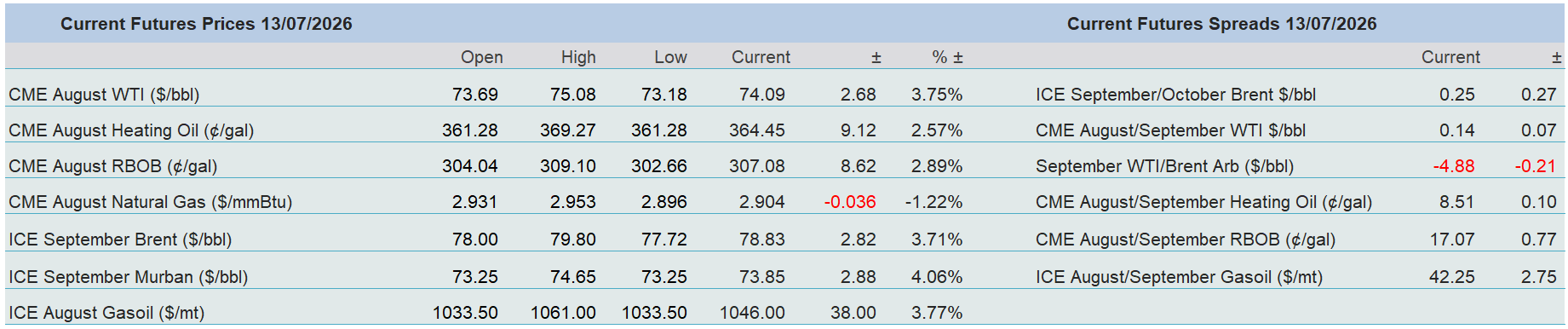
13 Jul 2026
