More Like a Little Bit of a Santa Sulk
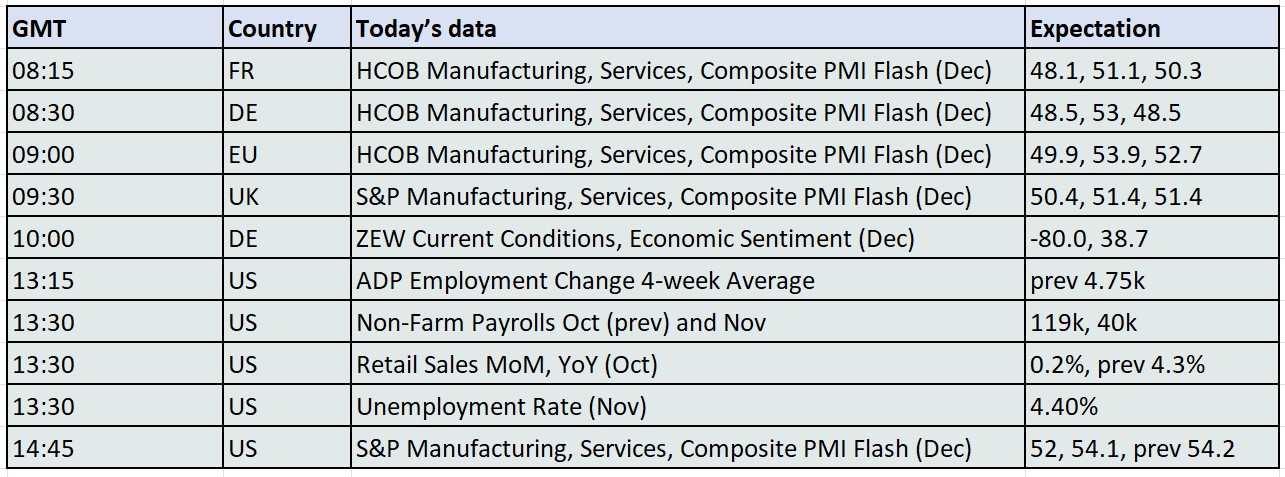
There is not much seasonal cheer going around in markets at present and the ‘Santa rally’ which was all set to be fuelled by a bullish take on the recent Fed rate cut, seems very much stuck in the chimney. Shy equities have no specific reason to suddenly becoming self-conscious other than them having to deal with a deluge of data, including a backdated lode, and little time to decipher what any untoward reading might mean for the near future as the trading days of the year begin to dwindle. Evidence in a creeping risk-off mood can be found in two-week lows in Bitcoin and a haven rotation toward Gold which is prowling around $4,300 and near its all-time high of $4,350 per ounce.
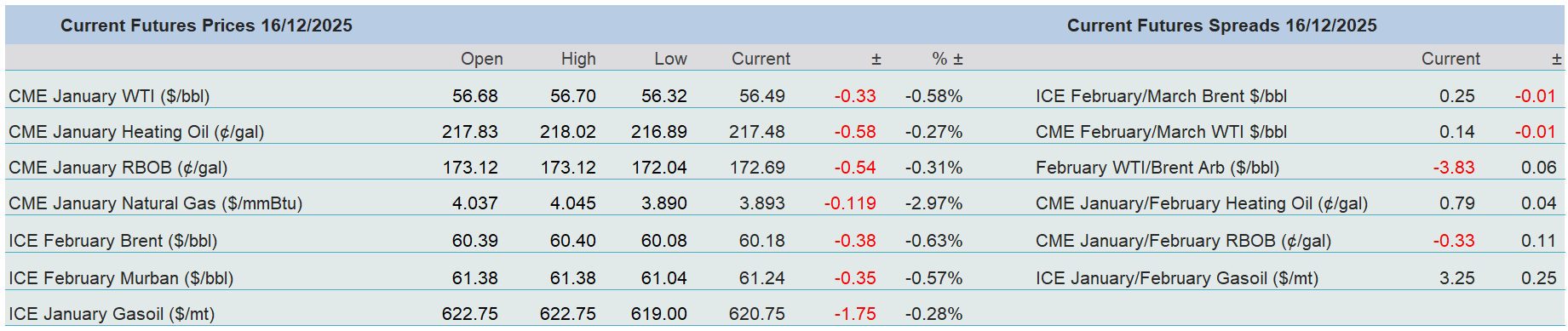
Such reticence is not lost on oil prices and even with news of further EU sanctions on Russia, the prospect of a peace deal is still casting a bearish colour to thinking even though most recognise the enormity of how any final deal may be reached. The European Union’s latest set of restrictions is aimed at individuals who it accuses of enabling circumvention of sanctions by Russian assets. Even with Venezuela cargoes turning around because of the threat of further boarding by US forces and a cyber-attack at PDVSA, leaving, according to Reuters calculations, 11mb of oil floating in Venezuela waters is not enough to spark an attitude in which the market foresees a shortage of heavier crudes. Holes in sour crude supply is likely to be filled by the ramping up of OPEC production, and outside of frozen situations and fires, readily available Canadian grades.
Transition needs group therapy
The world continues to keep itself tied up in a transition twist and the chequered path to a planet powered by green or renewable energies becomes longer and longer. The falling away of so many companies, be they of oil or motor car producing type, in pursuits of ‘net zero’ target years has been dramatic and any intention of embracing the collective ‘good’ policies of leaning on more wind, solar, battery, et alia modes of power generation to either replace or offset the ‘bad’ practices of fossil fuels, continue to find themselves being earmarked for dumping on the scrap heap of virtue signalling.
The accelerative, as he has been in everything this year, is Donald Trump. His antipathy toward new power technologies has been visceral particularly as they were the pet project of his predecessor Joe Biden. His attitude that giving away power or fuel self-sufficiency is tantamount to strategic suicide has not been lost on many of his global head of government peers. For all his detractors, the US President has portrayed a pragmatism which before was so apparently invisible and failed to include consideration of technological limitations, social and political will and primarily the costs involved. The United States is surrounded by land and sea full of fossil fuel potential, and with a hundred-year history of turning them into the enabling drivers of the globe’s most successful economy ever; enforced migration away from cheap fuel is hardly the stuff of the American dream.
The proverb, ’necessity is the mother of invention’ is one of our favourites we enjoy wheeling out, but it has never been more proven in the marked difference in attitude by China toward new power technologies. China is the leader in green energies because it must be. An argument could be constructed that without Beijing’s strategic buying of crude oil seen all year, feedstock prices might well be trading so very much lower. One only needs look at the state of China’s industry at present, the imports from Russia and Iran and all other contentious suppliers is not because of humming manufacturing and house building, it is to assuage the national anxiety surrounding energy security. According to an opinion on NPR, China now dominates the global renewable sector. In the first half of this year, it built more solar than the rest of the world combined. Seventy-four percent of all large-scale wind and solar projects are being built in China. Compare that to the US building of 6 percent. Additionally, and according to the IEA, in 2024 China’s clean energy investment was more than $625 billion, almost doubling since 2015. The Chinese government has facilitated private participation in more than 8,000 recommended projects in 2024.
Therein lies a clue to success, without substantial investment from government, whatever transition is sought, it cannot be achieved by the private sector alone. Therefore, in this world of political uncertainty and government policies that are as ephemeral as at any time in history, ‘joined up’ energy transition is almost myth. When the man at the top of the US legislative tree sets forth a flagrant bias toward oil and gas, then the likes of Exxon and Chevron were unlikely to change their position of businesses based around existing exposure and balance sheets built on fossil fuels. In an excellent piece in the Financial Times titled, ‘Inside a failed green revolution’, one of the reasons listed for the difficulties faced by the UK and Anglo-Dutch companies of BP and Shell were the envious eyes, being the only thing turning green, from shareholders as they watched the US oil majors reap the rewards of not committing billions of dollars to green goals.
It is over-simplistic to blame BP and Shell’s ultimate failure to deliver on their clarion of net-zero targets and carbon offsets on unwilling political leaders or the greed of shareholders, and indeed the start of the corporate reversal predates Trump II, but a lack of cohesion and premature assumptions of there being ‘deep electrification’ across the globe and a broad acceptance of populace in switching energies has elongated the process. Going too far and too fast made a race of transition and as the former CEO of Shell, Ben Van Beurden, explained in the FT, “climate strategy became a source of competition, with each company seeking to differentiate itself by taking a different approach.” How a unified approach manifests is not apparent and from the attitudes displayed at COP30 to the softening approach from the International Energy Agency on how fossil fuel will make up part of the energy picture for some time yet, energy transition will be a long work in process.
Overnight Pricing
16 Dec 2025
