Never a Dull Day, Never a Dull Week
The new year got off to a frenetic start, even by the standards of the incumbent US administration. What has been discernible, and admittedly may prove a premature observation, is that Donald Trump’s attention has shifted from domestic matters to his international agenda. Notwithstanding this change in focus, the methods employed to conduct business remain the same. A recalcitrant attitude, coupled with a “might is right” approach, has been imposed, or is about to be inflicted, on several countries, which are watching in horror as events unfold.
No doubt, the major story was the abduction of the now former president of Venezuela, Nicolás Maduro, and his wife, who was indicted on drug-trafficking charges in a New York court. As the ex-president landed in the US, warnings were sent to Colombia, Cuba, and Mexico, not to mention the explicit threat to Greenland and Denmark that the world’s largest non-continental island would soon belong to the US. In the meantime, after anti-government protests erupted in Iran, the US president also admonished the country’s hardline leadership to consider his ire should they crack down on demonstrators, as they invariably do.
While geopolitical tensions flared, including reciprocal attacks in the ongoing war between Russia and Ukraine, investors also kept a watchful eye on developments within the US. The shooting of a woman by an ICE agent in Minneapolis and the ensuing reaction were probably the most vivid display of the polarisation of American society and a true reflection of the erosion of the rules-based international order. The Supreme Court decided to postpone its ruling on Donald Trump’s tariffs until at least January 14. Meanwhile, the eagerly awaited US non-farm payroll data for December showed an increase of 50,000, lower than hoped for, while the joblessness rate retreated to 4.4% from 4.6% in November. The labour-market data hint at a pause in US interest-rate cuts this month. Over the weekend, the US DoJ opened a criminal probe into Jay Powell over the revamp of the Fed headquarters, much to the dismay of dollar bulls.
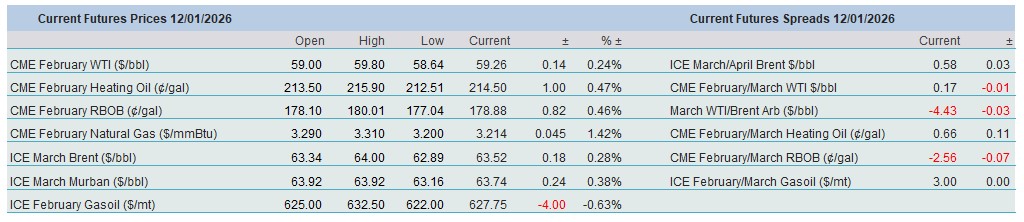
The whirlwind of geopolitical and economic activity was, on balance, conducive to risk assets. The global equity index gained 1.5%, with US stock indices scaling fresh historical highs. Uncertain prospects, nonetheless, were illustrated by a 4% rise in the price of gold. The five major oil futures contracts also finished the week convincingly higher after a mid-week wobble. An unpredictable outlook for major oil-producing regions makes any forecast more akin to a coin toss than a confident prognosis. The most consequential of these uncertainties will be how events surrounding Venezuela evolve.
Believe the Numbers, Not the Narrative
The extraction of the Venezuelan ex-president was quickly followed by the brazen announcement that the Latin American country is now under US management indefinitely, including its oil sector. It is a country that prides itself on having the largest oil reserves in the world, accounting for 17% of the global total, equivalent to 303 billion barrels, at its disposal. At the same time, its oil production, owing to two decades of mismanagement and corruption, stands at under 1 mbpd. These two strikingly contrasting figures clearly indicate tremendous upside potential for the long-suffering nation, hopefully for the betterment of its people, as the idealist would like to believe. It would entail sizeable growth in global oil production, loosening the oil balance. Will it happen?
It is impossible to provide a definitive answer unless one reserves the right to abruptly change one’s mind and realign views as circumstances change. Nonetheless, it is reasonable to distinguish between short- and medium-to-long-term prospects.
In the short term, it is imperative that the US blockade, which prohibits the sale of Venezuelan oil on the open market, is fully and irrevocably lifted. Otherwise, with tanks and storage already full, production will need to be halted and restarting it would be a gargantuan task.
President Trump is seeking around $100 billion from US oil companies to invest in Venezuela, ruling out any financial assistance from the government. The reception to this proposal has been tepid at best, with one US oil major going so far as to say that the country is currently “uninvestable”. Even if it were not, it should be borne in mind that the breakeven cost of Venezuelan oil projects is around $80 per barrel, according to Wood Mackenzie. Security concerns, arbitration risks, the legal framework, or lack thereof, and a shortage of skilled labour present additional challenges, not to mention the scarce availability of diluents such as naphtha, given the extra-heavy quality of Venezuelan crude. While exerting pressure on US oil companies is always a possibility, the broader picture suggests that the aforementioned $100 billion could be deployed more efficiently elsewhere.
The US’s relationship with stakeholders is another salient point of contention. Will Venezuela comply beyond rhetoric? How will China or Russia, steadfast allies of the Maduro regime, react? Will US shale producers feel sidelined once again, despite the “drill, baby, drill” campaign promise? How will the US–OPEC relationship be affected? It is worth recalling that three OPEC members, Iran, Nigeria, and now Venezuela, have come under military attack over the past six months. Growing US control over global oil supply could alienate Persian Gulf producers. Who will set production quotas for Venezuela, or will the country be wantonly forced to leave the organisation? Is it feasible that another supply war breaks out, pushing prices significantly lower? Or might the producer group decide to cut output again, sending international, and therefore US retail gasoline prices higher just ahead of the mid-term elections? In the event of deteriorating relations, could the NOPEC bill be revived?
It appears that while decisive US action has been taken against yet another adversary, the aftermath has not been fully thought through, and no clear follow-up plan exists, similarly to the Gaza truce. For this reason, and notwithstanding the inevitable belligerent rhetoric that may suggest escalating acrimony between the US and any country that crosses its path, it would be prudent to track changes in the global oil balance based on actual numbers, whether Venezuela, Iran or Russia. As for the Latin American OPEC member, at present, these point to 30–50 million barrels of oil arriving in the US in the near term, which will not materially alter the global supply surplus pencilled in for this year.
Overnight Pricing
12 Jan 2026
