No Crisis Mitigation on the Horizon
A quiet weekend, at least by recent standards, saw an alleged assassination attempt against US government officials, including the President himself, foiled, and yet another setback in the truce talks between the US and Iran. In another example of Donald Trump’s whimsical policymaking, he abruptly called off plans to send his team of negotiators to Islamabad, Pakistan, for the next round of talks with the Persian Gulf nation. In a way, there is probably not much to talk about, as the reluctance, or even the inability, to clearly articulate the reasons for the war against Iran makes the goals of a potential ceasefire or peace deal impossible to communicate convincingly.
All the while, the Iranian foreign minister held talks in Oman before flying to St Petersburg to meet the Russian President to discuss how to “ensure safe transit that benefits all dear neighbours and the world.” This diplomatic tug-of-war augurs ill for the reopening of the Strait of Hormuz, which remains under a double blockade and saw only one tanker sail through yesterday, according to Kpler data. Meanwhile, another fragile ceasefire between Israel and Lebanon is on the verge of breaking down, as Israel’s defence forces (the IDF) carried out strikes in southern Lebanon, killing at least 14 people, Lebanon’s Ministry of Health reported.
The amount of oil stuck behind the Strait is growing, tensions in the region are flaring up regularly, and the stalemate in talks continues. It is no surprise, then, that two investment banks, Goldman Sachs and Citi, have both increased their oil price forecasts, with the latter envisaging a $150 Brent price if normal traffic through the Strait of Hormuz does not resume until June. There is no way around it: physical markets remain tight and are likely to tighten further in the current powder-keg atmosphere.
Shale Bosses Join Doom-mongers
Since the beginning of the second Trump administration, the quarterly Dallas Fed Energy Survey has discernibly grown in significance. It is essentially a questionnaire aimed at about 200 oil and gas companies in the Eleventh District—Texas, southern New Mexico, and northern Louisiana. It provides a valuable snapshot of how the management of these ventures views the immediate oil landscape. It has also become an integral part of the FOMC’s monetary decision-making process. The anonymous nature of the responses enhances its credibility. In other words, it is designed to capture the true and honest opinions of those who play an indispensable role in shaping the US oil landscape.
Over the past 16 months, the survey has reflected an unforgivingly critical view of the energy policies of the incumbent US administration, whether regarding inflationary pressures caused by protective trade policies or the controversy surrounding the “drill, baby, drill” mantra and President Trump’s desire for low oil prices. Because of the ongoing tension in the Middle East, the Dallas Fed made a welcome move by conducting a follow-up survey between April 15 and 20 to complement the first-quarter survey published on March 25, in response to the Iranian war. The latest findings were published last Thursday.
In the update, 120 firms responded. Of those, 78 were exploration and production firms, and 42 were oilfield services companies. To get straight to the point, the first question asked when participants expected traffic through the Strait of Hormuz to normalise. The majority (40%) believes it will happen in August this year. A quarter expect it by November, 20% think it will occur next month, while 15% bet on later than November. If the majority proves correct, the repercussions could be significant.
Almost half of the respondents think that, once traffic through the Strait returns to normal, geopolitical events will disrupt oil flows again within five years. A further 38% say renewed trouble is somewhat likely, while only 14% reckon it is unlikely. Respondents were also asked how much total shipping costs (insurance, freight, tolls) would increase, in dollars per barrel, once the conflict is over. Estimates ranged from $0 to more than $6. Most (36%) selected the midpoint—more than $2 but less than $4. Nearly a quarter said more than $6, 20% opted for the second-highest range (more than $4 but less than $6), 17% expect the extra cost to be between $0 and $2, and only 4% foresee no impact.
As usual, the survey’s comment section was particularly revealing. Among E&P companies, one respondent concluded that extreme oil price volatility is leaving both small and large operators unsure whether to increase capital spending and activity. Even after nearly a month of oil trading above $90 per barrel, rig counts declined, signalling little confidence that prices will hold. Closing the supply gap resulting from the Iran conflict will require greater certainty and higher 2027 forward prices to incentivise additional rig and frack deployments. This uncertainty is also helping to keep supply chain inflation in the industry in check. Another respondent expects prices to fall back to $65/bbl quickly once the conflict ends. Finally, one noted that “the difference between the gyrations of paper market oil prices and what appear to be substantially higher physical prices sends conflicting signals to operators, who cannot plan rigs and capital budgets when prices swing wildly based on tweets. Our hypothesis is that the paper market is being manipulated. This will likely lead to an even worse supply–demand imbalance and higher prices in the medium term (next 12 months).”
A respondent from a support services firm foresees declining Middle Eastern oil output, which will be offset by production from the US, Latin America, and Africa, as the risk premium around the Persian Gulf increases. One of their peers envisages a WTI price floor of $70–$80/bbl in the near future after the Strait reopens. The most consistent theme across the comments, however, is the uncertainty and unpredictability caused by the crisis, which makes planning and operations unnecessarily cumbersome. It is hard to disagree.
Overnight Pricing
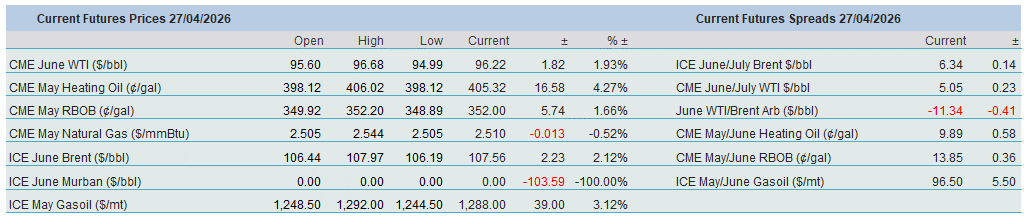
27 Apr 2026
