No Strait Answer on a Deal Yet
The many faceted discussions centred around the Strait of Hormuz seems stuck in some sort of temporal loop. Since Monday, the US President has promised an opening of the most written about waterway, and yet we wait. The other intriguing and confusing asset to this conundrum is the deal-making between Iran and Oman and how the routes in and out of the Persian Gulf will be policed. Mixed media sources are more than suggesting that Iran will be in control of inbound vessels with the opposite for Oman. However, it is totally unclear on whether the United States is party to this ‘hands across the strait’ carve up, for it has loudly decried any concession in which Iran would control the channel. Yet the bartering has got to such a point, and according to Reuters, that Iran is seeking fees of between 5 and 7 percent of the price of cargoes from ships using the strait. Oman is discussing fees of around 3 percent. How this can be acceptable to both the US and indeed, maritime law or convention is a mystery. Only a few weeks ago such a proposal would have been parried with scorn and missiles, but Uncle Sam is becoming tired of this misadventure and events are nudging it toward settlement, one of which we take a look at below.

Fanning the flames of war's cost
We have had a growing suspicion here, along with many others, that the US President is showing signs of a little desperation in bringing some sort of equitable end to the unnecessary war he started with Iran. His much touted ‘off ramp’ has turned into a metaphoric layby, desperately sought after drinking a litre of Diet Coke on a long journey with no official place of relief. As pointed out in yesterday’s note, on Tuesday there was a confluence of many diplomatic thrusts and maybe, just maybe there is something in these new negotiations to build upon rather than the shifting sands of an Arabian desert. Motivation and necessity are always the building blocks of invention, and it seems that the creation of this new set of Hormuz rules the United States is party to is born out of Iran winning this war of standoff and extenuating circumstances which now line up to bring the US to the negotiating table, rather than the other way round.
The incredible resilience of the US economy has not yet felt the teeth of inflation and judging by the performance of equities and bonds, investors are about their usual habit of ignoring the warning signs that the balance of this year is still subject to a possible interest rate increase by the Federal Reserve. The massive spends in A.I. buildouts and their financing will become even more scrutinised under a higher interest rate regime, and while the US President is looking down the barrel of a mid-term failure, the jewel in his measure of success, the US stock market, must be as unhindered as it can be in reaching ever new highs. The market-astute Trump likely believes that much can be forgiven by US citizens if their portfolios, well, at least those who can afford them, continue to show blowout returns. At the end of his tenure in 2028, M.C. DJ Trump will blare out his mash-up of success and much of his legacy music will be all about wealth creation.
Yet this can only be allowed if inflation and, as FED Chair Kevin Warsh recently pointed out, one of the only weapons to combat it, interest rates, remain contained. Financial weapons are, in the main, inexhaustible in the largest economy the world has ever known. However, the physical type, that which deploys destruction on foes, are not. In a stunning ironic twist, and one that highlights the need for a Trump off ramp or panicked layby; the U.S. Army has used up much of its global stockpile of highly accurate long-range missiles during its five-month war with Iran, according to Reuters sources, raising concerns about the military's readiness for future conflicts. The US ability to lever Iran into a more negotiable stance has blown up with the multitude of aerial vehicles used in attacking the assets of the Islamic Republic. How many Army Tactical Missile Systems (ATACMS) the US military has at any point is classified, but searches suggest that 4,000 were originally built. On the initial day of the conflict, the US reported that it had struck 1,000 targets. Using aircraft to drop bombs or loose air-to-surface missiles is a dangerous business, therefore much of the heavy lifting would have been achieved by surface-to-surface ATACMS. Such a rate of attack may not have been repeated, but it is easy to see how munitions have become depleted.
Here is the inflationary rub. On average, it appears that each attack missile originally cost $1 million, replacing say 3,000 of them is then an incredible expenditure. This does not take into account the many defensive systems fired off when Iran undertakes retaliatory strikes. Patriot interceptors, probably the most renown, cost £4 million each at manufacture. If Uncle Sam is in the market for missiles, rockets and bombs, one can almost guarantee that prices have been adjusted very much northward. The US will dip into its debt mountain again and the cost of financing the national debt will ratchet up accordingly. Indeed, at the end of June the Trump administration asked the US Congress for a further $67 billion for the Iran war, over and above the confessed $37.5 billion Defence Secretary Pet Hegseth informed the Senate Appropriations Committee it had already cost by the end of July.
This coincides with the ever-war going on in the Ukraine and the millions of pieces of hardware fired off in that bloody quagmire; the insatiable appetite for military hardware from marauding Israeli forces and a Europe that is in the throes of rearming. Germany alone has spent €125 billion as the Old Continent once again shudders under the threat of the Russian Bear, and, in the irony of ironies, fear that the US will act out on threats to withdraw from NATO or at least no longer stand as guarantor for Europe as it has done since the end of WWII. There will now be a scramble, not only for finished tactical aerial products, but for manufacturing centres which will gobble up high-strength composite materials, electronics, propellants, guidance computers and rare-earth materials. Forget the A.I. build out for the moment, or the inflationary effects of oil, think on the new the newfound price agitator, war. The world is no longer a safe place, it is about to become even more ‘locked and loaded’ at unimaginable financial cost, and that sadly will be this US President’s legacy.
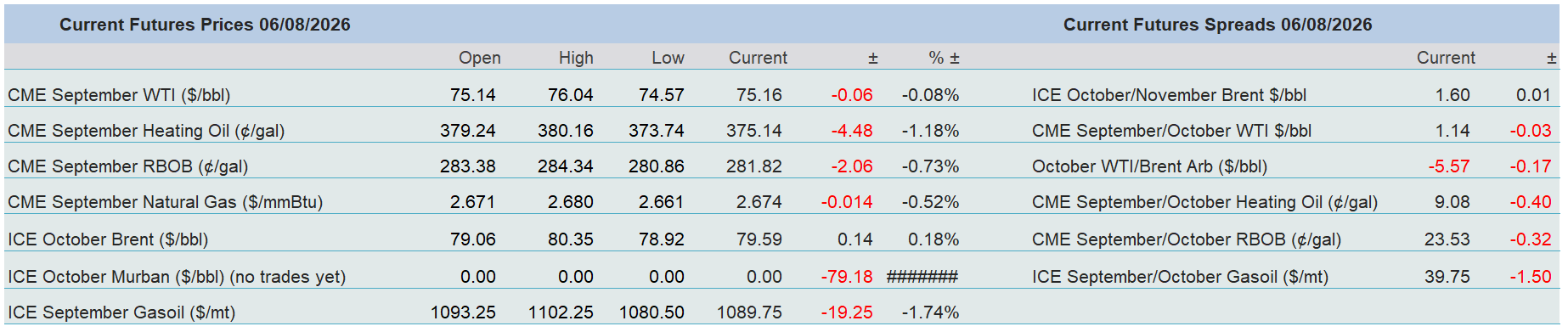
Overnight Pricing
06 Aug 2026
