Nothing is Certain
Another turbulent week came to a close with the IEA’s updated report on the global oil balance. As suspected, the divide between OPEC and the energy watchdog of the developed world remains insurmountable. We noted on Friday that OPEC anticipates a persistent supply deficit in the current quarter and throughout 2027. It expects global oil demand growth in 2027 to significantly outpace non-DoC supply growth. Conversely, the IEA forecasts consumption to expand by 1.98 mbpd next year, falling short of non-DoC supply growth and ultimately leading to swelling global and OECD oil inventories.
In fact, the IEA observes that the rebalancing process is already under way. It estimates that global oil supply exceeded demand last month for the first time since February. The impressive recovery in Persian Gulf oil production and exports, discussed below, resulted in a 1.7 mbpd stock build in October. Widely diverging views are also evident on the demand side. While the IEA has revised its forecast for global oil consumption in 2027 downwards by 1 mbpd between June and November, OPEC has upgraded its projection by 430,000 bpd. This leaves a substantial gap of 4 mbpd between the two forecasts – 104.28 mbpd versus 108.28 mbpd. There is no consensus on what the future holds.
It looks as though those involved in oil trading tend to agree with the IEA. Undeniably, their view, reflected in falling oil prices, has been reinforced by the Republican obliteration in the recent midterm elections. With Democrats controlling both chambers of Congress, the US President has lost leverage and influence over domestic and foreign policy, or so the thinking goes. This shift in sentiment, coupled with rising OPEC output, resulted in losses of more than $2/bbl in both major crude oil futures contracts last week and a dip in US retail diesel prices to below $6/gallon.
While recent developments have emboldened oil bears, they are fully aware that it is too early to pop the cork. Tensions in both Ukraine and the Middle East remain high. Over the weekend, several vessels were ablaze in the Strait of Hormuz after hitting mines. More worryingly, Yemeni government forces withdrew from the other pivotal regional chokepoint, the Bab el-Mandeb Strait, while Iran launched fresh attacks on a US military base in Bahrain. Ukraine has claimed to have struck an oil refinery in Russia’s Tatarstan. Although hopes of bringing the conflicts to an end have risen considerably over the past two weeks, the reality on the ground suggests that the downside remains limited for now. This week’s planned Trump-Xi-Putin summit on the sidelines of the APEC conference will be eagerly awaited. The Russian and Chinese positions on the geopolitical stage are clear. A debilitated and mercurial US President, on the other hand, is not necessarily a lame duck, but he might turn out to be even more unpredictable than usual.
Circumventing Trouble Spots
It has been well documented how the oil market has become comparatively immune to war-induced supply disruptions. Stock drawdowns, import constraints, demand destruction, and the extensive use of spare production capacity and alternative energy have all played their part in preventing oil from rallying to $200 following the outbreak of the Iranian crisis. The most important factor, however, has probably been the ability of Persian Gulf producers to navigate troubled waters effectively, both metaphorically and literally. Whether by utilising dormant alternative transit routes, opting for ship-to-ship transfers, or striking possibly clandestine deals with the Cerberus of the Strait of Hormuz, the initial supply shock was followed by an admirable recovery. The chart below illustrates this flexibility.
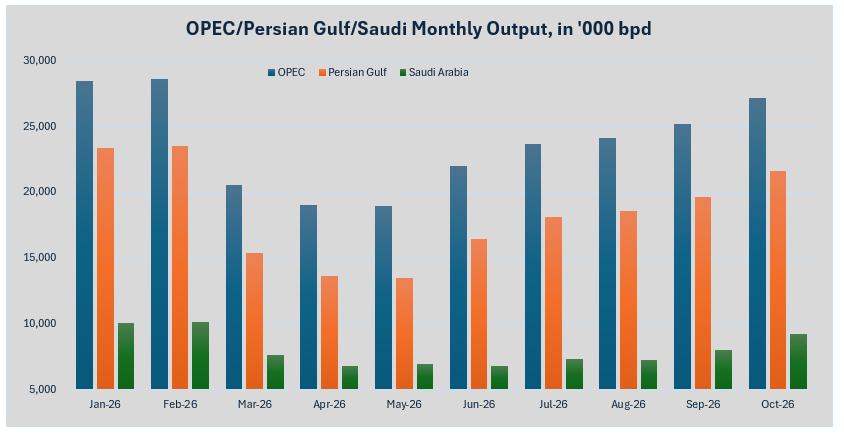
The latest Monthly Oil Market Report from OPEC shows that, according to estimates from independent sources, the core group, which still includes the UAE, produced 27.166 mbpd of oil in October, up by nearly 2 mbpd from the previous month and more than 8 mbpd above the trough recorded in April–May. The charge higher has been led by Saudi Arabia, with a monthly increase of more than 1 mbpd. Iraq has also been a notable beneficiary of this rebound, with output rising by almost 500,000 bpd from September. At 4.491 mbpd, production is now more than three times the 1.4 mbpd recorded in April.
The 8 mbpd recovery was concentrated exclusively in the Persian Gulf, where output increased from around 13.5 mbpd to 21.6 mbpd over the past five or six months. The UAE, taking full advantage of its decision to leave OPEC, ramped up production from below 2 mbpd in March to above 4 mbpd by October. Kuwait more than tripled its output between April and October, from 556,000 bpd to 1.998 mbpd. Understandably, Iran has been the odd one out. As a result of the US blockade, its production plummeted from 3.05 mbpd in March to 1.914 mbpd last month.
While ongoing tensions and the resulting attacks on oil installations, shipping lanes and ports in the region are a fait accompli with which producers and markets are forced to contend, the adaptability demonstrated by regional oil exporters since April or May should ensure that oil supplies and exports from the Middle East remain robust, unless all hell breaks loose. That scenario, however, does not appear realistic, at least for now.
Overnight Pricing

16 Nov 2026
