Nothing is Finished
The problems of the Strait of Hormuz are not cured. So says the Iranians when they launched attacks on commercial shipping for not adhering to requests to navigate in the shipping lanes nearer to the Iranian coast rather than that of Oman. And so says the US President. While attending the NATO summit in Ankara, Donald Trump was already in a combative mood, berating NATO for not doing enough and even touching upon the third rail of US/European relations by bringing up the sovereignty of Greenland once again. The retaliatory raid by US forces due to the earlier shipping attacks carried out by the IRGC had hardly been holstered when Trump, in his usual provocative, unfiltered style, declared the ceasefire with Iran and any negotiation around the memorandum of understanding to be over. Sadly, for the Donald, there is no FIFA official to call to overturn a red card, instead the US President is about to enter into his own war of attrition and frustration. The ingenious way, which we have touched upon in the past days, in how oil always finds a way, precludes massive marches in Crude prices beyond the highs seen this year, but these mini bouts of conflict will keep the dangers to price in the forefront of the oil fraternity’s mind while the passage of time reveals whether this increasingly drawn out ‘disturbance in the force’ for oil becomes the everyday and treated as the mundane like Ukraine and Gaza before it. It is a cynical world.

An unexpected revival of King Dollar
One can never pass any elongated period of time when assessing markets without often having to be drawn back to the wonderfully news-rich influence that is the mighty US Dollar. After a somewhat dramatic 2025, and the flux caused by the global imposition of tariffs doled by the Trump Administration, the greenback had a torrid year and fell from, in Dollar Index (DXY) terms, year-on-year in January 2026 to 99.00 from 109.00. The decline was something of a reflection of the chaotic state of the new type of politics introduced by a swashbuckling US President; prone to changing his mind within hours of a market-moving statement. His interference in central bank policy undermined confidence in the global currency marker and at the onset of the new year, inflation had been an ignored issue with many commentators, reflected in pricing tools, believing that there would be at least two interest rate cuts by the FOMC of 25-basis points for 2026.
There was also the ignominy of a US Government shutdown as politics played merry with the lives of tens of thousands of American employees, therefore if you cannot trust the system, you cannot trust the currency. The cavalcade of calls for alternative payments across the international system once again dropped rubber on the roads of media and a sort of doom spiral of the most significant currency there has ever been, found many predictors. It is difficult to know allies from foes these days, however, detractors of the US Dollar are against its global dominance and the ability that any occupier of the White House being able to weaponize economic sanctions and the global financial clearing system of Swift. There, being a groundswell of like-minded thinking when markets toyed with the notion of ‘sell America’ after the ‘carry trade’ between debt in Japanese Yen and debt in US Dollar narrowed, then saw conservative eyes fall upon the $35 trillion of US debt and it became easy to presume that the DXY might not see triple digits again for calendar 2026. The nonchalant way in which President Trump greeted questions on the weakness of his home currency also suggested that a devalued Dollar might be a welcomed thing in the current Washington circle of thinking. Markets rarely see a goldilocks signal, but these bearish waves found receptive shores and during February of this year, the DXY was cut down to a lowly 96.00, something not seen since the destitute year of 2022 during the pandemic.
How a bombing campaign can change all in a heartbeat. The questionably legal, but assuredly morally deficient attack by Israel and the United States on Iran, as February turned to March, has seen a completely unforeseen, as is the case in many parts of our intricate globe, complete reversal in the US Dollar’s fortunes. So many of recent market moves are better understood in retrospect, and it is interesting to observe in hindsight that the reaction to diminished trade because of tariffs caused the Dollar to swoon, but the closing the Strait of Hormuz and its debilitating effect on global trade caused a reverse reaction. Can happenstance be ruled out, of course not. The ensuing minesweeping of lazy longs in equities forced a panic into havens and at the time places to be financial safe had a paucity of availability. Although Gold had pulled back from being overbought in terms of its Relative Strength Index, it was still so in Slow Stochastic terms and its inclusion in portfolios was already likely well represented. Oil futures had already ‘gapped’ $10/barrel with the path higher unsure because the Hormuz development had not yet materialised, therefore the US Dollar suddenly found a bout of fancy.
Again, rare is it that one single reason diametrically changes a market’s path. As the news caught up with goings-on in the war and the follow-on, locked-in syndrome started to emerge from energy producers of the region, inflation, so widely filed under ‘acceptable’, suddenly became something to be fearful of and the tools which might be deployed to combat it, namely interest rates. While the pricing for rate hikes in the US have fallen in recent weeks, as seen in the CME FedWatch Tool, due to this mishmash of a ceasefire and the lower-than-expected US Non-Farm Payrolls, it belies the irritation felt within markets at the about-face prospect of interest rates as the war, and lengthy negotiations to end it, unfolded at the time. But here is the rub, there is now a bitter reality to those who, in some ways rightly, pegged the value of the US Dollar to be much lower before the outbreak of this war. The uncertainty of almost everything in the world and the return of the concept in interest rates of ‘higher for longer’ as almost mouthed by the fresh-faced, ought-to-be dovish, Chair of the US Federal Reserve will make it hard for Dollar bears to regain supporters. Momentum seems to have taken a fundamental change. According to Saxo Bank, at the end of June, speculators lifted the net dollar length for an eighth week to $39.8 billion, the highest in at least ten years.
There are no fancied traditional currency pairs that can challenge it. The Bank of Japan is wringing its hands in how to raise interest rates or again intervene to save a wallowing Yen. The European Central Bank is hamstrung by massive holes in economies and the financing of considerable debt, which is the same situation for the Bank of England, and both are likely keen to see their currencies devalue against the greenback. At present, the most important default currency on the planet is hip joined with the wild ride seen in oil prices and each time a rally comes from a spate of mutual missile exchanges from the US and Iran, thoughts of higher interest rates, risk reduction elsewhere and a dearth of resting places for investment flows means the US Dollar is nowhere near done and dusted in its relevance.
Overnight Pricing
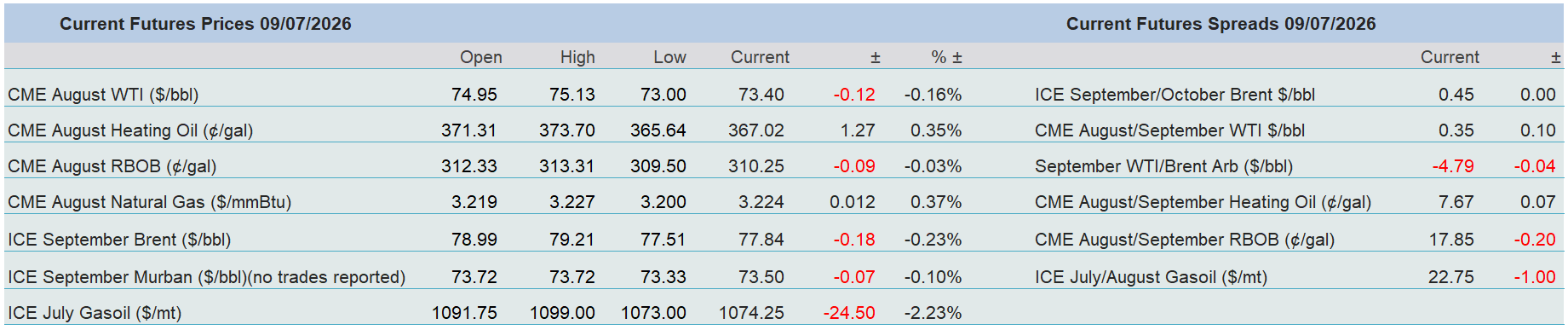
09 Jul 2026
