Nvidia, the Author of Global Wealth
Given the suspense afforded to markets on whether the US will go ahead and strike at Iran, and the collective fear of oil prices chasing on beyond $100/barrel as a consequence, ought to stifle any stock market exuberance. Additionally, the split for the outlook in policy outlined in the FOMC minutes from January leaves an uncertain road to any sort of US Central Bank easing should also make for uncomfortable reading for bourse bulls. But why worry about roaring energy inflation or interest rates when Nvidia and Meta announce a strategic alliance where the social media company will deploy millions of Nvidia chips and related equipment in its artificial intelligence data centres? The central role played by Nvidia in the last few years as the champion of technology and being the mainstay of global stock market rallies abides, still. The deal with Meta confirms Nvidia’s faith in A.I. and if the most valuable company in the world is putting money where its mouth is, then it would be almost churlish for investors who have thus far followed the meteoric company to great riches, to not remain loyal. This attitude has calmed the A.I. fear of overspend and employment threat, and while portfolios are diversifying in the current ‘rotation’ to other sectors and geographies, if the root of stock market confidence remains firmly planted it will propel bourses far and wide to greater achievement. It is no longer the remit of Wall Street to greet each close with an all-time high. Other bourses can be considered, but yesterday the Europe STOXX 600 registered levels never seen before, and so did the UK FTSE 100. These are hardly economies built on political and economic stability, but with the spate of bargain hunting coming from folk made rich in the A.I. boom, and the company which has ministered to that wealth setting good sail to obliging winds, the incredible stock market story continues.

Oil, oil everywhere, but not a bear in sight
The mismatch between geopolitical price premium and the potential for new oil to come flooding into the consideration of supply and demand continues unabated. Despite his hobnobbing with appeasing diplomatic rhetoric, the Iranian Foreign Minister, Abbas Araghchi, after much flimflam admitted on Tuesday, “both sides have positions that will take some time to bring closer together,” finished the day with no specific date set for the next round of talks between Tehran and Washington and unable to speak of any sort of negotiation roadmap. The American point of view joined in with a conciliatory tone, but Steve Witkoff, Trump’s special envoy pointed out how the Iranian delegation had asked for a fortnight to muster a detailed response to the positional differences, and with J. D. Vance commenting on Iran not meeting President Trump’s ‘red lines’, they hardly point to the cancelling of our market’s conflict expectation in the Middle East.
Staying with a sceptical tone, and indeed toward Witkoff, who pirouetted keenly from realist to spin doctor; the special envoy was the source of the narrative claiming talks between Ukraine and Russia had "brought about meaningful progress" to end the war. According to the BBC, one of the Ukrainian negotiators had indeed spoken on "practical issues and the mechanics of possible solutions", but that is about as good as it gets. The silence from Russian sources has been deafening only to be interrupted by a festoon of missiles and drones that it sent to rain down on Ukraine. The Ukrainian President, Volodymyr Zelenskyy, continues to ask in rhetorical perplexion on what Russia wants. Sadly, we believe the answer will see no deviation from a maximalist one and Moscow will cede not a thing. Each instance of these frustrating trilateral negotiations will grind in predictable fashion and see Russia naming Ukraine as being difficult and intransigent and the US blaming Kyiv for any lack of progress. The Ukrainian President in an interview with Axios, said, “it was not fair that Trump kept calling on Ukraine to broker a deal […], I hope it is just his tactics and not the decision." Zelenskyy is operating in ever-decreasing circles and if his only hope is from Europe he might just have to wait about five or ten years for them to physical turn up rather than their money and bloviation. At present there is little to suggest on Russian oil being upgraded to legal tender because of a peace deal and able to freely charter the world’s waterways. Instead, it will stay in the shadows and slop into the maw of the one big, beautiful buyer, China, leaving no trace on the oil balance other than be continually threatened by tariff and sanction.
The upscaling of oil prices due to conflict, or the fear of it and lack of solution must be belted with hardiness because the would-be downscaling influences continue to offer instances of increased oil supply. Chevron describes the Tengiz Oil Field in Western Kazakhstan as being the world’s deepest producing supergiant oilfield. The influence of Kazak oil and the production which flows through the CPC infrastructure was recently laid bare by how interruptions to its flow caused strengthening in lighter crude grades, as seen in the backwardation climb in Brent futures spreads and increased aggressive interest in CFDs and dated Brent contracts. These issues are now deemed as solved, so much so that Tengiz, which is responsible for 40 percent of Kazak production, has recovered from rates close to zero last month to full production by the end of February, some 950kbpd. It is an inordinate amount of crude returning from Central Asia, but it has gone unrewarded as an influence in the face of the ‘what might be’ possibilities of Iran and Ukraine.
The ambition of the Americas in oil production is well exampled by Guyana. It has an amazing short history in oil production, only starting commercial operations in 2019. Since then, it has rejected a formal invitation to join OPEC in 2023 because it did not wish to be collared by the quota expectations of the cartel. Being in charge of its own destiny has led it to producing up to 900kbpd and has been waiting to increase even on such a rapid rise in its standing within oil producing nations. One of the obstructions to expansion is the prickly relationship it had with neighbouring Venezuela. Since the author of tension, Nicola Maduro, now finds himself dwelling in a forsaken US prison, reticent investors, held back by fears of South American border conflict and a force majeure on disputed ownership of drilling rights, are starting to like the look of Guyana and its energy potential. Reuters report on an Exxon-led consortium expressing a greater interest in prospecting in the Stabroek Block producing region taking average production from 750kbpd to 1mbpd by next year and on to 1.7mbpd by 2030. Of course, this is very much a future consideration but one that alongside so many tales of oversupply ought to kick some of the stilts away from oil prices. However, the seriousness of Ukraine and the probable cataclysmic after-effects on oil prices of war in Iran, the market is judging that the increased production as outlined above, even if it were available tomorrow, cannot replace 20mbpd or so threatened by open US and Iranian war.
Overnight Pricing
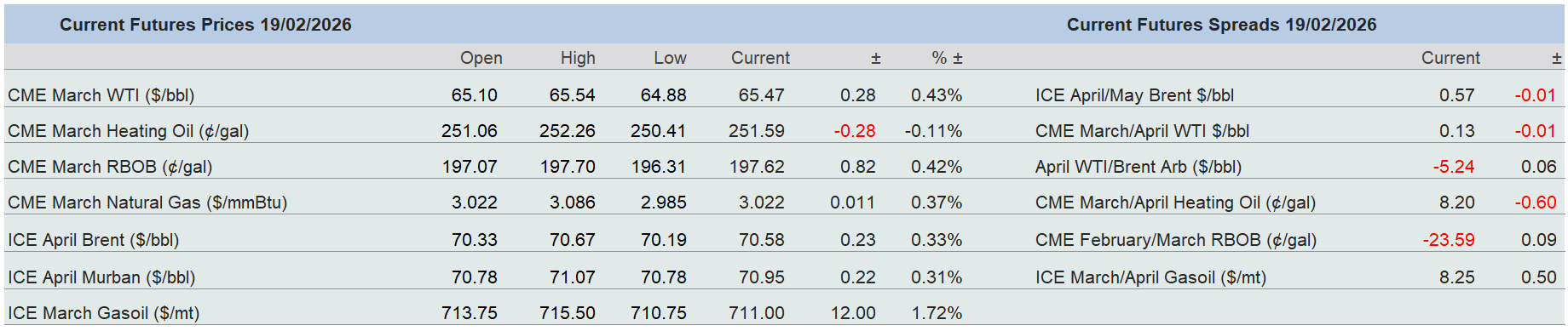
19 Feb 2026
