Oil Retraces, Fed Acknowledges Inflation Concerns
There were a variety of reasons yesterday to take a step back and decide to bank some profit. The retreat actually began on Tuesday evening, when the API reported builds in US oil stocks across the board. Although the EIA was somewhat more lenient as far as swelling inventories were concerned, the rise in commercial and product stockpiles nonetheless put a lid on every attempt to regain upside traction. The builds in gasoline and distillate stocks are probably the result of the 1.2 mbpd dip in net product exports. This, however, might be taken as a sign that US product supply to Europe and the Far East is diminishing, exacerbating an already tight situation. Curiously, notwithstanding the drop in outright prices, crack spreads remained admirably resilient, a possible indicator that what we saw yesterday and what we are experiencing this morning is, in fact, a correction and nothing more.
Contributing to the downside pressure was the resumption of Libyan oil production after three fields were shut down due to protests. Although Saudi oil exports from Yanbu remain suspended as repairs to the damaged East-West pipeline are ongoing, the Kingdom is able to offer some of its crude oil to Asian refiners via the Omani port of Sohar using ship-to-ship transfers, alleviating concerns about an unbearable shortage from the OPEC heavyweight. The planned meeting between the US President and Persian Gulf leaders at next week’s UN General Assembly might be another factor behind the follow-through selling this morning.
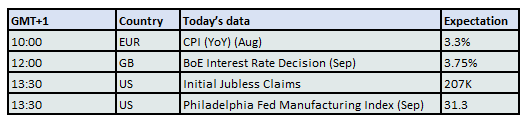
In a clear sign of growing anxiety about rising consumer prices, the US central bank, as expected, decided to make borrowing 0.25% more expensive, the first increase in three years, in its attempt to tame inflation. The move was greeted with an audible sigh of relief and murmurs of approval. Although bond yields have retreated a tad following the Fed's decision, their stubbornly high levels imply that bringing inflation down to the desired 2% level will be a marathon, not a middle-distance race, let alone a sprint. Further rate hikes will cause economic headwinds, which could hamper oil demand growth prospects; however, closing the gap between global oil supply and consumption does not appear imminent in the absence of a definite, or even ostensible, armistice in the Persian Gulf.
Will There Be a European Gas Crisis This Winter?
One of the reverberations of the simultaneous crises in Ukraine and the Middle East, both comparatively closer to the European continent than other major demand centres, is the reliability and continuity of natural gas supplies. The issue always resurfaces as winter in the Northern Hemisphere approaches. Today, therefore, is an opportune time to look at the current situation on the Old Continent and consider whether European households and industrial users should be concerned just a few months before winter starts knocking on their doors.
To begin with, due to its geographical proximity, Russia has traditionally been Europe’s largest gas supplier. Before the war in Ukraine, it supplied around 40%-50% of Europe’s needs. Since 2022, volumes have gradually declined, and by 2025/26, EU imports from Russia will have fallen to around 12%. Attacks on pipelines, Russia’s use of natural gas as a weapon, and sanctions have collectively been responsible for this plunge. The REPowerEU Strategy, which restricts short-term contracts and imposes a full prohibition on Russian pipeline gas and liquefied natural gas (LNG) imports by the end of next year, has been turned into binding law – much to the chagrin of member states with greater dependence on Russian gas.
A glance further south takes us to Qatar. The small Middle Eastern nation is an unavoidable and significant player in the global LNG market. It accounts for around 20% of global LNG supply, chiefly thanks to its state-of-the-art production facilities and liquefaction plants at Ras Laffan, an 80-km drive from the capital, Doha. Although up until the Iranian conflict, Qatar, which shares its natural gas fields with Iran, had a solid working relationship with the Islamic Republic, it was forced to declare force majeure on its gas shipments in March, when Iranian missile attacks caused severe damage to the Ras Laffan facility. The unaffected parts are expected to become operational again around one month after the Strait of Hormuz reopens, but major repairs will probably take more than a year, although the latest reports suggest that Qatar is preparing six LNG carriers to restart exports. The point is that Europe has lost another valuable supplier, which accounted for 10%-20% of the EU’s LNG imports.
The European winter approaches against this backdrop. On the Intercontinental Exchange, the front-month UK NBP Natural Gas Futures contract rallied 64% in over a month, before easing a little bit in the last few days. The other benchmark natural gas futures contract, Dutch TTF (Title Transfer Facility), advanced 56%, from €52.55/MWh on August 3 to €82.56/MWh on September 14. LNG prices in north-west Europe, as reported by Argus, rallied from under $14/MMBtu at the end of June to above $25/MMBtu by September.
In the energy market, the relationship between inventory levels and prices is inverse; therefore, it will come as no surprise that European natural gas stocks are low. They are, in fact, less than 70% full, equivalent to around 768 TWh. This is the lowest seasonal level in 15 years. In Germany, stocks are 55% of their capacity, although France and Italy fare somewhat better, at 75% and 84%, respectively.
During the winter period, storage is usually responsible for anywhere between 20% and 33% of the continent’s gas consumption, according to the Oxford Institute for Energy Studies. As current inventories are below historical seasonal averages, the race against time to bring stocks up to a comfortable level has begun. Given the unreliability of Russian supplies and the Qatari force majeure, it is not a far-fetched thought to expect fierce competition with Asia for scarcely available LNG cargoes. In the event of an uncharacteristically cold winter, all hell might break loose, in the form of elevated volatility and potentially even higher prices. While households will not be able to switch from natural gas to heating oil at the drop of a hat, some industrial users might opt for fuel switching, providing an additional layer of support to already elevated distillate prices.
Currently low European natural gas stockpiles foretell a gloomy winter outlook, but there is a silver lining. It is ‘The Christ Child’, El Niño, which might bring heavy rains and chaos, but possibly milder temperatures.
Overnight Pricing

17 Sep 2026
