Omnipresent Unease and Anxiety
When set against Russia’s invasion of Ukraine in 2022 or Hamas’s terrorist assault on Israeli civilians in 2023—followed by the devastation of Gaza, a US strike on Iran’s nuclear capability, the surreal “Liberation Day” announcement last April, and the abduction of the leader of an OPEC member—this latest eventful five-day period looks something of a damp squib. Yet trading conditions were vicious, with asset prices whipped around chaotically, as the constant shifts in the investment climate, unlike the meteorological one, show no sign of being a hoax.
Both the Bank of England and the European Central Bank left rates unchanged, while the US labour market softened modestly, even as unemployment remains around an acceptable level. The US–India trade deal is, if anything, a positive development. A surge in capex, fuelling the race for AI dominance, briefly backfired as investors questioned the returns on investments in technology firms that can resemble bottomless money pits. By Friday, however, confidence returned, and equities rebounded sharply. The Nasdaq Composite still fell 2% on the week, while the S&P 500 finished flat.
Bitcoin mounted a similarly strong recovery after Thursday’s rout, as did precious metals, which abandoned their usual inverse relationship with equities and moved largely in tandem. Silver jumped more than 9% on Friday after a 15% slaughter the day before. Correlations broke down, and safe havens lost their appeal.
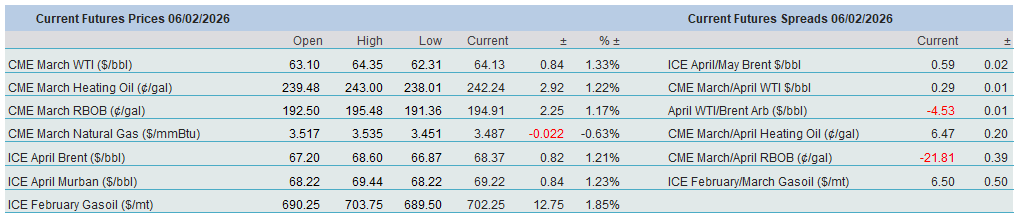
Perhaps a post-mortem at a later stage will shed light on the motivations of oil-market players, but pinning down the exact driving forces behind last week’s frenetic performance is equally onerous. Physical oil supply is clearly ample, as reflected in Aramco’s cut to the March OSP for Arab Light to Asia, even as India tentatively steps back from Russian barrels. While renewed US–Iran tensions and stalled nuclear talks may unsettle investors, their actual impact pales in comparison with past geopolitical developments, at least for now. It is not last week’s volatility that is puzzling, but the extent of it. What is conspicuous is that the market is sitting on the fence, nervous and reacting to headlines as they emerge. What is less clear is whether last week’s turbulence was merely a storm in a teacup or the harbinger of a bursting AI bubble, combined with heightened animosity around the Persian Gulf, resulting in a currently unforeseen loss of barrels.
Missing in Action
When global oil supply and demand deviate, swings in oil inventories re-establish equilibrium. If supply exceeds consumption by, say, 1 mbpd, this surplus finds its way into storage, commercial or strategic, on land or at sea. Conversely, should demand for oil outweigh available supply, the deficit is compensated for by drawing down stockpiles. Again, balance is inexorably restored. In other words, oil demand, together with changes in oil stocks, always equals oil supply.
Since the EIA publishes estimates for future OPEC+ production, its latest Short-Term Energy Outlook can serve as an example (an update is due out tomorrow). The sum of projected 2026 global consumption of 104.82 mbpd and a swelling of 2.83 mbpd in oil stocks equals the predicted supply of 107.65 mbpd. It is not exactly a gnarly mathematical challenge.
If only life were this simple. Data collection is becoming progressively more cumbersome and lacks transparency, now perhaps more than ever. As a result, revisions are required from time to time. If supply has been under- or overestimated, then, once corrected, demand and/or stock changes must be adjusted accordingly, and vice versa. When the main components of the above equation do not align with predicted inventories, the term “missing barrels” is used. This term is being cited with increasing frequency these days, with significant consequences for forecasting the future oil balance.
There are several reasons for the emergence of missing barrels, especially since 2022. Reliably tracking oil supply has become an unwieldy task because of the exponentially growing shadow fleet, which carries sanctioned oil from Venezuela, Iran, or Russia across the world, but mainly to the Far East. China’s clandestine stockpiling programme is another of the “known unknowns” when attempting to reconcile the supply–demand gap with global oil inventories.
Finally, additional demand is eventually unearthed from the past. Although data points are amended and adjusted monthly, reflecting swings in the global economy, geopolitics, or even Acts of God, the IEA’s 350,000 bpd upward revision of 2024 global oil demand between April and May 2025, retrospectively removing barrels from stocks, sent shockwaves through the market. What had been deemed a more than 200,000 bpd global glut in April turned into a more than 100,000 bpd draw a month later, with the inevitable knock-on effect on 2025 demand growth.
The recovery of these missing barrels then provided fertile ground for mutual accusations between OPEC and the IEA and contributed to the wide chasm in estimates of oil demand and stock changes. Last month’s findings put the 2026 demand gap at 1.6 mbpd, and the difference in annual stock builds at an almost irreconcilable 2.84 mbpd. So, who is right and who is wrong? This is more of a rhetorical question, one whose answer will probably only emerge well in the future.
It is nonetheless intriguing to observe that after identifying 350,000 missing barrels for 2024 last year, the IEA concluded in October that, for August 2025 alone, 1.47 mbpd of oil was unaccounted for. At the same time, a surplus of 2.04 mbpd was reported for the month. This offers low-hanging fruit for the IEA antagonists who argue that if the unaccounted volume were actually accounted for, the stock build would have stood at a mere 570,000 bpd.
Forecasting future, and even past, oil balances appears to be a messy business. There are wide variations in estimates on both the supply and demand sides of the equation, and the only consensus is that 2026 will see higher global oil inventories than 2025. After tomorrow’s EIA update, the issue will be revisited in the coming days when the other two amended analyses are released.
Overnight Pricing
09 Feb 2026
