A Pause For Thought
The price of Brent has paused around the $90/barrel area as the oil market once again comes up against another instance of mixed messaging from the US/Iran war. The US Central Command reported on continued attacks into Iran while the United Kingdom Maritime Organisation informed on another tanker being hit in the region. With Houthis in Yemen announcing a maritime embargo on Saudi Arabia, it appears that the current outbreak of hostilities is showing signs of spreading its theatre. These are potentially incredibly bullish developments but at present crude prices are reserving the right to further climb the ladder toward $100/barrel.
It looks as if the peacemakers of Pakistan, along with Egypt and Qatar are pushing for mediation as some suggest time is running out for the US President. Axios, seemingly privy to senior American officials, and as seen in an ‘X’ post, suggest, “President Trump is approaching a crucial crossroads in the war with Iran, with senior American and Israeli officials claiming that he has only two realistic options: promoting a new 10-day ceasefire, designed to reopen the Strait of Hormuz. Or: launching a new, large-scale military campaign.”
Any sort of ceasefire, no matter it being built on unreliable foundations, will see a great bite taken out the recent gains in oil prices. Which is why the enthusiasm from oil bulls finds itself curbed for the time being as we await, as we always have since January 2025, on which side of the bed Mr Trump emerges in the next few trading sessions.

It's about refinery capacity, not crude supply
You cannot plagiarise molecules. They are not something that A.I. can mimic and pass off as its own manufacture or create holograms of refiners processing at a maximum hum. At present there is a shortfall in refined products, and while the promise of a Presidential pardon on the Hormuz war, with the possibility of another memorandum of understanding emerging being never far away, or a claim that the war being won (again), and over, there will always remain a reticence in taking crude prices beyond triple digits. It was only a month ago that VLCCs and any manner of crude containers were straining at the leash to barrel through Hormuz and spill their contents into the globe’s oil balance. Story after story revealed how ingenious producers had been, and after 100 years of the world being an oil economy, practitioners in our midst have become incredibly adept at keeping crude oil flowing. Given that whoever is firing missiles in the Middle East are not targeting game-changing oil hubs or pipelines, as soon as the current cork is popped between the Persian Gulf and the Gulf of Oman, an Arabian gusher will once again pour forth.
However, there is no such ease of supply from refiners. In the main, refineries operate on a last chance mantra, with not that many having voluminous storage. When feedstocks become too expensive, refineries simply stop buying and this also becomes a pronounced problem for fuel production at times of refinery turnarounds be they from winter or summer. Imagine then a severe shortage of distillate and its derivatives during the summer without the usual pressures of demand from cold weather when it really should be the close season for fuels such as Heating Oil and Diesel and what that might mean when the cold seasons come to call.
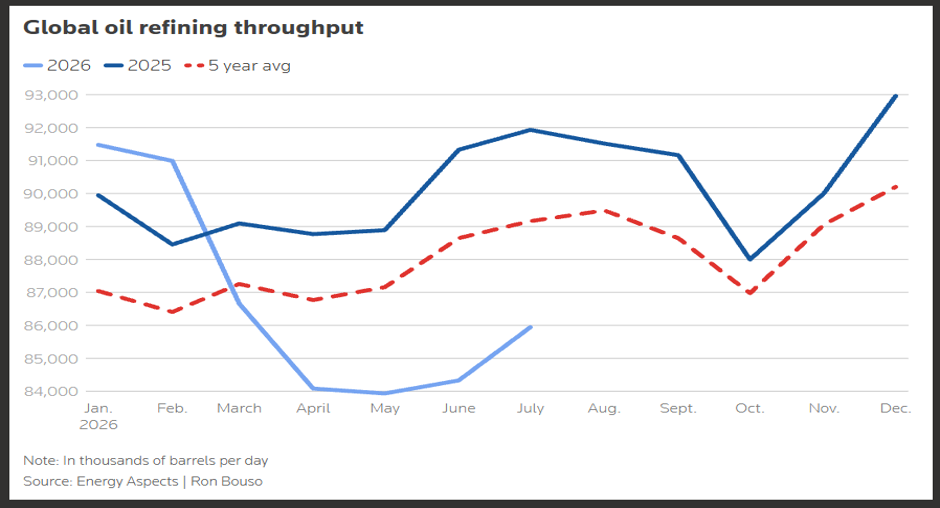
There are full closures or at least reduced capabilities from so very many of the refineries of the Middle Eastern countries around the Persian Gulf because of the shut-in of the Strait of Hormuz. Crude vessels might have been able to push on through during the brief opening offered by the MoU, but no so much boats laden with products. The struggles within Russia are well documented as per refining, but just because a story is well known, it does not make it any less relevant. The comeuppance wreaked upon the country’s major revenue resource by Ukraine drones is a live situation, and the export ban that straddles both Gasoline and Diesel are, on a daily basis, denuding the world of fuel flows. Staying with the workhorse fuel, and as seen on Reuters, Diesel and Gasoil loadings from Russia were just 234kbpd from July 1st to 10th, according to Kpler, down from 400kbpd in June and the 2025 average around 817kbpd. Some relief will eventually come from China as it begins to ramp up refinery runs again as its own product ban is lifted, but from processing to delivery the lead time might be months. The IEA recently estimated global refinery runs to be 78mbpd in the second quarter of this year, a 5mbpd delinquency from the same period of 2025.
The United States oil sector, such a beneficiary during this latest war, has enjoyed the role of swing exporter into a grateful world. However, its time in supplying the middle part of the barrel products is coming under pressure from domestic demand. Inventories are steadily falling and while there was a build shown in the EIA Inventory Report last week of 4.56mb, Distillate stocks are 11 percent below the 5-year average. Refinery margin, represented in futures by the 3-2-1 crack, is at an all-time high, therefore US refiners need not have to push out their finished fuels to foreign customers, tightening the global product situation further.
From running the combine harvesters bringing the crops in the Northern Hemisphere, to the stress created on the electrical system by the needs of cooling mechanisms across Europe, North America and the Middle East alike; Heating Oil, Diesel, Gasoil and all their kin are set to continue in scarcity. Oil demand is always about products; and allowing a brief insight into one of the things we here look for when assessing the state of the oil puzzle is to first look at what Gasoil or Heating Oil are doing.
Overnight Pricing
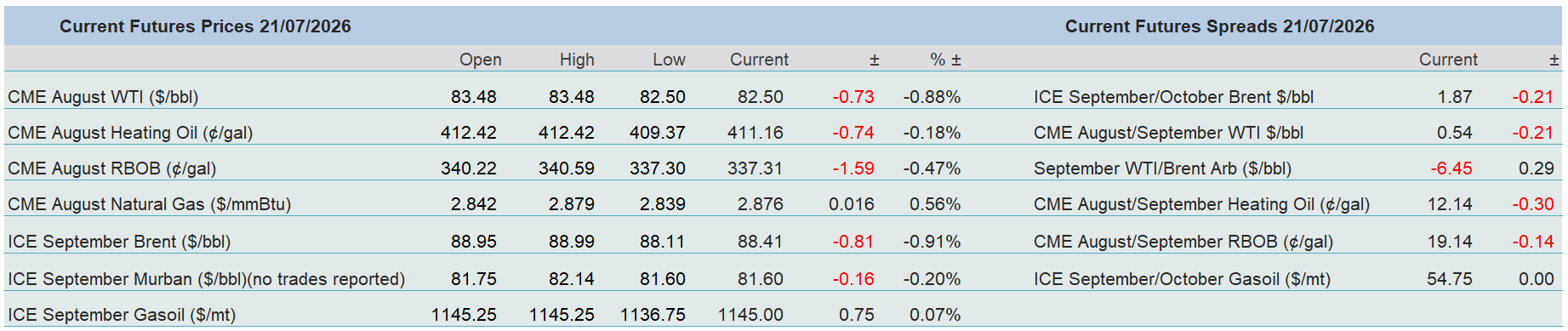
21 Jul 2026
