In Perpetual Flux
A successful politician is also a cunning linguist, and the words in his arsenal can prove more devastating than guns, drones, or sea mines.
On Friday afternoon, Iran's foreign minister said in a social media post that passage for all commercial vessels through the Strait of Hormuz is completely open for the remaining period of the ceasefire, in line with the ceasefire in Lebanon. The passage of vessels through the strait will follow the coordinated route already announced by the Ports and Maritime Organisation of Iran, Abbas Araqchi added in a post on X. Stocks and bonds rallied, and oil was pushed over the precipice. The pressure intensified when the US President declared that he expected the Iran deal “soon.”
Equities continued their upward journey, and the S&P 500 index registered a daily gain of 1.2%, while clocking a weekly return of 4.5%. The 10-year bond yield fell by 60 basis points on the day and 73 basis points over the week. The ostensible reopening of this pivotal passageway for the remainder of the temporary ceasefire sent the price of WTI $10.84 lower on the day and $12.72 on the week. Losses were slightly smaller for Brent: $8.58 and $6.99, respectively. Heating oil shed $18.42 per barrel equivalent on Friday and $15.30 over the past five days.
As usual, particularly in relation to the ongoing Iranian conflict, the devil is in the details. The Iranian foreign minister, in his X post quoted above, mentioned the passage of vessels through the strait on the coordinated route. As it turns out, the “coordinated route” referred to by the foreign minister is not a new international shipping lane, but a specific, pre-designated transit corridor set by Iran’s own maritime authorities. Effectively, it is a controlled shipping lane, possibly close to the Iranian coastline and monitored by the Iranian military, implying practical Iranian operational control over the transit. The word “unconditional” in the original tweet appears misleading, and when combined with a social media post by an equally mendacious US President, namely, that the US Navy blockade remains in full force until a deal with Tehran is struck, one was left after Friday’s settlement scratching one’s head, wondering what exactly had changed.
Developments over the weekend suggested that not much had. The US insistence on maintaining the blockade on Iranian ports led the Persian Gulf country to state on record that the Strait of Hormuz would not fully reopen and would remain under Tehran’s control. A war of words has broken out between these long-time adversaries, and attacks on ships in the Gulf have resumed. Iran’s military leaders accused the US of having a “history of repeatedly failing to meet commitments” and maintaining “its maritime piracy under the so-called blockade.” The swift response from the US warned Iran not to blackmail the world’s mightiest military power, but in the same breath reassured anyone who listened (effectively, at least half the world) that ceasefire talks were progressing well, while claiming that Iran had made several concessions on its nuclear programme—causing an uproar within Iran’s hardline conservative leadership.
As mutual accusations of violating the terms of the temporary ceasefire, which expires tomorrow, continued to fly around, reports emerged of shots being fired at vessels in the Strait. According to the Financial Times, a container ship belonging to CMA CGM was hit. At the same time, a crude tanker owned by an Indian company was forced to turn around shortly after receiving permission to sail through the Strait.
Almost simultaneously, President Trump announced on his social media platform that his negotiating team would return to Islamabad, Pakistan, to resume talks, and urged his Iranian counterpart to accept whatever offer was on the table; otherwise, and here comes the mandatory uppercase, “NO MORE MR NICE GUY.” He added that in the event of a failure to conclude negotiations imminently, “the United States is going to knock out every single power plant and every single bridge in Iran.” Iran has not confirmed its participation in the new talks.
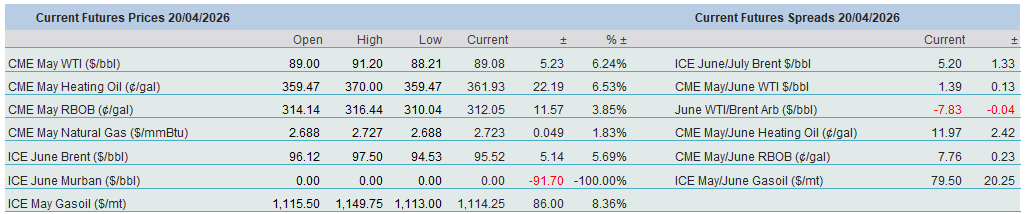
Apologies for the numerous quotations, but they are perhaps the most expressive way to describe a situation that is no closer to a mutually acceptable conclusion than it was two, three, or four weeks ago. Meanwhile, the ceasefire ends tomorrow, and hardly any ships have passed through the Strait in the interim. The volume of oil stranded behind the Strait is now estimated to exceed 600 million barrels and is growing by the day. Tension rose further overnight. The US has intercepted and seized an Iranian-flagged cargo ship, which, the US President claims, attempted to breach the blockade. Although oil prices fell sharply on Friday, they are understandably and unsurprisingly rallying again this morning. This will do no favours for monetary policymakers, investors, or the average Joe, all of whom are already anxious about inflationary pressures and persistently elevated retail energy prices.
It is difficult to interpret the weekend’s events as anything other than a prelude to further turbulence and continued rhetorical posturing. The Israelis and the Iranians do not seem to have the intention to end the war for now, and the US always ramps up belligerent rhetoric and military actions when equities rally and oil falls. The market appears to have learned to navigate this unprecedented geopolitical environment without undue panic, yet a renewed price surge significantly above $100 cannot, and should not, be ruled out. Unless, of course, a peace deal is reached, which, as last weekend’s events suggest, is anything but a foregone conclusion.
Overnight Pricing
20 Apr 2026
