Results, Interest Rates and Oil Prices
The reverse correlation between oil prices and stocks/bonds was given yet another kicker overnight with the posting of Nvidia results. The CEO of the tech darling, Jensen Huang, was cock-a-hoop claiming the AI industry had reached a “golden age”, as the chipmaker posted revenue of $96.2 billion for the second quarter, far outstripping the $92 billion Wall Street expectation. The successful result has taken much of the anxiety that could very well have emerged from the earlier reading of the US PCE inflation. US stock market bulls will argue on how the strong durable goods and decent GDP growth show an economy in good shape, but the PCE, the usually favoured measure of inflation of the US Federal Reserve, accelerated again being up monthly, quarterly and importantly year-on-year at 3.7 percent, well above the FED target of 2 percent.
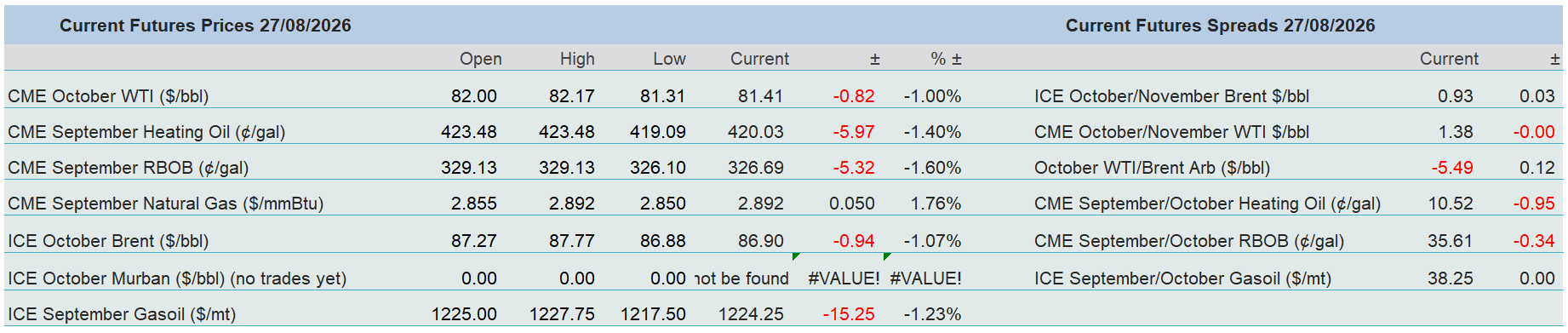
As oil prices continue to fall on various overtures of a peace deal in the Iranian war from Qatar and Pakistan and the heavily advertised possible agreement between Iran and Oman on the opening of Hormuz, inflation fears are dulled. One wonders if the words of the FED Chair, Kevin Warsh, at the Jackson Hole Symposium on Friday will allow the Nvidia inspired optimism, and the current funk in oil prices, to paper over the very real threat of higher interest rates.
Precedent is set this week from central banks. On Monday the Reserve Bank of Australia tacked on 25-basis points to its main lending rate, which was repeated today by the Bank of Korea and according to commentators will likely be aped by the European Central Bank and the Bank of Japan. When the next failure in this latest pastiche of peace occurs around the oil flows of the Middle East, the seesaw of oil prices and bonds will flip the other way.

Confidence, what confidence?
It really is difficult to square away the proposed stricter sanction regime the US is set to undertake against Iran and the aggressive retreat in oil prices. The press release seen on the US Department of the Treasury website grandiosely announces, “the U.S. Department of the Treasury has begun Operation Economic Outcast: an unprecedented, whole-of-government, economic campaign against the Islamic Republic of Iran and its enablers.” ‘Enablers’ is hardly prosaic in being aimed at a battalion of Iran aiders; Tehran’s allies are hardly queuing outside its diplomatic door, accordingly, there can only be one realistic target of gripe, and that is China. Yes, there are owners of ‘dark fleet’ ships and financial facilitators in areas such as Dubai, but they only play middle-man services to Iran’s truest clients, the refineries of Shandong, Zhejiang and Guangdong.
It is worth looking at the amount of oil the independent refineries, or derogatorily named ‘teapots’, are taking from Iran. For it is the privately owned facilities which are in the crosshairs of the US Treasury Department. State owned processors are a little more circumspect, they have for many years shunned (or at least publicly declared of doing so) Iranian feedstock for fear of being excluded from the US Dollar financial system. Kpler ship-tracking data, as seen in ‘the Guardian’, showed Iranian crude exports to China tallying at 1.47mbd in March. Since the failing of the memorandum of understanding, and the reimposition of the US blockade, barrels shipped fell to 823k/d in July and are now moving at only 534kbpd. From the point of view of a world producing say, 105mbpd and exports being circa 75 percent of that, the Iranian contribution to the global oil puzzle, and its ongoing demise, is really not much of a blot on the landscape. This is a compelling reason to ignore what Iran might or might not be sending to China, and a possible reason why oil price momentum has taken a negative bent. However, stricken exports from the Islamic State hold much more poignancy when lumped in with the Hormuz-stymied shipments from Iraq, Kuwait, Saudi Arabia, Bahrain, Qatar and the United Arab Emirates. Whatever perspective is taken up over the influence of reduction in oil supply from Iran, bulls or bears cannot dismiss this constant occlusion.
Stepping back from the physical aspect of barrels being moved and concentrating on the geopolitical dynamics, there are a few reasons, be they all subjective, on why after the aggressive speech by Scott Bessent, oil prices have taken a southerly trajectory. Firstly, the new sanctions, and the penalties held within, are being delayed. The US Treasury Secretary stated there would be a "cure period" allowing countries to shift away from Iranian trade before facing retaliation. This does seem to show a lack of resolve and the Iran hawks in the US legislature once again smell a delaying tactic. Indeed, for any of the sanctions to take further sizeable bites into the economy of Iran, applied immediately or delayed, it will take time. Given that the United States has distanced itself from a much-mooted all-out military campaign, one might be of a mind to feel that while not suing for peace, Uncle Sam is at least suing for dialogue which as we have witnessed before is always treated very bearishly by fast money.
Secondly, the market cannot get behind any notion that Washington will go head-to-head with Beijing over the latter’s oil relationship with Tehran. China’s Foreign Ministry has already dismissed the latest US moves as "illegal unilateral sanctions" and would take all necessary measures to safeguard China’s rights. Again, the world has been here before. Back in October 2025, when the US threatened China with 100 percent tariffs, a series of negotiated truces broke out as China dug its heels into its position of controlling 90 percent of global rare earth material processing. Critical minerals are an Achilles heel for the US and that has not changed in a year. In a time of alarm bell warnings of higher inflation, a broad scope trade war with China can only be an accelerative for US domestic price rises.
Angling for market reasoning at this time is like fishing under an electric pylon, one wrong cast risks being zapped. Oil prices are scathing of the US’s new sanction regime; scathing of Uncle Sam’s stomach to go head-to-head with China over trade and are preparing themselves for price trench warfare. Debatable, but that is all our fraternity is left with. What cannot be argued against is a rundown, once again, in confidence and with it another spate of migration into other trading mediums which offer far less insecurity.
Overnight Pricing
27 Aug 2026
