So Much for Significant Progress
Oil prices, like those of any other asset, are influenced by a blend of perception (hope, belief, and expectations) and hard facts. A clear direction can be identified with relative confidence when the two converge, which is currently not the case in the Middle East. Tuesday's optimism about an imminent agreement between the US and Iran, as well as between Oman and Iran, that could lead to the unconditional—or at least partial—reopening of the Strait of Hormuz is fading fast. Instead, reality has set in, in the form of a Houthi claim of an attack on a Saudi tanker in the Red Sea and reports that an Iranian parliamentary committee is reviewing a draft bill that would bar US and Israeli ships from transiting the waterway. Meanwhile, traffic through the Strait has fallen week on week, and crude oil and condensate exports remain about 40% below their pre-war level, Reuters observes.
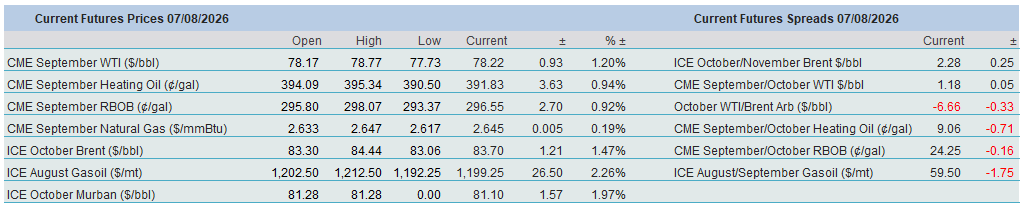
Against this backdrop, add the relentless Ukrainian strikes on Russian oil installations and the heatwave and drought in Europe, which are disrupting refinery operations, and one could conclude that the recent retreat in outright prices and crack spreads was merely a temporary phenomenon. Right on cue, yesterday's jump in refined product prices outpaced that of crude oil, and the move higher continues this morning. Unless credible agreements lay the foundation for an uninterrupted flow of oil out of the region, perceptions will continue to tilt at the windmills of hard facts, as global and regional oil inventories gradually but inexorably decline. Let us be blunt: the impish narrative and crude reality are not on speaking terms.

When Currency Intervention is Needed
Let us think about the eurozone and the euro for a moment. There are both benefits and drawbacks to joining the common currency club and adopting the euro. There is no denying that when several nations use the same currency, exchange-rate risk is eliminated, transaction costs are significantly reduced, economies are better protected from speculative attacks, and investment tends to increase. The trade-off is the loss of monetary sovereignty, together with the exchange-rate flexibility that national currencies usually provide. A single monetary policy, conducted by the European Central Bank, also provides ammunition for critics of the common currency.
Japan, however, does not face the challenges associated with a monetary union. Instead, it has had to contend with a rather different problem, namely a persistently weak currency. The Japanese yen, one of the six components of the US Dollar Index with a weight of 13.6%, has been losing considerable value against the greenback over the short, medium and long term. It reached its lowest level since 1986 last month, when it fell to ¥163.98 per dollar. This represented a decline of 15% since the beginning of 2025, 23% since the beginning of 2023, and 38% since March 2020.
The reasons for this staggering underperformance are probably threefold. First, the wide interest-rate gap with the United States, as the Land of the Rising Sun struggled with deflation for three decades, remained substantial even after the Bank of Japan recently raised the cost of borrowing. Second, the resulting carry trade, whereby investors borrow in yen and invest in US dollars or other higher-yielding currencies, has also played a significant role. Finally, as Japan is heavily dependent on imported energy and food, demand for the US dollar has been robust.
A weak currency, while generally supporting exports through higher revenues, also makes imports more expensive by raising costs. Such a situation is tolerable only up to a point. Intervention becomes necessary when it turns politically, socially and economically unsustainable. For Japan, that point was reached last week, when the authorities once again decided to act.
Foreign exchange interventions, which should not be confused with currency manipulation because they are publicly announced and transparent, are monetary policy tools through which central banks participate in foreign exchange markets to influence or stabilise exchange rates and restore a degree of economic equilibrium. In Japan's latest intervention, the yen strengthened from a low of ¥163.98 to ¥155.21 per dollar, a gain of 5.3%, within just three days before stabilising under ¥160.
It is neither the first nor the last time that local authorities have deemed it appropriate, or even necessary, to intervene in currency fluctuations. What makes the latest operation particularly intriguing is that it was coordinated with the US Treasury, something that had not happened since 1998. The obvious question, therefore, is: what motivated the United States to become involved?
Some speculate that the US decision heralds a new era of government activism and a greater willingness to intervene whenever American economic interests are perceived to be at stake. It is also possible that concerns were growing within US political and financial circles that a weak yen might force Japan, one of the largest holders of US government debt, to sell a significant portion of its Treasury holdings, pushing US bond yields higher. Another possible motivation was the competitive advantage Japanese exporters had been enjoying due to the depressed yen, which contributed to a wider US trade deficit with one of its key trading partners and strategic allies. Finally, as US Treasury Secretary Scott Bessent pointed out, the US involvement may have been intended to prevent broader instability across Asian financial markets.
Although the coordinated intervention caught markets by surprise, it could ultimately prove beneficial for both countries. Yet another curious aspect of the operation is that, instead of selling US dollars, the United States reportedly sold euros to support the yen. As opined in the Financial Times' Market Insight column on Wednesday, this suggests that the US Treasury was reluctant to sell dollar-denominated assets to strengthen the yen, fearing that such sales would place renewed downward pressure on US Treasury prices and push yields even higher. Following the joint intervention, market expectations of a September interest-rate increase by the Bank of Japan have strengthened further. More broadly, the operation illustrates how far the United States is prepared to go to protect its economic priorities. Over the longer term, it may also signal the gradual erosion of the dollar's role as the world's dominant reserve currency, with potentially far-reaching repercussions for a wide range of asset classes, including oil.
Overnight Pricing
07 Aug 2026
