Stalemate is the New Status Quo
Dignity and ego play a more important role in shaping the outcome of the Iranian conflict than pragmatism. There is no appetite, or, to rephrase it, there is a disappointing reluctance on both sides, to resume negotiations, which might just nudge the adversaries towards a tentative armistice. Quite the opposite, actually. Not only does Iran pledge to keep the Strait of Hormuz closed until it is satisfied that the US adheres to the legally tenuous temporary truce struck in June, and not only does President Trump rule out further talks, but hostilities in the region also continue. The Houthis attacked a Saudi military ship in the Red Sea, the UAE claims that Iran fired two missiles at it, and a vessel was hit by a projectile in the Strait of Hormuz. Traffic through this chokepoint, therefore, remains limited, and oil inventories are unlikely to swell any time soon. The API reported drawdowns in crude oil and distillate stocks last night and a build in gasoline stockpiles.
It is the economy, stupid, that might be the straw that breaks the camel’s back. But when? As my colleague aptly described in yesterday’s note, the suffering of the Iranian people leaves the country’s leadership unmoved for now, and bleak global inflationary prospects have failed to override supply considerations so far. Yet, it must be noted that fiscal conditions are deteriorating, and governments in major economies are being forced to pay increasingly more to borrow. The dark clouds gathering above the global economy will unleash a massive financial thunderstorm when central banks are forced to use the ultimate weapon to tame inflation: raising interest rates.
Opposing Forces with One Winner
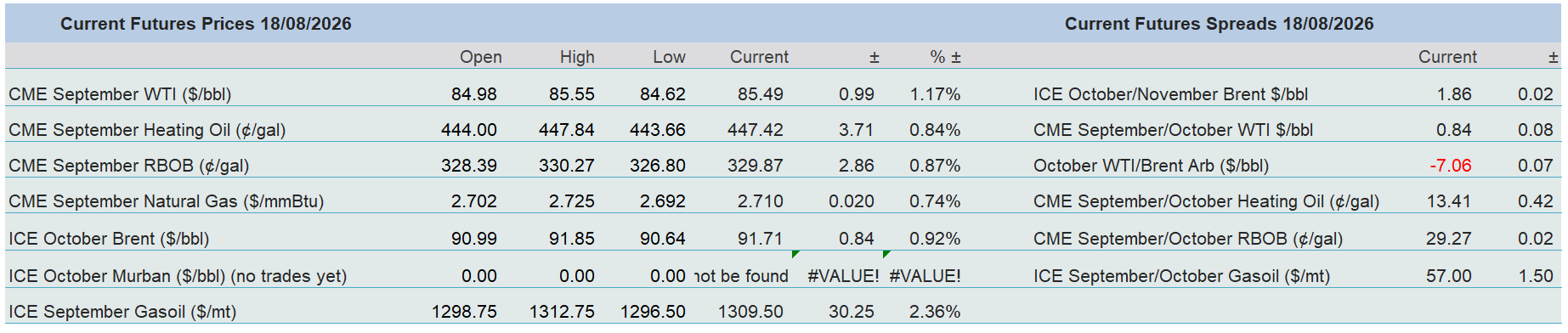
The CME Heating Oil crack spread settled above $100/bbl for two successive trading sessions. Let us relish this figure for a moment. While WTI is more than $30/bbl off its March peak, Heating Oil is worth more than twice as much as the US crude oil benchmark. And it is not just Heating Oil. The RBOB crack, while unable to match the stellar performance of Heating Oil, at $54/bbl is close to its all-time high, as is ICE Gasoil’s premium of $84/bbl to Brent. In a nutshell, while the availability of crude oil, judging by the performance of assorted refining margins and the comparatively subdued backwardation in WTI and Brent, seems sufficient, product shortages, whether perceived or actual, are driving prices higher, with all the consequences.
Galloping crack spreads, therefore, warrant a fresh look at oil inventories in major storage hubs just before the release of the updated weekly inventory data today (the US) and tomorrow (Singapore and ARA). In the US, there are considerable deficits in both distillate and gasoline stockpiles relative to year-ago levels and the five-year seasonal norm. In the former, these are 7.8% and 4.6%, respectively, while in the latter they are 5.7% and 6.6%. These compare with US commercial crude oil inventories, which are only 0.5% lower than in August 2025 and 1.7% below the five-year mean. These differences are one reason for the hefty premiums US products command over refinery feedstocks. The other is exports. In a clear and desperate search for refined products in Europe and Asia, US net product exports were just above 7 mbpd during the latest week, around 2 mbpd more than in the corresponding week of 2025 and 1.8 mbpd higher than the five-year average.
In the European Amsterdam-Rotterdam-Antwerp triangle, although product inventories edged higher last week, they remain severely depleted, as reported by PJK/Insights. At 4.2 million tons, they are 23% lower than in August 2025 and 20% below the long-term average. The shortage is particularly acute in jet/kerosene (41% and 30%) and fuel oil (40% and 43%) stocks. Nonetheless, both gasoil and gasoline inventories are also at historically low levels. The picture is only a tad more sanguine in Singapore. Combined product inventories are well below 40 million litres and were at their fifth-lowest level since 2022. Middle distillates inventories, a welcome development, match their year-ago level and their five-year average, but gasoline inventories are around 15% below both.
The perpetual Middle East crisis and the utter lack of prospects for promptly and permanently reopening the Strait of Hormuz and ensuring safe passage via the Bab el-Mandeb waterway are having a conspicuous impact on product prices, much to the delight of those refiners who can operate. Product tightness is exacerbated by the other war, a few thousand miles north of the Persian Gulf, as Russia’s ability to refine and export vital gasoil and diesel has been seriously impeded by meticulous Ukrainian strikes on the country’s energy infrastructure. The collective impact of these crises sends the values of both the CME Heating Oil and ICE Gasoil crack spreads significantly above those registered in the immediate aftermath of Russia’s full-scale invasion of Ukraine four and a half years ago.
Under the circumstances, refiners operate as effectively as they can, while politicians do what they are best at: paying lip service. According to the US Energy Secretary, without elaborating, measures will be announced soon to help boost product output, which should then act as a mitigating factor and tame the politically damaging ascent in retail gasoline and diesel prices. Rising Chinese July refined oil product exports might temporarily alleviate the tightness, although shipments abroad were still meaningfully lower last month than in 2025.
Given the historic relationship between oil prices and inflation, constrained supply and costly products are resulting in an anxious rise in bond yields. The US 30-year Treasury bond yield rose to a 19-year peak yesterday. If one thinks of the bond market as a reflection of inflation expectations, the outlook is ominous. It points to interest rate hikes and a sustained decline in consumer sentiment and spending, while painting a grim picture for the Republican Party ahead of the midterm elections. As alluded to in the preamble, it will ultimately harm oil demand, but for now, the conflicts on two continents, with no end in sight, keep the focus on the supply side of the oil equation.
Overnight Pricing
19 Aug 2026
