Supply and Demand, Yin and Yang
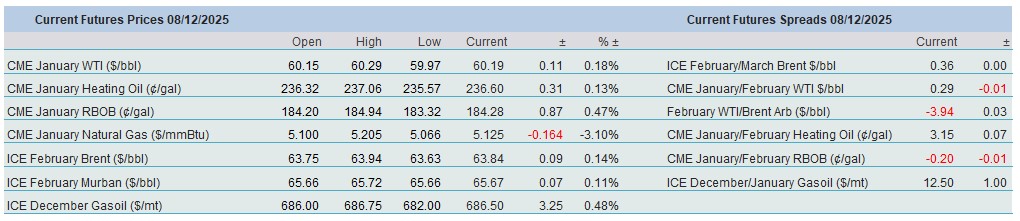
The weekly trading ranges in the two main crude oil futures contracts inaccurately indicate an uneventful period, with prices struggling for direction. WTI moved in a $2.22/bbl range, whilst its European peer managed an even narrower band of $1.92/bbl. The structure at the front, whilst not exactly telling the story of a tight underlying oil balance, remained solid. Physical Brent, notwithstanding the recent weakness, still commands a premium of around $4/bbl over the forward contract until the end of the year. Crack spreads shed some value over the week but remain above seasonal averages. Major stock indices managed to eke out weekly gains, implying that risk appetite has not fallen.
The two major factors investors are focusing on are financial data, tasked with painting a reliable picture of how US tariffs affect the health of global and regional economies, and the consequent actions of central banks, as well as the seemingly perpetual talks about achieving peace in Ukraine. It is, therefore, reasonable to ask: what is common to import tariffs and the invasion of Ukraine? In both cases, the concept economists coin as comparative advantage, which serves the betterment of the people of any nation, is loudly and proudly denied and replaced by nationalistic intentions. In the case of the US, it is economic nationalism; in the case of Russia, it is political.
Comparative advantage is an economic principle in which a country specialises in producing and exporting goods and services with the lowest opportunity cost (the loss or potential gain forgone by selecting one option over another). If coffee production is prevalent in Colombia but its electronic industry is virtually non-existent, then it does not make much sense for the US, for example, to support its own coffee farmers; it should rather concentrate on producing mobile phones. It is for this very reason that markets were shaken by Donald Trump’s Liberation Day tariff announcement, a broad package of import duties designed to punish trading partners and allow the US to flourish economically.
As the end result would have meant giving up the above-mentioned comparative advantage, the market did not take the announcement kindly, and a sharp sell-off precipitated by this measure ensued. Since the middle of April, a tacit acknowledgement of the unsustainability of the original excise duties from the US administration has been perceptible. It has come in the form of renegotiating trade deals with individual countries. Renegotiations, in this instance, mean lowering tariff rates whilst maintaining belligerent economic rhetoric. The United States cut tariff rates, for instance, on certain UK exports, most notably on cars, from 27.5% to 10%. The previously levied 25% duty on South Korean imports, including national-security-related auto duties, was dropped to 15% at the beginning of this month, retroactive to November 1. Most importantly, we still vividly remember the war of words with China and the threat of punitive reciprocal measures of well over 100%, which would have had a decisively adverse impact on the global economy and inflation. The combined tariff burden has been reduced to around 30%, although detailed import duties remain product-specific.
These changes have not been lost on investors, and their impact on the US economy is also tangible. Stock markets, also supported by ongoing and relentless optimism in the tech sector, are holding up reasonably well. The S&P 500 index is not far off its all-time high. Consumer prices, as the latest PCE index indicated, grew 2.8% in September, somewhat above the Fed’s 2% target, but inflation remains contained, and so does unemployment, which at 4.4% is higher than the 4% at the beginning of the year but still manageable.
The point is that the wind has been taken out of the sails of the trade warriors. The nasty correction in stock markets expected by many, including ourselves, has been put on the back burner. In other words, the current snapshot of the global economy warrants solid oil demand expectations until probably the second half of next year, when US fiscal stimulus (e.g. the $2,000 tariff dividend, akin to the pandemic-era stimulus), a sycophant new Fed chair, a weak dollar and the stagflationary impact of US immigration policies might re-ignite inflationary pressure.
The immediate impact from the demand side of the oil equation is supportive, if anything. On the supply front, however, the near- and medium-term outlook is ambiguous. Currently, the market is reacting sensitively to events in and around Ukraine. These include the indirect talks between Russia and Ukraine to halt fighting, the effect of sanctions, and the Ukrainian strikes on Russian energy infrastructure. When the invasion, explainable only through ideological intentions, as it carries no economic or social benefit, began almost four years ago, Russia forewent one of its salient comparative advantages: the export of its abundance of natural resources, chief amongst them oil. Coupled with tepid Western sanctions and effective Ukrainian retaliatory measures, the impact on the Russian economy is progressively devastating, as outlined in last Tuesday’s note. The conqueror is being deprived of oil revenues. The discount Russia is now forced to accept to sell its oil to the Mediterranean region has plunged by $12/bbl in less than a month, and even to India it has fallen from $2.50/bbl to $7.30/bbl, according to pricing agency Platts.
Whilst keeping and tightening sanctions on Russia could probably end the war favourably for Ukraine, we suspect that the opposite is a more plausible outcome. The US is keen to broker a peace deal, first, for its own sake; second, because of the business potential in reintegrating Russia into the world economy, which is aligned with the transactional nature of the Trump administration; and third, due to its animosity towards Ukraine’s main ally, Europe, as brazenly declared in the updated National Security Strategy released late on Friday. Ukraine will likely be coerced into a Russian-friendly “peace agreement,” with sanctions at least partly lifted on the invader. As Russian supply and exports grow, its impact on refining margins will be more profound than on outright price levels, after all, the country’s total oil exports have retreated rather than collapsed. Sanguine economic prospects in the first half of 2026, coupled with supply developments that are probably already accounted for in oil balance estimates, will complement each other. An initial dip in prices will be followed by a gradual recovery in the first six months of 2026, before deteriorating economic conditions re-emerge towards the end of next year due to rising inflationary pressure.
Overnight Pricing
08 Dec 2025
