Is Tonight Really the Night that Anything Changes?
The damage being done in the war around the Persian Gulf and the Gulf of Oman is not just on localised infrastructure, for there drips a continued narrative of how further conflict will not just damage the soft indicators of confidence but actual physical metrics. The world may no longer be complacent or delusional in how long the war lasts or at least the longevity of its aftereffects, but the bite of increased energy prices is being felt across the globe, even within the insulated economy of the United States. The stunning Non-Farm Payrolls of last week brought about another twinge of exceptionalism, but that was soon sheathed when the ISM Service PMI was publish yesterday. The reading of 54 percent, and while still in expansion, was much slower than the 56.1 percent seen in February, but importantly, within the reading the prices paid reach 70.7 percent and at levels not seen since 2022. This came simultaneously with comments from the Managing Director of the International Monetary Fund, Kristalina Georgieva, who in an interview with Reuters said “[…] all roads now lead to higher prices and lower growth.” In the unlikely event Tehran suddenly agrees to the US demands over ceasefire terms and the opening of the Strait of Hormuz, the fallout and echo will be with the global economy for years.
Iran keeps droning on with a capacity of unmanned aerial vehicles (UAV) that completely confounds the expectation of the US, and we, among others will continue droning on, on how the fortunes of oil prices are solely fated to the decisions made in the Oval Office. None of us are privy to the corridors of power between the White House, the Pentagon and US Department of Defence, yet it cannot be denied that so many commentators are now framing this war as ill-conceived and against all possible advice. It is now difficult to see how President Donald Trump steps away from this or uses the ‘off ramp’ without a massive loss of face and indeed an accountable or verifiable meeting of targets seem more and more unlikely.
The repetitious declaring that the war is nearly over is no longer kidding anybody, let alone himself. Or maybe not. In a Trumpian world, Iran’s navy is at the bottom of the Persian Gulf, its air force “in ruins” and the stockpiled UAVs, and the manufacturing facilities building them have been vapourised. “Not so much,” would be the response from Oman, Bahrain, Saudi, Qatar, UAE, Kuwait and any other of Iran’s neighbours that are suffering the almost daily violations of their airspaces as they receive unending attention from Tehran’s backlash. For all the promises made by Trump at the beginning of the war, regime change and nuclear nullification were top of the agenda. But the advice that Tehran’s religious autocracy is as great an example of a hydra as any was ignored, and whoever is in charge of Iran’s wartime strategy is a mixture of leadership that is now dug-in deep and/or mobilised and not offering themselves as easy targets. As far as nuclear capability, its lack of mention in US briefings now leaves a sonorous gap. The threat of the regime being only a short time from getting hold of ‘the bomb’ has disappeared into the explanation that any uranium enrichment equipment or stockpiles are now buried due to the attacks of ‘Operation Midnight Hammer’ last June.
The switchbacks seen in the state of peace negotiations is now a worry for the US Gulf allies, well, any that still remain as friendly. They among others smell a TACO and the possible worst outcome. According to Reuters and AP, Saudi Arabia, the UAE and probably a silent few more are pressing for a continuance in the war until the job is done, even though at its outset they were more than peeved at not being consulted beforehand. Their logic is sound. Imagine an Iran that survives this existential threat to its governance. It would be even more malevolent than before because it must surely negotiate terms that give it greater protection from further attacks. Under such guarantees, and in the dark of newfound freedom from any meaningful scrutiny from the International Atomic Energy Agency, Iran would acquire nuclear weapon capability. It would reacquaint itself with proxies and once again spread its threat throughout the region and beyond. All the while, it will hone its new global disruptive superpower and make good on its ability to control Hormuz and even go as far as to charge a toll for its traverse. This might arguably offer its exchequer more money than is received from international oil sales.
Predicting if Donald Trump goes ahead and bombs bridges and energy facilities or even uses more demeaning profanity if tonight’s deadline for peace talks expires is beyond a guess. But oil prices and our fraternity remain tight with expectancy, and there are too many ‘blinds’ and too many ‘dark’ cards to see who will take the pot in this geopolitical poker game. The late great Kenny Rogers warbled in his version of the ‘The Gambler’, “You got to know when to hold ‘em, know when to fold ‘em, know when to walk away, know when to run”, and at present this current US President does not look as if he is prepared to quit the table, even if Iran is shaping to go ‘all in’ because it has little choice if the current theocracy is to last.
Overnight Pricing
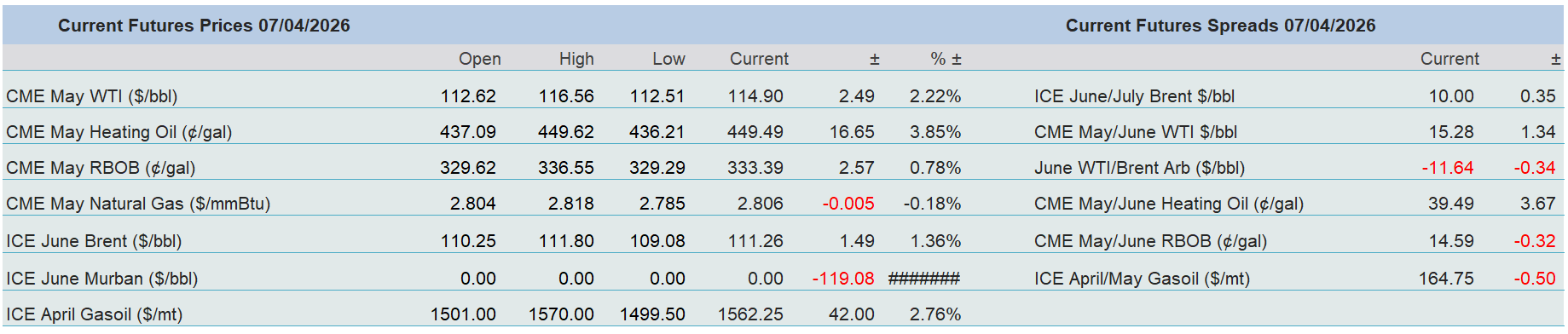
07 Apr 2026
