Too Early to Release Your Seat Belt
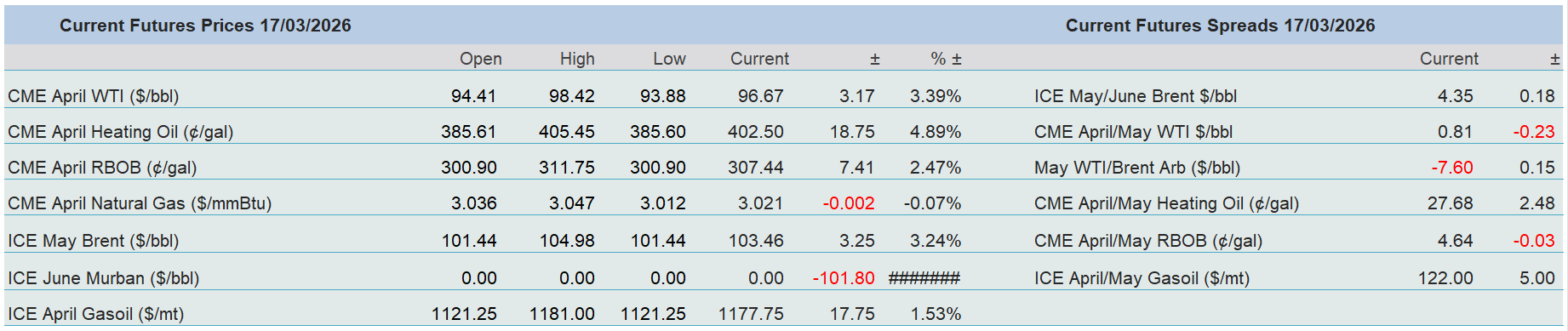
Such constant gyration in prices and indeed emotion have become something of the everyday. It is always intriguing that at low oil prices movements are measured in dollars per barrel, but at inflated levels they are measured in percentages. A three percent move at $60 is hardly as headline grabbing as a similar move at $100/barrel, yet such is the human insistence on qualified measurement. This is why the Israel/US war on Iran causes such knuckle cracking as we sit in front of our screens and try to apply logic to an unfathomable issue. Well, at least that is how European, Japan and Australian leaders see it, it is not just markets. The closest allies of the US, Israel apart, are refusing to be dragged into any commitment to escort oil vessels through Hormuz. The politics of it do not matter, oil is simply not moving and despite the constant badgering of the airwaves by this White House on diplomatic talks with Iran and willingness of allies to help, nothing of the sort has shown up.
Our community is urged to see through the supply shock and consider the amount of oil the world has in potential production. However, all we see is Iraq’s southern oilfields’ output falling by 3mbpd, Kuwait declaring force majeure and cutting production by approximately 500kbpd, Saudi cutting by an estimated 2.5mbpd and the UAE reporting of an on/off situation in loadings Fujairah. One can question the validity of benchmark crude prices such as Dubai because of the lack of liquidity, nonetheless, and as pointed out for us by Reuters, cash Dubai on Monday in the Platts assessment printed $153.25/barrel, being the record high of any crude since Brent achieved $147.50/barrel in 2008. This rally is not over, neither are the opposing reactions, be they bullish or bearish, by other instruments to our market’s losses or gains.

Oil prices debunk deglobalisation
The inky strands of anti-globalisation writings have reached far and wide into a receptive audience made more cynical after the Covid desert and Ukraine war. Beggar-thy-neighbour is a vote winner in a world shrouded in suspicion and lack of compassion. This has brought a false perception that nations are able to go it alone and the stump speech of all leading politicians is never complete without at least a mention on ‘national security’. A broad sweep, but such examples have historical precedent and always lead to war and is why we now stand where we are. However, as much as world leaders demand our attention and tell us that unilateralism will work, the very fabric of the globe’s trading mechanisms is one of international cooperation and crossover.
There is no greater example than the current clogging of the Arabian seas. The span of the Strait of Hormuz is twenty-one nautical miles, oddly enough, the same as the English Channel, but intrepid thrill seekers will not find an Iranian welcome such as those emerging in Calais to a round of applause and a warming glass of pastis after swimming across from Dover. Swimmers are probably subject to blockade in Hormuz. Levity aside, if there were any doubts as to the effect of military calcification of the biggest fuel artery, the issues that are now grasping for attention are much wider than first anticipated.
Prioritising predicament or opportunity is the same is as random prediction in current climes. The one thing that we can all take for granted is that the effects of Hormuz will compound with time. ‘You pays your money and you takes your choice’ on whether Trump will perform a TACO or the Iranian regime collapses or an unforeseen power takes control of Tehran. But time is the X-factor and the longer this debacle goes on the more considerations we will all inherit.
Look through the immediacy of oil prices and one will see Tier 1 events on this week’s docket. They are the interest rate decisions of the US Federal Reserve, the European Central Bank, the Bank of Japan, the Bank of England, the Bank of Canada and the Reserve Bank of Australia. No matter how hard Trump screams at ‘too-late Powell’, the inflation threat posed to economies by restricted oil supplies is sleep-depriving for central bank governors. There can be little doubt that the rest of central banks will leave as is, the RBA has been more hawkish of late and raised by 25-basis points this morning, but the central bankers forward thinking will make for intriguing study. An attractive and appeasing argument for interest rates to not go scuttling north, as was seen during the start of the Ukraine war, is that they are starting from elevated settings rather than the almost zero readings before 2022. Added to this is that rather than being an inflation shock, ballooning oil prices will be a productivity and economic shock with the likes of the Fed even having to consider rate cuts. But this presumption is dangerous because oil prices have the potential to shift themselves so much higher than seen in 2022. It also fails to consider that the best performing hedge against inflation is oil itself and the self-perpetuating relationship that might ensue.
Additionally, and it is a two-way consideration, currency wars are a possibility and depending on data, will central banks defend or deflate? Each quarter tick adjustment will bring accord or dissention from allied or competing countries and by that time none will know the difference who is friend of foe. Yet everything remains linked. If the ECB creates a bulge in the Euro, there will be dent in the US Dollar which must bring reaction from the FED, which will bring reaction from the BoJ, BoE, BoC and RBA et alia. Placing a tax, tariff or landing fee on intrusive exports will not see negotiation, it will be just avenged in kind and will be pursued as policy in other trading centres.
We could go on. But the point is that the world is a conditional paradox. There is inseparable economic interdependence and the only deglobalisation will be of the political kind. Economies are too much reliant on international supply chains, and the genie is out the bottle in terms of technology. Modern communications are inherently global, and money movement has never enjoyed such interconnectedness, therefore, borders do not exist. The ramifications of this war are so much more far-reaching than this broad muse can possibly take in, but the point is still the same on how the nearby welfare of the ‘global’ economy is ransomed to a twenty-one-mile-wide stretch of lunacy.
Overnight Pricing
17 Mar 2026
