Is a War Deal Really Closer?
We approach another weekend not knowing which way is up with regard to a viable peace process in the Iranian war. For all the fanfare of a deal (of sorts) between Israel and Lebanon, an integral requirement for Iran, the then rejection of it by Hezbollah can only mean that any chance of agreement between the United States and Iran must be some way off. The White House is still plying the airwaves of a “deal being near”, but what are we supposed to make of a fresh US State Department security alert for nearly all Middle Eastern countries because of a “potential for hostilities?” The only thing that our collective can be sure upon is that oil cargoes are not ‘Passing Go’ and are having to ‘Go to Jail’ back beyond Hormuz in this Middle East rendition of the board game ‘Monopoly’.
Meanwhile, critical energy infrastructure is being targeted and while the cause of the explosion is unknown, according to Reuters, Oman’s key crude oil export terminal, Mina al Fahal, has suspended loading operations. Several super-tankers were seen anchored off the port on Friday, shipping data from LSEG showed. Historically, the port has exported up to 1mbpd with the significance being that it is beyond the Strait of Hormuz. With an additional Reuters report outlining how Iran’s crude exports have now fallen to 300kbpd, a level not seen for over 6 years, no matter the ships that might ghost through, oil flow is minimal. The report goes on to cite a Kpler opinion that if such a state continues then Iran will effectively run out of oil to export to China. We here often think that when an eventual change in this sorry status quo occurs, either further war or agreement, it will be at a weekend. Will this be the one, or shall we once again all gather to resume our ignorance on Monday?

Donald will not be getting a thank you card from the ECB
Next Thursday will see the gathering of the European Central Bank and with it the decision on how the interest rate path for the rest of the year might pan out. It is widely accepted that the ECB runs in fear of inflation and has in the last few years endeavoured to create a reputation that it will be more aggressive if any sort of a sniff of increasing prices is seen in its jurisdiction. It is a lesson hard-won after the price shocks of 2022, following the confluence of both the Covid pandemic and the illegal start of Russia’s war into Ukraine. One only need look at its mission on the ECB website in which it proclaims, “The ECB’s primary objective is to maintain price stability, that is, to preserve the purchasing power of the euro. We do this by making sure that inflation […] remains low, stable and predictable.”
This then almost guarantees that some sort of hawkish action will be witnessed. Euro zone inflation accelerated to 3.2 percent last month, well above the 2 percent target. At her post-decision press conference at the end of April when interest rates were held, Christine Lagarde, the President of the ECB, noted that, “the longer the (Iranian) war continues and the longer energy prices remain high, the stronger is the likely impact on broader inflation and the economy.” Therein lies the most important point, the longevity of this war will increasingly grind economic activity and confidence while pressuring input prices and supply chains. As much as German Defence Minister Boris Pistorius argues, “this is not our war, we have not started it,” the EU along with other centres of commerce will pay an indirect price for it. It is a cruel hand now dealt to Lagarde and her cohort of grey men at the ECB. To be aggressive and risk smothering what’s left of any growth or be cautious and let inflation be fanned by the winds of war. At present, markets are pricing in a rate increase in both June and September. It is hardly surprising as even core inflation, which is exempt of food and energy, rose by 2.5 percent last month suggested the effect of war inflation is interfering in more than just energy.
Whatever decision the ECB makes, it has been given aid by a very differing situation to that which prevailed after the outbreak of war in Ukraine in 2022. While debt still dogs the European Union, the fiscal tap is not as wide open as it was in the early part of this decade, household demand is weaker, the employment situation is defensive and because the war is not on the European border or indeed initiated by the source (Russia) of what seemed nearly all of its energy needs, the pain to the old continent thus far has been what can only be described as tolerable. However, leaving the geography aside and how Europe is a long way down the path of being supplied with energy from elsewhere, the war in Iran is much more of global shock and its ripples pulse across the whole planet. The cost increases are more subtle and enter into the chains of industry and all manner of trade in much broader terms. If a finished article requires many components, derived from commodities which need to be shipped from the four corners of the globe and then bent and moulded into shape using power from a fossil fuel derivative, the layered inflation is almost exponential.
The price increases will then be stubborn and long-wave and likely influence the decisions of the ECB for at least until the end of the year. Even if the economy weakens further, the Central Bank must by its mission definition maintain a posture to keep inflation at close quarters. It is either that or risk having to raise them to 4.5 percent as seen between September 2023 and June 2024 because it failed to nip inflation in the bud as it soared to 10.6 percent in October 2022. We do not often feel much compassion for central bankers, but…….
Overnight Pricing
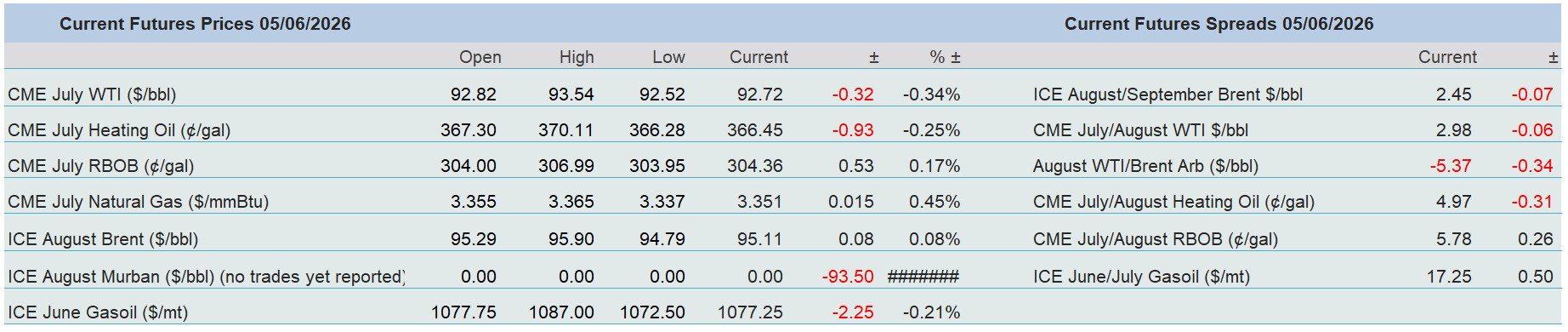
05 Jun 2026
