What Bubble?
However one treats the turning of a new year, be it in proposed new attitudes or resolutions, the firebreak has not altered the furore surrounding artificial intelligence. Despite warning after warning of a bubble and the almost bear market witnessed post-liberation day, the Magnificent 7 returned investors between 15 and 66 percent for 2025, and while nuance should be applied to why performances show such a spread, what cannot be denied is that most results were viewed through the prism of A.I. performance and investing. In 2026, the curiosity in A.I. is likely to carry on unabated and companies canvassed in a McKinsey survey revealed that 60 percent of companies are only at the experimental stage of using the new technology, allowing investors to shun the warnings of the rally in tech stocks being ‘mature’ and carry on regardless.
Such is the base of confidence for Wall Street which saw the S&P500 and the Dow Jones once again climb to record highs. The rally is even more impressive given the style and incessant interference in almost everything from the US President who refuses to let any sort of ball, be it political or economic, pass him by without him taking a swing. Trump’s beef with the Chair of the US Federal Reserve has at last seen a reaction from Jerome Powell who after enduring subpoenas from the Department of Justice over spending in the Fed’s headquarters renovation, spoke on the “unprecedented political pressure” coming from the White House. Adding to questions on the future independence of the US central bank was the President’s calling for a cap on credit card interest rates which ought to have upset stock markets more. Yet the resilience of US investors is palpable, and the international influence sees most bourses of the world enjoying the slipstream. None more so than the Nikkei, which runs to its own record again pushed on by the possibility of an affirming snap election, which if won by Prime Minister Sanae Takaichi, will give her a mandate to apply the stimulus she so heavily campaigned on. Massive capex from technology companies and quantitative easing from governments, it is a heady mix.

Venezuela yesterday, Iran today, will it be Greenland tomorrow?
We often consider fear gauges, or volatility indices if you like, but one wonders how goes your personal measure on what might come this year? If 2025 worried your inner peace, then the start of 2026 might mean any bandwidth in which the geopolitics play out will have to be considerably broadened. We entered 2025 with two potential flare points, namely Ukraine and Gaza. Ukraine continues in its cesspool of death and deception, Gaza is hardly done and dusted but now oil practitioners will have to add Venezuela and Iran to the list of symptoms which make up the pandemic of not knowing what to do. What about Greenland, the sharp-eyed of you question? It is difficult to know how a targeting of Denmark’s semi-autonomous territory by the US might affect the oil market other than risk perception and possible interruption to shipping, however, at the peril of tempting fate, the strategic importance of the massive island does not harbour great oil price influence, yet.
The positions of our geopolitical riders will jockey for being the most important for some time to come but at present it does appear as if Iran has a nose ahead in grabbing our market’s attention. The US-based Human Rights Activist News Agency says over 500 protestors have been killed and well over 10,000 people been detained in this latest flare up in civil unrest. As pointed out to the BBC by a former US Middle East ambassador, times oft before potential rebellions over ideology were quickly nullified as the religious police relaxed their medieval attitude to women or other socially unacceptable behaviours. However, what cannot be cured with a blind eye is the collapse in the standard of living. Ever since US sanctions began to bite after implementation in 2018, inflation has roared, wages have at best stagnated, and depending on the source, between 30 and 50 percent of the population now live below the poverty line. The government has sought to rectify the country’s woes with successive failures in economic policies which include increasing costs for public services, a besottedness in running budget deficits and accelerating inflation by printing more money. The systematic beheading of all proxy allies by Israel last year has left Iran almost friendless in its geography with the only alliance of any oil-income note being with China, which is a matter of convenience for Beijing, being more than happy to keep importing discounted Iranian crude when sanctions can be evaded. One wonders how the 25 precent sanction announced overnight by the US on those countries conducting business with Iran plays out with the ongoing intrigue in Sino/US trade relations.
The Beijing/Tehran trade relationship is the only thing that is keeping Iran from going fully bottom-up. Long gone are the halcyon days of Iranian production of the energy crisis years of the early 1970s when it pumped up to 6mbpd. And while production has increased from the delinquent 2.9mbpd following the Trump 1 administration’s reinstatement of sanctions, petrodollar generation is still falling. Output has climbed to around 3.5mbpd, of which 2mbpd are exported with China taking 1.35mbpd in November 2025, according to Kpler, and using calculations from the Foundation for Defence of Democracies (FDD) which allows for a price $10/barrel discount to Brent, generated between $3.2 and $3.4 billion for the month showing consistency in revenue reduction. The World Bank warned in 2024 that, “a sharper than anticipated decline in global demand and oil prices would adversely affect economic growth and further limit the fiscal space needed for pro-growth and social protection measures. The growing concentration of trade with limited trading partners such as China, exposes the economy to fluctuations in these partners’ economic prospects.” How prescient.
It is also intriguing on how Iran is tied in with Venezuela in how it exports oil expertise to the South American country, its traditional strategic and military links with Russia and their combined trio of growing mastery in avoiding sanctions. This axis of the unwilling is now subject to an increase in US impatience and scrutiny. Yet, on paper, depriving the world of Iranian crude would ordinarily have little effect bearing in mind the expectations of oversupply for the whole of this year. Lump all three in together, then it is a different story and one that would make the world oil balances look very different. In addition, whatever red lines one has mentally drawn up in international law and behaviour, they have been blown away by the Nicolas Maduro smash and grab. One only needs to look back at Trump’s words during the Israel/Iran conflict when the US helped in taking out nuclear sites. “We know exactly where the so-called ‘Supreme Leader’ is hiding,” imagine the ensuing carnage if the US did a ‘Maduro’ on the Ayatollah. We fall into line with most other predictors looking for a temporary slump into the mid-$50s for the Brent price in a war-free world. But the international tearing up of the rules and unpredictability of this unprecedented US President makes any expectation uncomfortable, which is why the market readjusted itself in the latter part of last week and why being uncomfortable in any view for the whole of 2026 is probably wise.
Overnight Pricing
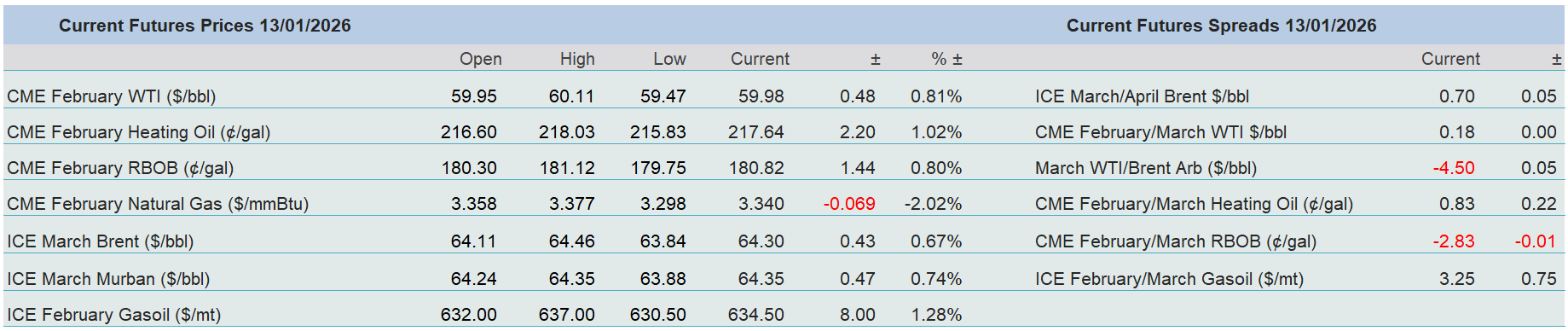
13 Jan 2026
