In What Do We Trust?
“It’s the hope that kills you.” The modern philosophy usual associated with sports is too tasty not to prepend what is going on in the Middle East, for it seemed as if the protagonists, or antagonists, involved in this pointless war had been limping toward some sort of workable workaround. If this appears further away this morning due to the attacks by the US on Iranian ships attempting to lay mines in the Strait of Hormuz, it probably is. However, we are assured by US Central Command it is only an act to “protect US troops” and so the surrealism continues of hindered flow of oil from the Middle East being coloured by a wishful thinking, wider-market wanting to believe the daily assurances piped from US politicians elected for us to take at their word.
There will not be a wholesale victory for the United States, Israel or Iran, and the only thing that the parties will eventually agree on is that molecules must flow through the Strait of Hormuz. The good ship ‘inflation’ is sailing directly into this conflict and will inspire more of an outcome than any military intervention. Therein lies the military equivalent to an unscratchable itch. At present the regime in Tehran has not been overthrown and the real inspiration of this war, namely Iran’s enriched uranium will continue to find residence in its homeland and cause palpable discomfort to an Israeli population fed on a diet of paranoia from the likes of Benjamin Netanyahu, with all the horrors and concepts of existential threat. This has now taken a turn in what can only be described as preparatory language for the long game. Readying with the idea that there now cannot be any sort of one-shot, decisive blow, according to ‘Ynetnews’, a senior Israeli defence official warned that the war against Iran will be prolonged and could result in recurring rounds of fighting "perhaps every year and possibly even more frequently" as long as the current regime in Tehran remains in power. What a thought, and what a future for us all.
Iran has found its superpower; at present it does not need nuclear weapons. In retaliation to such perceived frequency of Israeli and likely American airstrikes outlined above, all it has to do is deploy a few mines and fast attack boats and 20 percent of the world’s oil suddenly stops moving. These will be administered to by the US floating some aircraft carriers and threats at the spot market level timeline; and in the future timeline market, no doubt there are plans for expansions in pipelines that will circumvent this geography of chaos. That being said, whatever oil communications are conjured up, they will have to be subject to cross country agreements, and one need only look at the problems involved in Iraq’s pipeline to Turkey, the Greater Nile and Petrodar pipelines in Sudan/South Sudan, and obviously the issues of Druzhba and its like that are held to ransom by both Ukraine and Russia. Additionally, and notwithstanding its fracture due to the departure of UAE, there is a cartel called OPEC whose primary tool is to manipulate oil production for the benefit of its members.
Commonly attributed to Albert Einstein, the phrase "the definition of insanity is doing the same thing over and over and expecting different results," is becoming increasingly apposite. One wonders if this is now dawning on the day-to-day consumers of oil who support their travels, their businesses and general lives by relying on a commodity that is so influenced by an area of the world that continues to let them down. There is no point in holding a post-mortem of how we got here, but the globe is so much more at risk of localised conflict than it ever has been and is there any denying that a part of any of these flashpoints is associated with oil? Still, “drill, baby drill,” oozed its self-proclaiming abundance across the considerations of us all. So much so, that countries, car companies, oil giants and individuals started to abandon energy transition and taper their aspirations in such flighty notions of ‘net zero’.
Roughly, and using a mix of data from the EIA and Wikipedia Tracking, nearly 73 percent of global oil production is controlled by just 5 percent of countries with 50 percent in the hands of the USA, Russia, Saudi Arabia, Canada and Iraq. In terms of refinery capacity, 50 percent of the world’s needs are in the hands of just China, the USA, Russia and India. It is then blatantly clear how this is not strategically sound for most of the world’s inhabitants. With such material assets being subject to free and fair trade upon the seas, it can only be a matter of time that choking points will once again occur. Hindsight is a blessed thing, but the pursuit of a green agenda particularly in the countries of Europe has happily seen the export of refinery pollution at the cost of energy security. The UK is an energy basket case. Capable of being molecularly rich, it has chosen a path of green dogma and the current Secretary of State of Energy, Ed Milliband, is the most dangerous politician in the country as he beats upon his lectern of zealously not allowing fresh licenses for the ample oil and gas fields of the North Sea. Instead, the country imports from Norway, its neighbour which drills the same northern water space. Even more harrowing is the UK now resorts to allowing the import of refined products that have been processed from Russian crude as an antidote to the current shortage in product derivatives. Apparently, “the UK stands shoulder-to-shoulder with Ukraine;” perfidious Albion indeed.
However, it says something that when the green screechers such as Milliband, who ought to be summarily dismissed, are becoming more plausible. His argument that laying the UK bare by throwing it on the third rail of alternative energies is not the reason, such a position is akin to undertaking unilateral nuclear disarmament and expecting it to be a show of strength. No, in a world made mad on diplomatic and military conflict, the greenery brigade has stumbled onto a new phenomenon that is starting to steep in the teapots of the great unwashed. Oil prices are not to be trusted. Neither really are the political and agenda motivations of the likes of the COP movements. In the weekend before last, in an excellent opinion by Pilita Clark of the ‘FT’, it was noted that the “push to phase out fossil fuels looks like much of the world does now. It is messy, chaotic and very far from unified. Its goals seem hopelessly distant, even utopian.” However, price is the first thing, and confidence the second when change is afoot. One year ago, the idea of owning an EV came with incredible anxiety of infrastructure and range. Is owning an internal combustion engine (ICE) any less so at present? There will be no advertising of Chinese cars here, but the low prices they command and how plugging them into one’s house in the evening is becoming less stressful than wondering when the local petrol/gas station runs out of deliveries. We still believe that oil has a substantial future in the makeup of energy demand. But whatever Mister Trump’s misanthropic view that he cares not for American’s finances, or by extension the rest of ours, he will inspire further discussion on why the globe keeps putting faith in the black stuff and the geographies that control them.
Overnight Pricing
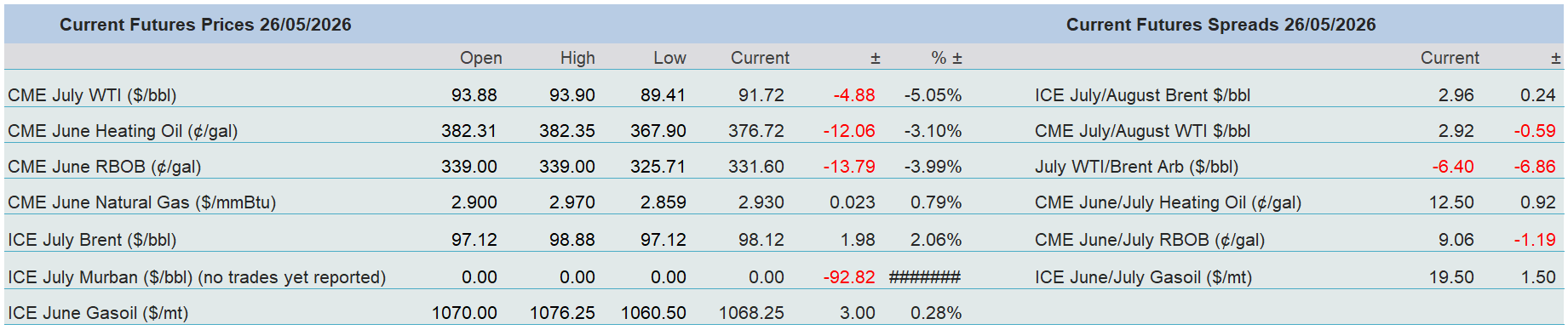
26 May 2026
