What Would the King Make of it?
It is odd how Donald Trump found time to visit Graceland yesterday amid the carnage he created. Maybe he really does think he is the new King of rock ‘n’ roll. For the rest of us we are stuck in the mud and await the next bout of conflict, which is not where warcraft might land, but the completely different words and announcements regarding a ceasefire in the Middle East. The US President announced a postponement to the threat of US strikes on the Iranian power grid after productive negotiations with Tehran. In complete denial, the Speaker of Iran’s Parliament, Mohammad Ghalibaf, said no such discussions had taken place, calling it “fake news.” He in fact wrote in an ‘X’ post, “No negotiations have been held with the US, and fake news is used to manipulate the financial and oil markets and escape the quagmire in which the US and Israel are trapped.” The early hours of this morning have seen a wave of missiles sent into Israel, but reports of negotiation still loiter. Media pieces are widespread on Steve Witkoff being dispatched to Islamabad, and even J.D. Vance joining him in Pakistan to negotiate with Iranian envoys, but nothing can be taken at face value. The only thing we can rely on, and it is not cynical, is that words used by the US seek to lower oil prices and those from Iran seek to raise them. On second thoughts, Graceland might be very opportune to remind all concerned the immortal words of the late, great, real King of Rock ‘n’ Roll, Elvis Presley. “We can’t go on together with ‘Suspicious Minds.’”
This oil crisis will not quickly go away
There is no clandestine element to this current war. It is not conducted via proxies and with them, the ability to hide behind layers of responsibility and neck-twisting trails of funding. The animosity is out for the world to see, and the world is lapping up this assault on the things one never thought possible with ghoulish, morbid fascination. It must. We are all plotting a linear gamble and join in to corroborate, somewhat drearily, that the effects of this war are completely dependent on how long it lasts, and more importantly the effect on oil prices.
Yet there is some measurement available in precedent. The two oil crises of the 1970s involved many, but among a wider number the biggest players were, surprise-surprise, the United States, Israel and Iran. There is a whole lot of repetition and unfinished business echoing through this current disaster and little to suggest that unless our planet weans itself from hydrocarbons or at the very least, its reliance on this historically, geographically flashpoint, then we should not be surprised to see something similar happen in the 2070s. We wonder, mischievously, what the pricing for that would be on Polymarket?
The Yom Kippur War of 1973 saw Egypt and Syria mount a surprise attack on Israel on the Jewish Holy Day and might have had more success if it were not for the benevolence of the United States. The Arab world under the Organisation of Arab Petroleum Exporting Countries (OAPEC) imposed an oil embargo on the US in retaliation and as the US sought oil from other points of global production, crude prices rose by a factor of four from $3/barrel to a high, close to $12/barrel. Later in the decade, the overthrow of the Western-allied Shah during the Iranian revolution of 1978-79, caused such a panic that crude values doubled to $40/barrel. This was then exacerbated, and again smells of some sort of could-be repetition, by Iraq’s invasion of Iran which while excused as an activity to stop revolutionary spread, also aimed to take control of oil-producing regions.
Iran’s production has shrunk in size, but more importantly bearing since 1978. As an estimate it produced around 8.5 percent of global production, while now it is a lowly 5.2 percent. However, and despite the now named ‘OPEC’ production falling from half to a third of the world’s supply since then, the amount of oil being denied to the market is much higher and is involuntary. Indeed, IEA Executive Director Fatih Birol said, and according to Al Jazeera “This crisis, as things stand, is now two oil crises and one gas crash put all together,” Birol said in remarks to the National Press Club of Australia in Canberra. Birol said the effective closure of the Strait of Hormuz and attacks on energy facilities had reduced global oil supplies by about 11 mbpd, more than double the combined shortfalls of the 1970s’ crises.
Birol continued. “The global economy is facing a major, major threat today, and I very much hope that this issue will be resolved as soon as possible.” Historically, there is also interesting parallel with the considerations faced by the US Federal Reserve. Due to fragile growth in the US in 1979, the FOMC were more than reluctant to increase interest rates. Its tardiness, encouraged spiralling inflation and subsequently more aggressive monetary policy and so the cycle turned to stagflation, the very thing that sends shivers through the cohort of Jerome Powell, the Chair of the Fed.
Donald Trump is free with his market swinging comments. The utterances yesterday on the back door discussions with Iran are inspired only by the fear he has on a ballooning oil price and an on the brink of disaster equity and bond market. If he cared of the consequence for Iran’s neighbours, he would have been much more mindful before this scratched out plan on a beer mat strategy was undertaken. The damage is now vast. One only need look at the comments from Doha. QatarEnergy said that the attacks on Ras Laffan have reduced Qatar's LNG export capacity by 17 percent and it will take up to five years to repair the damage to its production facilities. Such injuries that need healing are likely to be widespread and can only come if Iran has actually agreed to cease hostilities. We believe that this is not over, not in conflict or in infrastructure casualty, attitudes to oil, to economies and the fate of the globe’s well-being. We wish we were wrong.
Overnight Pricing
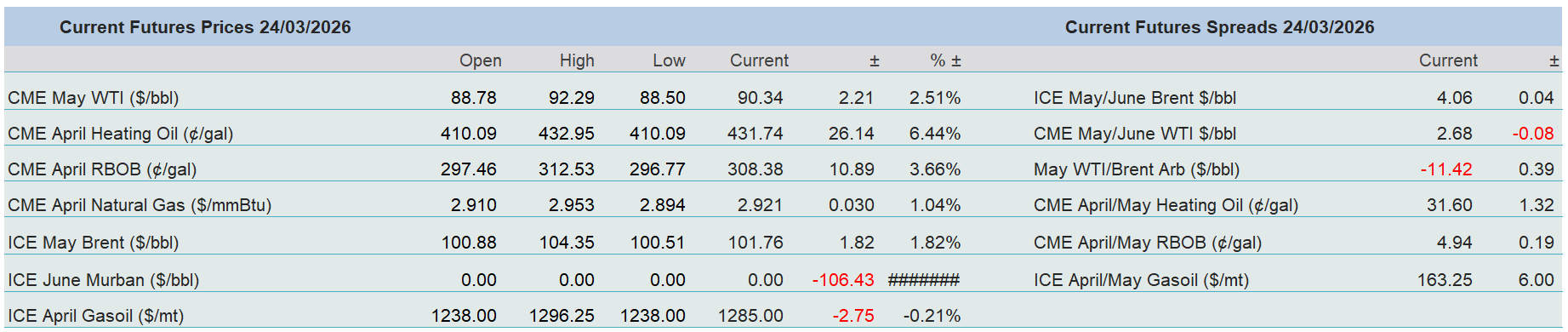
24 Mar 2026
