When Dialogue Fails, Sabres are Rattled
Securing a reliable supply of oil must be becoming increasingly cumbersome, an inevitable consequence of the ongoing conflict in the Middle East. Although ships are still passing through the critical Red Sea waterway, the Bab el-Mandeb Strait, their numbers are considerably lower than before the Houthis' naval blockade last week. The planned introduction of transit fees by the militant group will do nothing to encourage traffic. As Tehran has flatly rejected a similar proposal from Oman for the Persian Gulf, traffic through the Strait of Hormuz remains severely impeded as well.
And the outlook could easily deteriorate. The brief pause in hostilities is well and truly over, and reciprocal strikes between Iran and the US/Saudi Arabia foreshadow further disruption. Not only has the conflict escalated, but it has widened as well. Risks intensified once again after a US-owned floating storage tanker came under a drone attack at the Mediterranean port of Damietta, while President Trump, in his characteristically expletive-laden style, threatened to unleash a unique kind of storm on Iran in retaliation for the attack on the US military. As it turned out this morning, he has been true to his word. The US has renewed its strikes on the Persian Gulf country.
It is therefore no surprise that Brent jumped by more than $6/bbl and continues to advance this morning, while Heating Oil rose by the equivalent of nearly $10/bbl, aided by the extension of Russia's diesel export ban and a massive drawdown in US crude oil inventories, which reduced commercial stockpiles. US refiners are running close to full throttle to capture attractive margins, but demand appears to be outstripping supply.
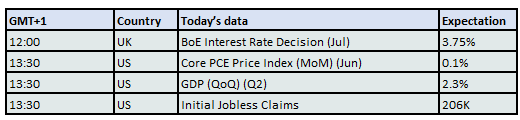
And when oil becomes expensive, central banks begin to sound the alarm over inflation. Last night's Fed decision to leave interest rates unchanged was viewed as a balancing act between pleasing the President and combating rising consumer prices. Ominously, three of the twelve FOMC members dissented, which may prove to be a harbinger of future rate increases, much to Mr Trump's frustration, unless the rise in energy prices is brought under control. US equities fell out of bed, and the yield on the 30-year Treasury bond surged to a 19-year high. The pinball game of pugnacity and diplomacy continues, with no end in sight.
Uncertain Present, Uncertain Future
There is no denying that the most consequential event of the year has been the war the US chose to wage against Iran. It has become abundantly evident that the decision, successfully advocated by the Israeli prime minister, has been one huge miscalculation, perhaps partly stemming from the blitzkrieg the US launched against Venezuela in January, when it captured the country's former president in 47 minutes. While the latest chapter of the Middle East conflict has been an unmitigated disaster, embodied in high energy prices, rising inflation, the worsening of US relations with its allies, and widespread disapproval outside the Republican Party, it must be acknowledged that it is the direct consequence of the October 2023 terrorist attack on Israeli civilians and the inevitable but disproportionate response, which obliterated Gaza and has kept the southern part of Palestine under siege.
The original US goals, declared at the beginning of March, appear to be unattainable, at least at the current stage of the conflict. Iran has not relinquished its nuclear capabilities, and the oppressive, autocratic regime remains in power. In fact, so much time is being devoted to mediation, predominantly by Pakistan and Oman, that the ultimate objective—a sustainable and lasting peace, with the Strait of Hormuz unconditionally reopened—simply does not appear to be on the horizon. Moreover, shuttle diplomacy does not focus exclusively on bringing the warring parties to the negotiating table; they are also directed at Iran itself, where different factions of the ruling establishment, the government, parliament, and the IRGC, frequently clash over how to achieve whatever objectives remain realistic. On a side note, Iran is such an ethnically diverse country that the eventual removal of the current regime might well precipitate a protracted struggle to fill the political vacuum, with unforeseen consequences for social and economic cohesion, as well as oil production. Look no further than post-Saddam Iraq or post-Arab Spring Libya.
Returning to the here and now, and considering Iran's reluctance to engage in substantive peace talks, or, rather, to abide by any agreements in a constructive manner, it is difficult to dispel the suspicion that the leadership of the Islamic Republic is merely buying time whenever it appears cooperative. Following this logic, it is only reasonable to speculate that any meaningful change in Iran's attitude towards bringing the conflict to an amicable resolution is unlikely to occur before the US midterm elections at the beginning of November. It is well worth toying with the idea of how the fault lines in this geopolitical and geoeconomic conflict might shift if the Republican Party were forced to surrender its razor-thin majorities in both the House of Representatives and the Senate—something that, according to recent polls, cannot be ruled out, but is far from a foregone conclusion, given the Democratic Party's apparent impotence to harvest the very low-hanging fruits presented by the Republicans and their leader, President Trump.
It is probably fair to say that the US government's leverage in conducting the military campaign would suffer a blow, but a decisive Democratic victory would not necessarily bring the war to an end. Congressional oversight would gain momentum as pliant Republicans were replaced by a Democratic majority. Future military operations would face tighter Congressional scrutiny and authorisation, raising both the political and legal thresholds for continuing the war. Democrats would be more inclined than Republicans to favour diplomacy over military action. Such an approach would likely find support among an electorate that has become increasingly dismayed by the economic costs of the crisis. US support for Israel would probably continue, but its unconditional military backing might well be called into question by some Democrats.
Iran would also welcome an overwhelming Democratic victory, albeit with reservations. From Tehran's perspective, the likelihood of de-escalation would increase significantly, while recognising that the Democratic Party is by no means pro-Iranian. The regime is fully aware that Congress does not determine foreign policy and that the US President would remain commander-in-chief until early 2029. Admittedly, the midterm elections will be a contentious issue for all stakeholders in the US-Iran conflict. The bottom line, however, is that diplomacy would stand a far greater chance in the event of a Democratic sweep. From this perspective, Iran has little incentive to surrender its principal source of leverage, the Strait of Hormuz, and to adhere fully to the ostensible ceasefire agreements over the next three months.
Overnight Pricing

30 Jul 2026
